
XRP Ledger edges closer to key upgrade as validator support surges

The XRP Ledger has moved closer to activating its xrpld v3.2.0 upgrade after more than 55% of trusted validators adopted the latest software version.
- XRP Ledger validator adoption of xrpld v3.2.0 has climbed above 55%, moving the network closer to upgrade activation.
- The release introduces infrastructure updates, security fixes, and the official rename from rippled to xrpld.
- The fixCleanup3_2_0 amendment has 40% support, while developers continue monitoring validator migration issues.
According to XRP Ledger Explorer data, 84 trusted validators, or 55.63% of the validator set, are now running xrpld v3.2.0. The latest software has also been installed on 353 network nodes, accounting for 42.12% of all nodes. By comparison, version 3.1.3 remains active on 58 validators, representing 38.41% of the validator set, and on 440 nodes, or 52.51% of the network.
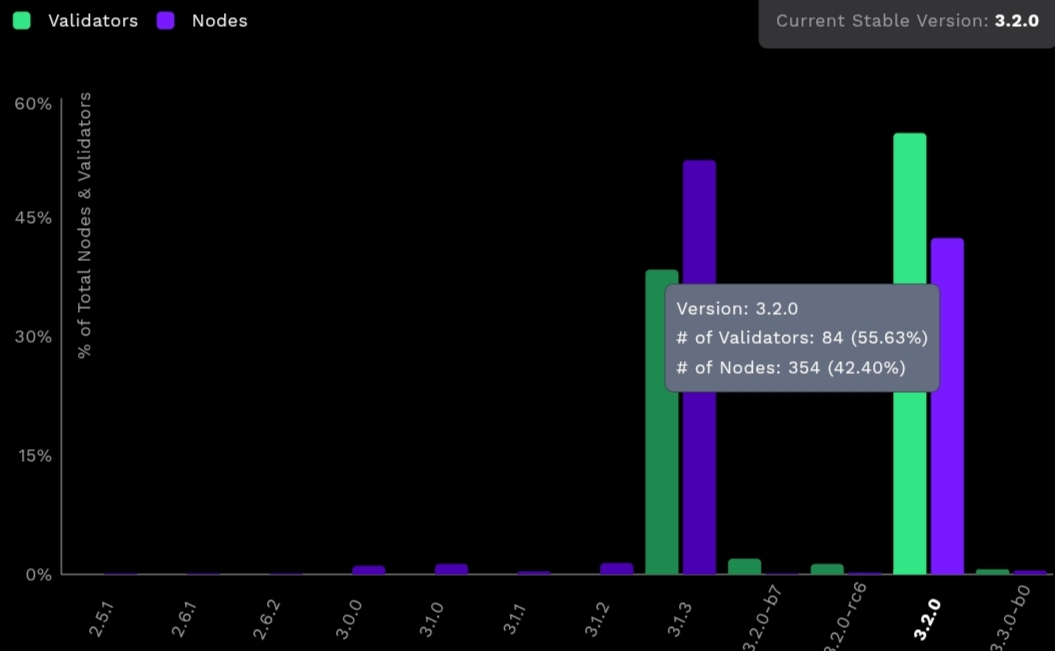 XRP Ledger v3.2.0 adoption across validators and nodes | Source: XRPL Explorer
On the XRP Ledger, trusted validators are responsible for approving protocol changes, while regular nodes follow the decisions made by the trusted validator list. Under the network’s governance rules, a protocol amendment requires support from more than 80% of trusted validators for two consecutive weeks before it can be activated.
Based on the current figures, roughly another quarter of the validator set must migrate to v3.2.0 before the upgrade can move toward activation.
Latest release introduces infrastructure and security changes
Released as xrpld v3.2.0, the software package includes infrastructure updates, developer improvements, and bug fixes across the XRP Ledger. One of its most notable changes is the official renaming of the network’s main server software from rippled to xrpld, following the XLS-0095 proposal.
Beginning June 15, the upgrade changed configuration paths, server metadata, database directory locations, and version naming conventions. As a result, validator operators and node administrators are required to update deployment scripts and server configurations before completing the migration.
Alongside the software release, developers also introduced the fixCleanup3_2_0 amendment. According to the release documentation, the amendment contains security-related fixes covering Single Asset Vaults, the Lending Protocol, permissioned decentralized exchanges, Multi-Purpose Tokens (MPTs) and permissioned domains.
The proposal also adds new invariant checks designed to prevent deleted accounts from leaving residual ledger data, improving ledger consistency. In addition, the update allows developers and users to access XRP Ledger protocol information and server definitions without operating a full server, a change intended to simplify integrations for wallets, APIs, blockchain explorers and other automated services.
Amendment voting still has ground to cover
Even as validator adoption of the software continues to climb, support for the attached fixCleanup3_2_0 amendment remains well below the activation threshold. Current network data shows the amendment has secured roughly 40% support, leaving it far short of the supermajority required for approval.
Ripple has publicly supported the amendment, helping strengthen confidence around the proposed changes. Separately, the XRP Ledger Lending Protocol recently passed an independent security audit, adding another layer of reassurance for the lending-related fixes included in the amendment.
At the same time, developers continue to monitor issues reported during validator migrations. A GitHub issue tracked under report #7581 describes a case where the service log displayed the correct new validator public key while the running server continued using the older public key stored in the wallet database.
The report attributes the discrepancy to validator migration behavior rather than the protocol itself, highlighting an operational issue that node operators may need to address as adoption of xrpld v3.2.0 continues to expand.
Disclaimer: The content of this article solely reflects the author's opinion and does not represent the platform in any capacity. This article is not intended to serve as a reference for making investment decisions.
You may also like

Wall Street giants collectively raise rate hike forecasts, US Treasury futures continue to fall, gold drops over 1% to break 4000
After the US October CPI exceeded expectations, Goldman Sachs and Nomura added a forecast for an interest rate hike in March next year, while Deutsche Bank included a forecast for a rate hike in January next year. Currently, the market has fully priced in a 25 basis point rate hike in December, with a 13% probability for a 50 basis point hike. On Wednesday, the US Treasury spot market was closed, but Treasury futures continued to fall, with corresponding yields rising by about 2 to 4 basis points, and spot gold came under pressure, dropping by 1.1%.

No Need to Worry About the Cooling Down of AI Data Center Construction? The US Import Boom Is Unlikely to Subside in the Short Term, Real Impact May Come in 2029
It takes an average of 4.8 years from finalizing investment to starting construction of a data center project, and an additional 2.6 years from construction start to becoming operational. Servers usually cannot be installed until after the building structure and racks are completed. For trade partners such as Taiwan (China), South Korea, and Mexico who rely on US data center supply chain demand, the inertia in construction timelines provides at least a one- to two-year buffer for future exports.

Federal Reserve Major Debate: When Should the Tenure of “Number Three” Williams End?
The main point of contention is whether Williams should step down in June 2028, upon completing a full 10-year term, or in June 2027, when he reaches the mandatory retirement age of 65. Analysts point out that the Federal Reserve Board holds ultimate discretion; if he leaves early, Fed Chair Waller would be able to assert greater control over the appointment to this critical position. However, forcing Williams to shorten his term could easily be interpreted as political manipulation. Williams himself is expected to serve until June 2028.

Crypto prices
More


