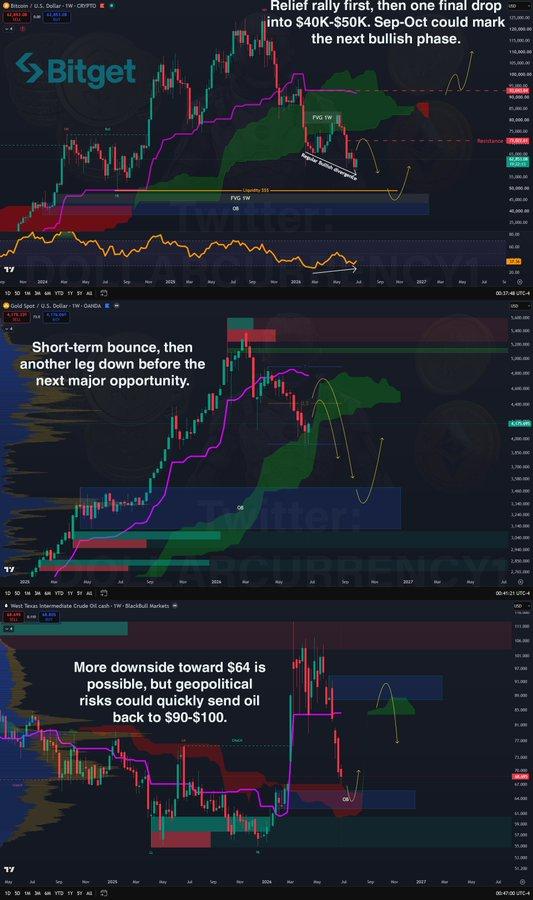
- Bitcoin’s projected relief rally toward $40,000-$50,000 may precede another corrective phase before September-October recovery.
- Gold’s consolidation structure suggests a short-term rebound could occur before another move toward accumulation zones.
- Crude oil maintains a $64 base-case target, while geopolitical risks support a potential $90-$100 scenario.
Macro Correction Cycle remains a dominant theme across major asset markets, as recent technical projections indicate Bitcoin, gold, and crude oil may experience additional corrective phases before broader directional trends reemerge.
Bitcoin Structure Suggests Relief Rally Before Further Weakness
A recent market outlook shared on social media presented a synchronized correction scenario. The analysis focused on Bitcoin, gold, and crude oil markets. The framework suggested that broader corrections remain incomplete.
 Source:
The Bitcoin chart represented the primary component of the analysis. Bitcoin has previously reached heights of over $110,000, but now seen a significant drop. The news of the correction brought prices below key technical support levels.
The published scenario is that there could be a relief rally for Bitcoin. The estimated recovery is in the $40,000-$50,000 range. But there’s another pullback that might come after that bounce.
The posted chart indicated resistance remains positioned above current levels. Additionally, unresolved supply zones continue influencing market structure. Therefore, sustained bullish momentum has yet to receive technical confirmation.
Gold Outlook Points Toward Additional Corrective Movement
The same market thesis extended to gold’s current structure. Gold previously completed a strong multi-year advance. Subsequently, prices entered an extended consolidation phase.
The shared analysis projected a short-term rebound for gold. However, another decline could emerge afterward. That move may establish a longer-term accumulation area.
Technical observations centered around gold’s interaction with cloud structures. Long-term momentum indicators remained constructive overall. Nevertheless, selling pressure appeared incompletely exhausted.

Historical market behavior provides context for this projection. Gold frequently experiences multiple corrective phases during secular advances. This pattern often occurs following periods of accelerated price appreciation.
Oil Markets Balance Economic Pressures and Geopolitical Risks
Crude oil presented a different market structure within the analysis. Recent geopolitical developments initially triggered substantial price increases. Those gains were later followed by a sharp correction.
The published outlook identified $64 per barrel as the base scenario. Economic concerns continue influencing demand expectations globally. Meanwhile, production expectations have added downward pressure.
The social media post also outlined an alternative scenario. Escalating geopolitical tensions could support a return toward $90-$100. Regional instability remains an important variable for energy markets.
Current oil market conditions reflect competing macroeconomic forces. Demand concerns continue weighing on prices. At the same time, geopolitical risk premiums remain active across energy markets.
The broader market framework presented a unified corrective thesis. Bitcoin, gold, and oil each displayed transitional structures. According to the analysis, elevated volatility may persist before longer-term trends reestablish themselves.
If needed, I can also produce a version optimized specifically for CoinDesk style, Bloomberg Crypto style, or Delphi Digital research style.