
XRP Price Drops as Long-Term Chart Pattern Breaks “For the First Time in Three Years”

XRP (XRP-USD) is experiencing a sharp decline as its value slides below key long-term market levels. Analyst Damian Chmiel noted that an important line on the price chart broke “for the first time in three years” during a steep June selloff.
This structural breakdown has shifted XRP’s overall momentum into a negative phase. Many crypto traders are now preparing for deeper losses if the asset fails to hold its current ground.
Technical Breakdowns Cause Bigger XRP Price Drops
XRP recently closed the month of June at $1.04, marking a swift 22% loss. This slide pushed the digital asset below a steady $1.26 price floor that had successfully stopped every decline since 2023.
XRP’s price also fell beneath its 50-month moving average line, which had acted as a safety net for several years. This double breakdown means the market structure is favoring sellers right now.
If XRP’s price drops below the psychological $1.00 mark, analysts warn that a much larger retreat could happen. The next stop for the asset could be a drop of 35% down to $0.67. If the selling accelerates, the price could plummet 55% to $0.47 or even hit a multi-year floor near $0.29.
Institutional Sales Hurt XRP Investor Confidence
XRP’s downward move affected the entire crypto market, causing a big pullback across all major tokens. Bitcoin (BTC-USD) dropped by about 20% in June, which drained cash out of alternative digital assets.
Furthermore, corporate actions created extra selling pressure across the crypto sector. In fact, Strategy (MSTR) confirmed it sold roughly $216 million worth of Bitcoin, despite previously harping on about its “never sell” rule.
Paul Howard, a senior director at Wincent, explained that such large corporate sales often cause other investors to reduce their risk. This activity signals caution to the broader market for the coming months.
Delayed Regulations Remove XRP’s Positive Catalyst
Political hurdles are also slowing down any potential price bounce. A vote on the CLARITY Act, a bill that would formally classify the token as a commodity under U.S. law, has been delayed.
The U.S. Senate left for recess before holding the vote, pushing the timeline into late July or early August. This delay removed a major positive news event that buyers were counting on to reverse the trend.
Instead of a fast recovery, XRP must now rely on global economic trends and general market liquidity. Until XRP’s price can climb back above the old $1.26 resistance level, the overall outlook remains stuck in a downward phase.
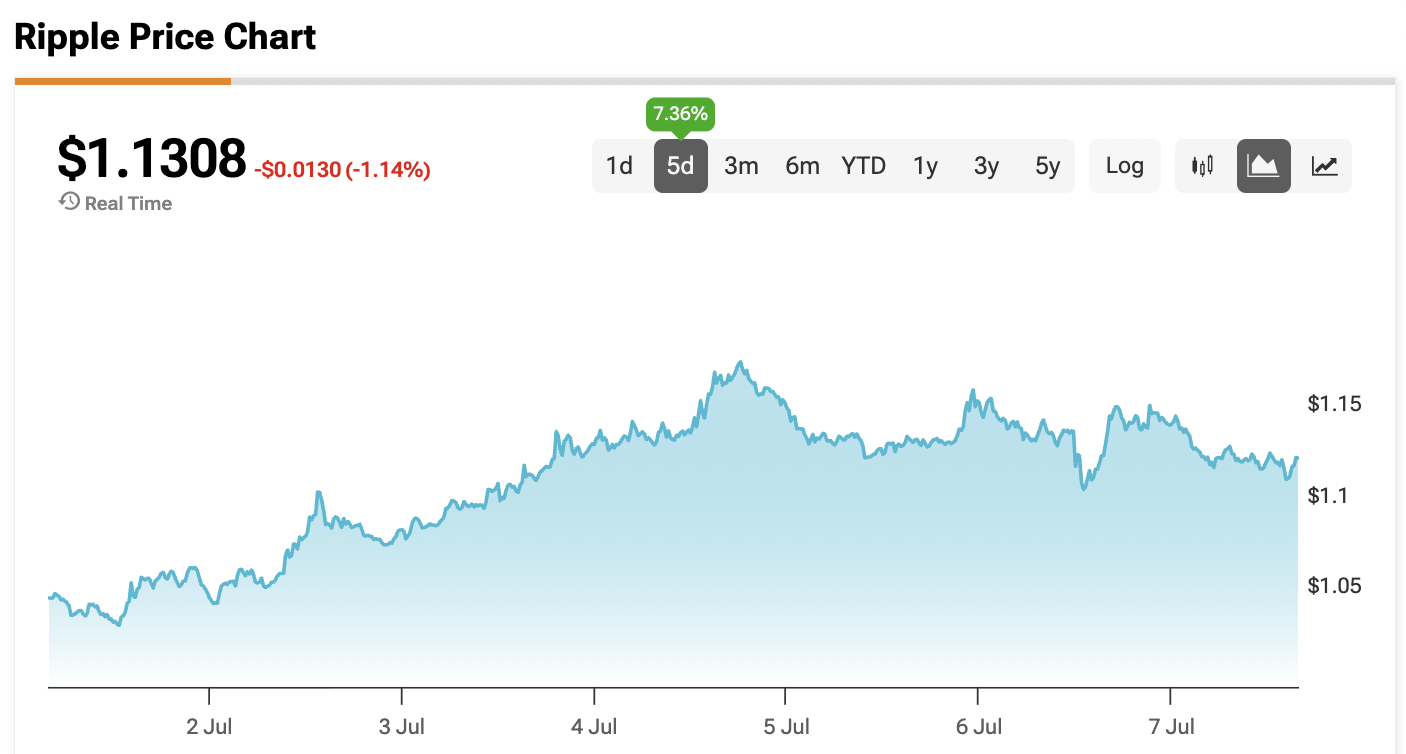
At the time of writing, XRP’s price is sitting at $1.13.
Copyright © 2026, TipRanks. All rights reserved.
Disclaimer: The content of this article solely reflects the author's opinion and does not represent the platform in any capacity. This article is not intended to serve as a reference for making investment decisions.
You may also like
Wall Street giants collectively raise rate hike forecasts, US Treasury futures continue to fall, gold drops over 1% to break 4000
After the US October CPI exceeded expectations, Goldman Sachs and Nomura added a forecast for an interest rate hike in March next year, while Deutsche Bank included a forecast for a rate hike in January next year. Currently, the market has fully priced in a 25 basis point rate hike in December, with a 13% probability for a 50 basis point hike. On Wednesday, the US Treasury spot market was closed, but Treasury futures continued to fall, with corresponding yields rising by about 2 to 4 basis points, and spot gold came under pressure, dropping by 1.1%.

No Need to Worry About the Cooling Down of AI Data Center Construction? The US Import Boom Is Unlikely to Subside in the Short Term, Real Impact May Come in 2029
It takes an average of 4.8 years from finalizing investment to starting construction of a data center project, and an additional 2.6 years from construction start to becoming operational. Servers usually cannot be installed until after the building structure and racks are completed. For trade partners such as Taiwan (China), South Korea, and Mexico who rely on US data center supply chain demand, the inertia in construction timelines provides at least a one- to two-year buffer for future exports.

Federal Reserve Major Debate: When Should the Tenure of “Number Three” Williams End?
The main point of contention is whether Williams should step down in June 2028, upon completing a full 10-year term, or in June 2027, when he reaches the mandatory retirement age of 65. Analysts point out that the Federal Reserve Board holds ultimate discretion; if he leaves early, Fed Chair Waller would be able to assert greater control over the appointment to this critical position. However, forcing Williams to shorten his term could easily be interpreted as political manipulation. Williams himself is expected to serve until June 2028.

Crypto prices
More


