
Here’s why MemeCore rallied 150% over the past week

MemeCore has surged more than 150% over the past week after recovering from a sharp selloff that erased more than 80% of its value in late June, with renewed buying driven by security updates and improving market sentiment.
- MemeCore has jumped more than 150% in a week after developers addressed security concerns following its June crash.
- A short squeeze and improving technical momentum helped push the token from $0.51 to a weekly high of $1.79.
- Traders are now watching whether ecosystem growth and on-chain activity can sustain the recovery above key resistance.
According to the MemeCore team, the rebound followed a series of public clarifications addressing concerns that emerged after the token’s steep decline. The developers said the network had become the target of a coordinated campaign and a fake project using the MemeCore name on another blockchain.
They also warned users about fraudulent airdrop pages impersonating official channels, drawing a distinction between the Layer-1 network and malicious copycat platforms.
Security updates helped restore confidence
Those statements came after MemeCore plunged to about $0.51 in late June from levels above $2.80, wiping out billions in market value within days. The collapse fueled speculation over insider activity and market manipulation, leaving traders reluctant to re-enter positions while uncertainty dominated sentiment.
As the development team responded to those concerns, buyers gradually returned. The recovery accelerated as traders viewed the clarification campaign as a sign that the project was actively addressing security risks rather than remaining silent during the crisis.
The rebound also gathered momentum in derivatives markets. After the violent selloff left the token deeply oversold, bearish traders were caught off guard when prices began climbing.
As MemeCore broke above resistance around $0.80 before clearing the $1.20 region, short sellers were forced to buy back positions, adding fuel to the rally. The token eventually reached a weekly high near $1.79 before easing into consolidation around $1.48.
Although early dip buyers locked in profits near the local top, selling pressure faded quickly enough for buyers to defend higher price levels. Instead of revisiting the June lows, MemeCore has so far maintained a sequence of higher lows, suggesting demand has remained active after the initial recovery.
Technical indicators point to stabilizing momentum
The 4-hour chart shows that the recovery has entered a consolidation phase rather than another sharp reversal. MemeCore is trading around $1.48 after holding above the $1.35-$1.40 support area, while immediate resistance remains near $1.60, followed by the recent swing high around $1.80.
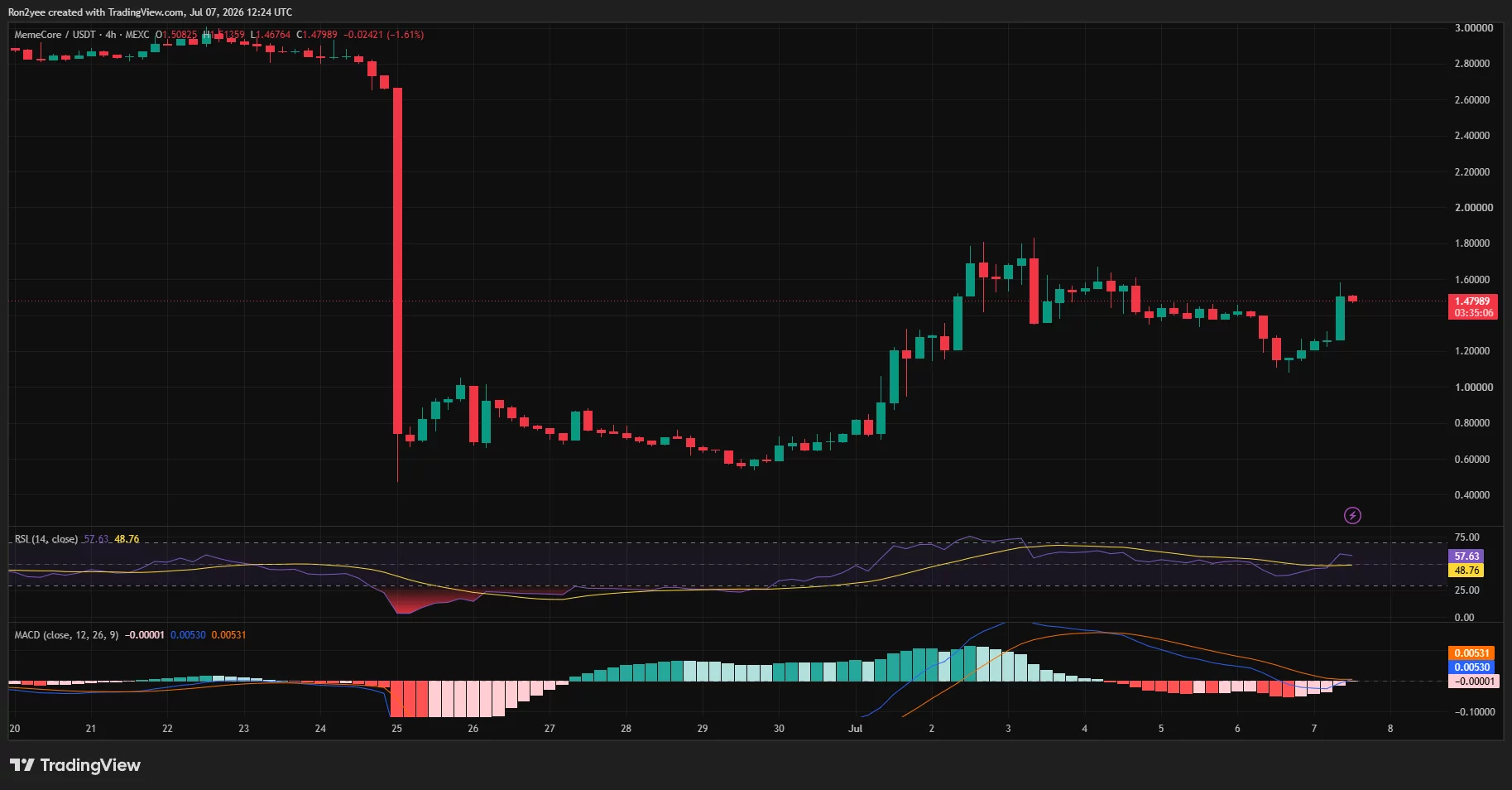 MemeCore 4-hour price chart — July 7 | Source:
Momentum indicators have also improved. On the 4-hour timeframe, the relative strength index has climbed to about 58, placing it above the neutral 50 level without entering overbought territory.
Meanwhile, the MACD histogram has turned positive, with the indicator approaching a bullish crossover, suggesting downside momentum has weakened following several days of sideways trading.
Even after the recent recovery, MemeCore remains well below its all-time high of $4.84, illustrating how much ground the token lost during June’s collapse. The rapid swing from a market capitalization below $700 million to roughly $1.9 billion within days also underscores how quickly liquidity and investor sentiment can change in smaller crypto assets.
Looking ahead, the next stage of the recovery will depend on activity beyond price action. Market participants are likely to watch whether MemeCore can expand on-chain usage, attract sustained capital inflows, and grow its ecosystem of decentralized applications.
Without continued network growth, the recent gains could face renewed pressure if crypto market volatility increases, while a decisive move above the $1.80 region would strengthen the case for another leg higher toward the $2.20 area.
Disclaimer: The content of this article solely reflects the author's opinion and does not represent the platform in any capacity. This article is not intended to serve as a reference for making investment decisions.
You may also like

Wall Street giants collectively raise rate hike forecasts, US Treasury futures continue to fall, gold drops over 1% to break 4000
After the US October CPI exceeded expectations, Goldman Sachs and Nomura added a forecast for an interest rate hike in March next year, while Deutsche Bank included a forecast for a rate hike in January next year. Currently, the market has fully priced in a 25 basis point rate hike in December, with a 13% probability for a 50 basis point hike. On Wednesday, the US Treasury spot market was closed, but Treasury futures continued to fall, with corresponding yields rising by about 2 to 4 basis points, and spot gold came under pressure, dropping by 1.1%.

No Need to Worry About the Cooling Down of AI Data Center Construction? The US Import Boom Is Unlikely to Subside in the Short Term, Real Impact May Come in 2029
It takes an average of 4.8 years from finalizing investment to starting construction of a data center project, and an additional 2.6 years from construction start to becoming operational. Servers usually cannot be installed until after the building structure and racks are completed. For trade partners such as Taiwan (China), South Korea, and Mexico who rely on US data center supply chain demand, the inertia in construction timelines provides at least a one- to two-year buffer for future exports.

Federal Reserve Major Debate: When Should the Tenure of “Number Three” Williams End?
The main point of contention is whether Williams should step down in June 2028, upon completing a full 10-year term, or in June 2027, when he reaches the mandatory retirement age of 65. Analysts point out that the Federal Reserve Board holds ultimate discretion; if he leaves early, Fed Chair Waller would be able to assert greater control over the appointment to this critical position. However, forcing Williams to shorten his term could easily be interpreted as political manipulation. Williams himself is expected to serve until June 2028.

Crypto prices
More


