Bitget App
Trade smarter
Buy cryptoMarketsTradeFuturesStocksEarnInstitutionAI & More
Solana activity hits 1 billion milestone – Is a SOL price surge next?

Solana activity hits 1 billion milestone – Is a SOL price surge next?

AMBCryptoAMBCrypto2026/07/07 09:04
By:AMBCrypto

A network proves its strength by processing transactions efficiently.

Solana’s latest milestone reinforces that. With the Alpenglow upgrade, Solana reduced finality to 100–150 ms, allowing the network to confirm transactions instantly and move closer to Web2-level responsiveness.

Notably, those improvements are already translating into higher network activity.

@media only screen and (min-width: 0px) and (min-height: 0px) { div[id^="bsa-zone_1774359638628-7_123456"] { min-height: 50px; transition: min-height 0.3s ease; } } @media only screen and (min-width: 640px) and (min-height: 0px) { div[id^="bsa-zone_1774359638628-7_123456"] { min-height: 90px; } }
AD

As the chart below shows, Solana processed 1 billion non-vote transactions over the past week, marking the first time the network has crossed that threshold. The milestone underscores Solana’s ability to sustain high throughput at scale. 
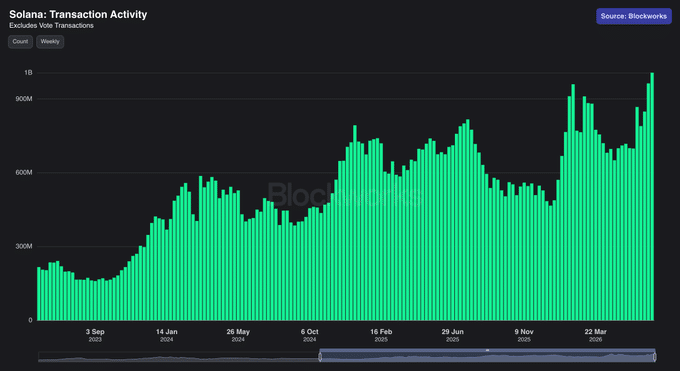
Solana activity hits 1 billion milestone – Is a SOL price surge next? image 0 Source: Blockworks

To put the milestone into context, it’s worth comparing Solana’s [SOL] execution performance with other L1s.

According to Chainspect, Solana is currently processing nearly 1,500 transactions per second (1H average), roughly 41x Ethereum’s throughput.

Finality also remains significantly lower, with transactions settling in around 12.8 seconds versus 12 minutes 48 seconds on Ethereum, a 98.3% reduction in confirmation time.

Against this backdrop, Solana’s latest milestone of 1 billion non-vote transactions reinforces the network’s underlying execution strength and suggests that the Alpenglow upgrade is already translating into higher on-chain throughput.

Yet, the market still hasn’t priced in those network improvements, raising the question of whether Solana’s fundamentals remain undervalued.

After 1 billion transactions, Solana faces its next test

Solana no longer needs to prove it can scale. The next frontier is market efficiency. 

As noted earlier, Solana already leads the L1 landscape in throughput, with the recent 1 billion non-vote transaction milestone reinforcing that in real time. The focus is now shifting to how efficiently capital moves across the network.

Projects like Jito are building the “market layer” to improve liquidity, transaction execution, and capital efficiency without changing the underlying execution layer. 

Jito echoed this view in a recent post on X, arguing that Solana’s next growth phase will come less from higher throughput and more from a stronger market layer.

Circle has already minted more than $64 billion in USDC on Solana, highlighting the network’s growing role in stablecoin settlement. As liquidity continues to deepen, efficiently deploying that capital becomes just as important as processing transactions quickly.
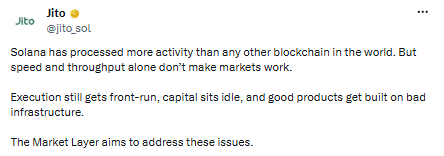
Solana activity hits 1 billion milestone – Is a SOL price surge next? image 1 Source: X

At the same time, the conversation is also shifting toward Solana’s tokenomics. 

Despite the network’s execution gains, SOL remains one of the more inflationary major Layer 1 assets.

According to on-chain data, Hyperliquid has an annualized supply growth rate of 0.14%, while Ethereum stands at 0.83%. Solana, meanwhile, remains higher at 3.76%. This puts SOL at a relative disadvantage, as higher token issuance continues to weigh on its tokenomics despite improving network fundamentals.

Therefore, while Solana’s 1 billion non-vote transaction milestone reinforces the network’s execution strength, its market layer and tokenomics still trail its infrastructure.

How quickly those two areas mature could determine whether SOL’s valuation begins to reflect the network’s underlying fundamentals.

Final Summary

  • Solana crossed 1 billion non-vote transactions, showing strong network growth and faster execution.
  • The next focus is improving market efficiency and tokenomics to support SOL’s long-term value.

 

0
0

Disclaimer: The content of this article solely reflects the author's opinion and does not represent the platform in any capacity. This article is not intended to serve as a reference for making investment decisions.

Understand the market, then trade.
Bitget offers one-stop trading for cryptocurrencies, stocks, and gold.
Trade now!

You may also like

Wall Street giants collectively raise rate hike forecasts, US Treasury futures continue to fall, gold drops over 1% to break 4000

After the US October CPI exceeded expectations, Goldman Sachs and Nomura added a forecast for an interest rate hike in March next year, while Deutsche Bank included a forecast for a rate hike in January next year. Currently, the market has fully priced in a 25 basis point rate hike in December, with a 13% probability for a 50 basis point hike. On Wednesday, the US Treasury spot market was closed, but Treasury futures continued to fall, with corresponding yields rising by about 2 to 4 basis points, and spot gold came under pressure, dropping by 1.1%.

华尔街见闻•2026/11/11 21:18
Wall Street giants collectively raise rate hike forecasts, US Treasury futures continue to fall, gold drops over 1% to break 4000

No Need to Worry About the Cooling Down of AI Data Center Construction? The US Import Boom Is Unlikely to Subside in the Short Term, Real Impact May Come in 2029

It takes an average of 4.8 years from finalizing investment to starting construction of a data center project, and an additional 2.6 years from construction start to becoming operational. Servers usually cannot be installed until after the building structure and racks are completed. For trade partners such as Taiwan (China), South Korea, and Mexico who rely on US data center supply chain demand, the inertia in construction timelines provides at least a one- to two-year buffer for future exports.

华尔街见闻•2026/11/11 21:18
No Need to Worry About the Cooling Down of AI Data Center Construction? The US Import Boom Is Unlikely to Subside in the Short Term, Real Impact May Come in 2029

Federal Reserve Major Debate: When Should the Tenure of “Number Three” Williams End?

The main point of contention is whether Williams should step down in June 2028, upon completing a full 10-year term, or in June 2027, when he reaches the mandatory retirement age of 65. Analysts point out that the Federal Reserve Board holds ultimate discretion; if he leaves early, Fed Chair Waller would be able to assert greater control over the appointment to this critical position. However, forcing Williams to shorten his term could easily be interpreted as political manipulation. Williams himself is expected to serve until June 2028.

华尔街见闻•2026/11/11 21:18
Federal Reserve Major Debate: When Should the Tenure of “Number Three” Williams End?


