
Is Nvidia being stirred up by rumors again?

Nvidia
Last weekend, SemiAnalysis posted several comments stating that Nvidia's Kyber NVL144 rack has suffered significant delays, with the delay possibly exceeding 12 months and shipments further postponed to 2028. This news has attracted considerable attention. Fortunately, Nvidia was not much affected today—though the gains weren't high, at least there was no selloff. So, what impact does this news really have on Nvidia? Is Nvidia's major risk only from the supply chain? Let's find out together.
SemiAnalysis noted that the key bottleneck for the Kyber rack is a PCB midplane for linking GPUs, specifically the orthogonal backplane Nvidia showcased at the GTC conference. Its role is to enable compute trays and switch trays to connect directly at a 90-degree angle, thereby reducing the need for traditional cables.
Let me explain briefly: This orthogonal backplane is currently only used in the Rubin Ultra flagship series racks and is not yet implemented in the standard VR NVL72 and NVL144 racks, so its impact is mainly on the flagship line. The logic behind the orthogonal backplane design isn't complicated, but the complexity lies in the manufacturing process and precision requirements. For example, imagine 144 cities, each interconnected by highways; the highways must be efficiently designed with perfectly smooth surfaces, free of any dips or bumps. The design goal is for vehicles running at full capacity to travel at 120 km/h. Achieving both connection and high-speed travel is very challenging—any flaw in the road, narrow lanes, or sharp angles could cause slowdowns and resulting congestion.
This is precisely the main difficulty of the orthogonal backplane: it demands extremely high-precision internal stacked copper wires, and it must remain error-free amid high heat. The two circular holes on top in the image are for water cooling input and output, cooling the board, because as temperature rises, material properties change, leading to decreased signal stability.
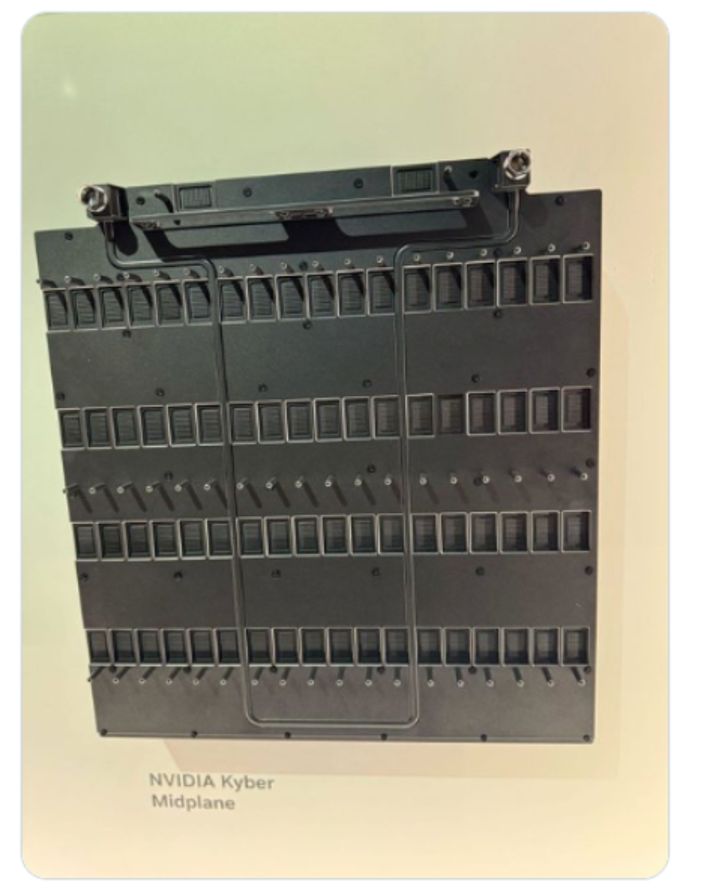
SemiAnalysis, for instance, mentioned that if the copper cable solution continues to be used, the final rack might require over 20,000 cables, increasing the weight by more than 30% and causing more significant signal attenuation. Therefore, the significance of the orthogonal backplane is that it uses more complex PCB manufacturing to achieve fewer cables, higher density, and lower latency. This is the business logic behind engineering choices.
When Jason expressed his view in this article, Nvidia officially issued a statement saying the product roadmap was not affected. But assuming the worst-case scenario, I still don’t think it will have much short-term impact, and its effect on the mid-to-long term is also limited.
This is because Ultra is a flagship product and the most expensive. Although hardware efficiency improvement does lower the total cost of ownership for customers, given that hyperscale cloud vendors are extremely cost-conscious at the margin, and with storage, CPU, and self-developed accelerators rapidly squeezing the market, the share left for general-purpose GPUs continues to be under pressure.
So even if Nvidia and its upstream supply chain manage to overcome manufacturing challenges, I think the revenue contribution from the flagship Ultra will hardly match the strong performance of the Blackwell Ultra from two years ago.
Correspondingly, if news ever emerges that Vera Rubin's standard series is delayed, then that's when concern would be warranted, since the core standard version is what drives performance and market share. Fortunately, for now, there are only reports of specification reductions and no news of shipment delays.
As to why Nvidia's stock can neither rise nor fall substantially?
I think it’s unable to rally due to a lack of valuation catalysts—the current landscape is Nvidia playing defense, with AMD and other self-developed accelerators on the offensive. The downside is limited thanks to strong earnings support, but those results are gradually driving the stock higher step by step. This situation, which started with Gemini 3 last year, has persisted for over half a year. Judging from the current state, the equilibrium between defense and offense has not yet stabilized.


Disclaimer: The content of this article solely reflects the author's opinion and does not represent the platform in any capacity. This article is not intended to serve as a reference for making investment decisions.
You may also like

Wall Street giants collectively raise rate hike forecasts, US Treasury futures continue to fall, gold drops over 1% to break 4000
After the US October CPI exceeded expectations, Goldman Sachs and Nomura added a forecast for an interest rate hike in March next year, while Deutsche Bank included a forecast for a rate hike in January next year. Currently, the market has fully priced in a 25 basis point rate hike in December, with a 13% probability for a 50 basis point hike. On Wednesday, the US Treasury spot market was closed, but Treasury futures continued to fall, with corresponding yields rising by about 2 to 4 basis points, and spot gold came under pressure, dropping by 1.1%.

No Need to Worry About the Cooling Down of AI Data Center Construction? The US Import Boom Is Unlikely to Subside in the Short Term, Real Impact May Come in 2029
It takes an average of 4.8 years from finalizing investment to starting construction of a data center project, and an additional 2.6 years from construction start to becoming operational. Servers usually cannot be installed until after the building structure and racks are completed. For trade partners such as Taiwan (China), South Korea, and Mexico who rely on US data center supply chain demand, the inertia in construction timelines provides at least a one- to two-year buffer for future exports.

Federal Reserve Major Debate: When Should the Tenure of “Number Three” Williams End?
The main point of contention is whether Williams should step down in June 2028, upon completing a full 10-year term, or in June 2027, when he reaches the mandatory retirement age of 65. Analysts point out that the Federal Reserve Board holds ultimate discretion; if he leaves early, Fed Chair Waller would be able to assert greater control over the appointment to this critical position. However, forcing Williams to shorten his term could easily be interpreted as political manipulation. Williams himself is expected to serve until June 2028.

Crypto prices
More


