
When will the sluggish volatility break?

Morning FX
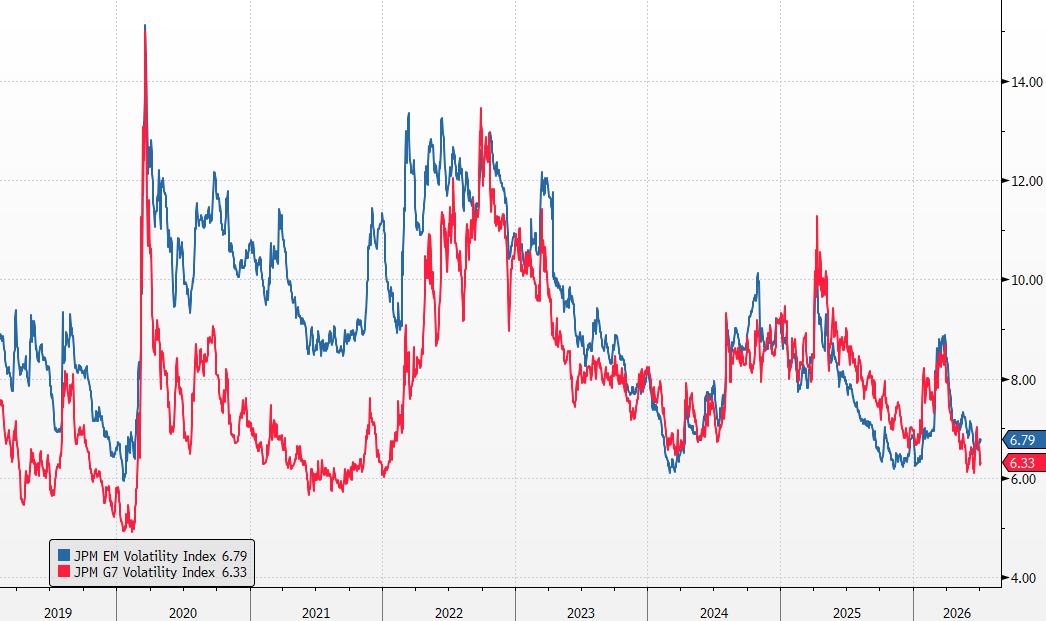
When will the subdued volatility break out?
Waller removed forward guidance at the June FOMC, stating that the Fed would not provide any forecasts for future interest rate paths. At the Sintra ECB Forum on July 1, it was officially announced that the “forward guidance era is over.”
Meanwhile, the ECB President also proposed abandoning traditional forward guidance at the forum:
“I have always regretted being constrained by traditional forward guidance in the past. We have completely set aside path-based forward guidance—the kind of commitment that ‘interest rates will remain at a certain level until a specific time, pre-committing to a policy path’.
Instead, we are providing framework guidance: we won’t predict the next rate move but will present our policy reaction function clearly and openly. The market must study our monitoring indicators and decision logic, instead of passively waiting for the central bank to reveal the clear path.
Our judgment anchors on four aspects: inflation outlook, underlying core inflation, high-frequency economic and financial data, and the efficiency of monetary policy transmission. All interest rate adjustments will be based on these four types of data, with no pre-commitment.”
After forward guidance was fully implemented in 2008, it lowered the premium for policy uncertainty and led to a significant decline in the central volatility in financial markets. With the removal of forward guidance, Wall Street will no longer be able to form unified rate expectations based on dot plots, meeting minutes, and officials’ speeches; the importance of data such as CPI and non-farm payrolls will increase significantly.
2. Bank of Japan intervention is imminent
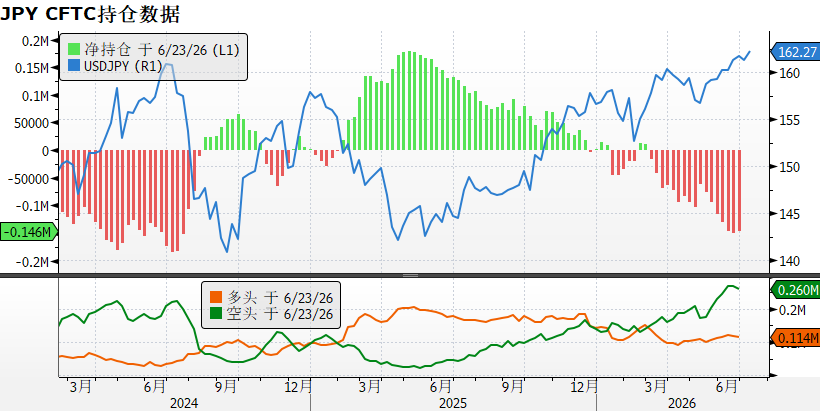
USDJPY has surpassed 162, reaching its highest level since December 1986. Despite this key breach, Japanese authorities have not intensified their verbal intervention. However, according to Reuters on July 2, citing sources, if FX intervention is conducted in the future, Japanese authorities may not release the strong pre-warning signal as they did on April 30.
Japan’s intervention strategy has changed and may involve surprise, staggered, small-scale and ongoing operations. With current crowded short positions on the yen,a surprise intervention at any time could trigger a pulse-like shock in the forex market, leading to joint fluctuations in non-dollar currencies and cross currency pairs, and serving as a key catalyst for a short-term volatility breakout.
3. AI semiconductor correction could trigger a rise in financial market volatility
The core narrative of strong capital expenditures in AI computing power is starting to weaken, and there are growing doubts about the sustainability of tech companies’ capital spending. Meta’s opening up unused computing power for leasing marks a key signal of turning in supply/demand dynamics, coupled with a global release of chip production capacity, with the market already pricing in the risk of future capacity oversupply.
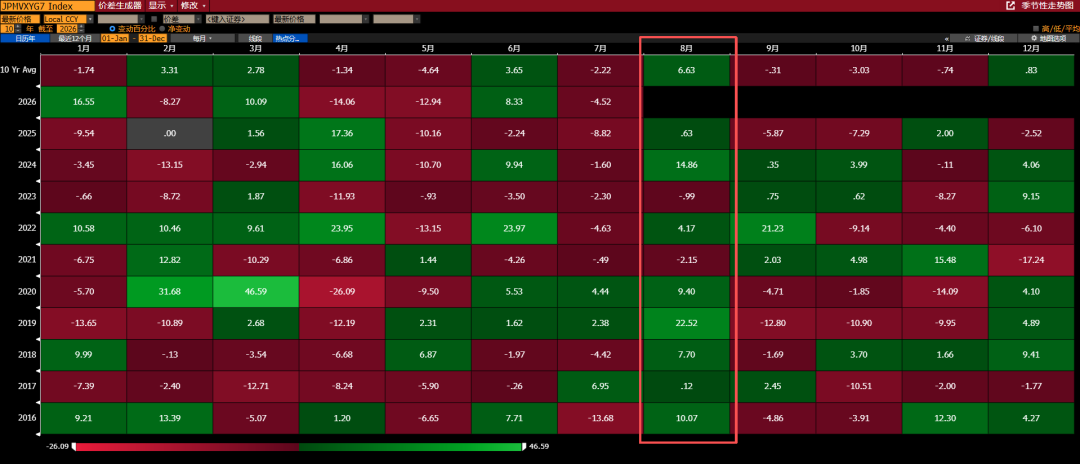
4. August forex market volatility usually rises seasonally
In general, forex market volatility tends to rise in August due to seasonal factors. This is likely caused by reduced liquidity from European and US institutional summer holidays amplifying price shocks. At the same time, the Jackson Hole Economic Policy Symposium takes place at the end of August, and without forward guidance, central bank officials’ statements are highly uncertain, intensifying market expectations and policy uncertainty premiums.
Chart: G7 Volatility Index Seasonality
Summary:
Forex trading has been difficult this year, as the volatility in rates markets has not been transmitted to FX, leaving currency pair ranges extremely tight. Looking to the second half of the year, four factors—central bank policy framework reconstruction, yen intervention risk, the shift in AI industry momentum, and August seasonality—may finally break the prolonged low-volatility regime. At a stage when trading direction is unclear, considering long volatility trading strategies could be worthwhile.
Disclaimer: The content of this article solely reflects the author's opinion and does not represent the platform in any capacity. This article is not intended to serve as a reference for making investment decisions.
You may also like

Wall Street giants collectively raise rate hike forecasts, US Treasury futures continue to fall, gold drops over 1% to break 4000
After the US October CPI exceeded expectations, Goldman Sachs and Nomura added a forecast for an interest rate hike in March next year, while Deutsche Bank included a forecast for a rate hike in January next year. Currently, the market has fully priced in a 25 basis point rate hike in December, with a 13% probability for a 50 basis point hike. On Wednesday, the US Treasury spot market was closed, but Treasury futures continued to fall, with corresponding yields rising by about 2 to 4 basis points, and spot gold came under pressure, dropping by 1.1%.

No Need to Worry About the Cooling Down of AI Data Center Construction? The US Import Boom Is Unlikely to Subside in the Short Term, Real Impact May Come in 2029
It takes an average of 4.8 years from finalizing investment to starting construction of a data center project, and an additional 2.6 years from construction start to becoming operational. Servers usually cannot be installed until after the building structure and racks are completed. For trade partners such as Taiwan (China), South Korea, and Mexico who rely on US data center supply chain demand, the inertia in construction timelines provides at least a one- to two-year buffer for future exports.

Federal Reserve Major Debate: When Should the Tenure of “Number Three” Williams End?
The main point of contention is whether Williams should step down in June 2028, upon completing a full 10-year term, or in June 2027, when he reaches the mandatory retirement age of 65. Analysts point out that the Federal Reserve Board holds ultimate discretion; if he leaves early, Fed Chair Waller would be able to assert greater control over the appointment to this critical position. However, forcing Williams to shorten his term could easily be interpreted as political manipulation. Williams himself is expected to serve until June 2028.

Crypto prices
More


