Bitget App
Trade smarter
Buy cryptoMarketsTradeFuturesStocksEarnInstitutionAI & More
Bitcoin may not be done capitulating – Why a $50K bottom is still in play

Bitcoin may not be done capitulating – Why a $50K bottom is still in play

AMBCryptoAMBCrypto2026/07/06 21:03
By:AMBCrypto

Conviction in a risk-off market is often the hallmark of long-term strength.

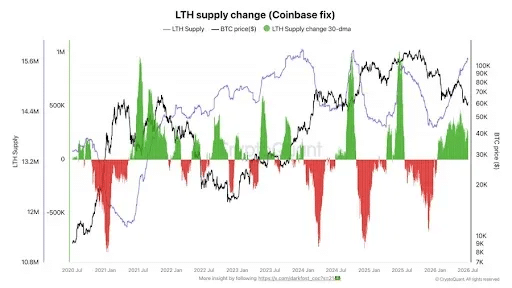
Bitcoin’s [BTC] current setup reflects that conviction. Technically, BTC has posted three straight quarterly losses, with an average decline of around 20% each quarter. It’s the first three-quarter losing streak since the 2022 bear market, leaving more than 50% of Bitcoin’s circulating supply underwater and putting long-term holders (LTHs) firmly in focus.

The logic is simple: LTHs now control 78% of Bitcoin’s circulating supply. In other words, a large share of the underwater supply is held by investors who have held BTC for more than five months, covering the rally to its $126,000 all-time high and the subsequent correction to around $60,000. That makes their conviction a key factor in shaping Bitcoin’s Q3-Q4 outlook.
@media only screen and (min-width: 0px) and (min-height: 0px) { div[id^="bsa-zone_1774359638628-7_123456"] { min-height: 50px; transition: min-height 0.3s ease; } } @media only screen and (min-width: 640px) and (min-height: 0px) { div[id^="bsa-zone_1774359638628-7_123456"] { min-height: 90px; } }
AD

Bitcoin may not be done capitulating – Why a $50K bottom is still in play image 0 Source: CryptoQuant

Notably, what’s standing out is that long-term holders aren’t selling into the weakness. 

Instead, they’re absorbing it. Despite the correction, LTH supply reached a record high in June, reinforcing the view that these investors continue to accumulate rather than exit. Historically, Bitcoin has tended to bottom when long-term holders begin to capitulate. So far, this cycle is unfolding differently.

That said, long-term holders remain highly sensitive to macroeconomic developments, as they tend to price in the broader economic outlook when positioning their portfolios. From that perspective, Bitcoin’s capitulation phase may not be over yet. 

Why Bitcoin’s strongest cohort may soon face their toughest test

Bitcoin’s past bear markets provide a useful benchmark for the current cycle. 

Before drawing parallels, though, it’s worth looking at what’s changed on the macro front. Fed rate expectations for the July and September FOMC meetings have shifted noticeably. For July, there’s a 77% probability the Fed keeps rates unchanged, while the odds of a 25-basis-point hike stand at 23%. 

By September, the picture becomes more balanced. Markets are pricing a 41% chance of no change, a 47% probability of a 25 bps hike, and a 10.5% chance of a 50 bps hike. In other words, markets are increasingly positioning for tighter financial conditions into the fall rather than the rate cuts many had anticipated.
Bitcoin may not be done capitulating – Why a $50K bottom is still in play image 1 Source: TradingView

That shift makes Bitcoin’s previous bear markets a relevant reference point.

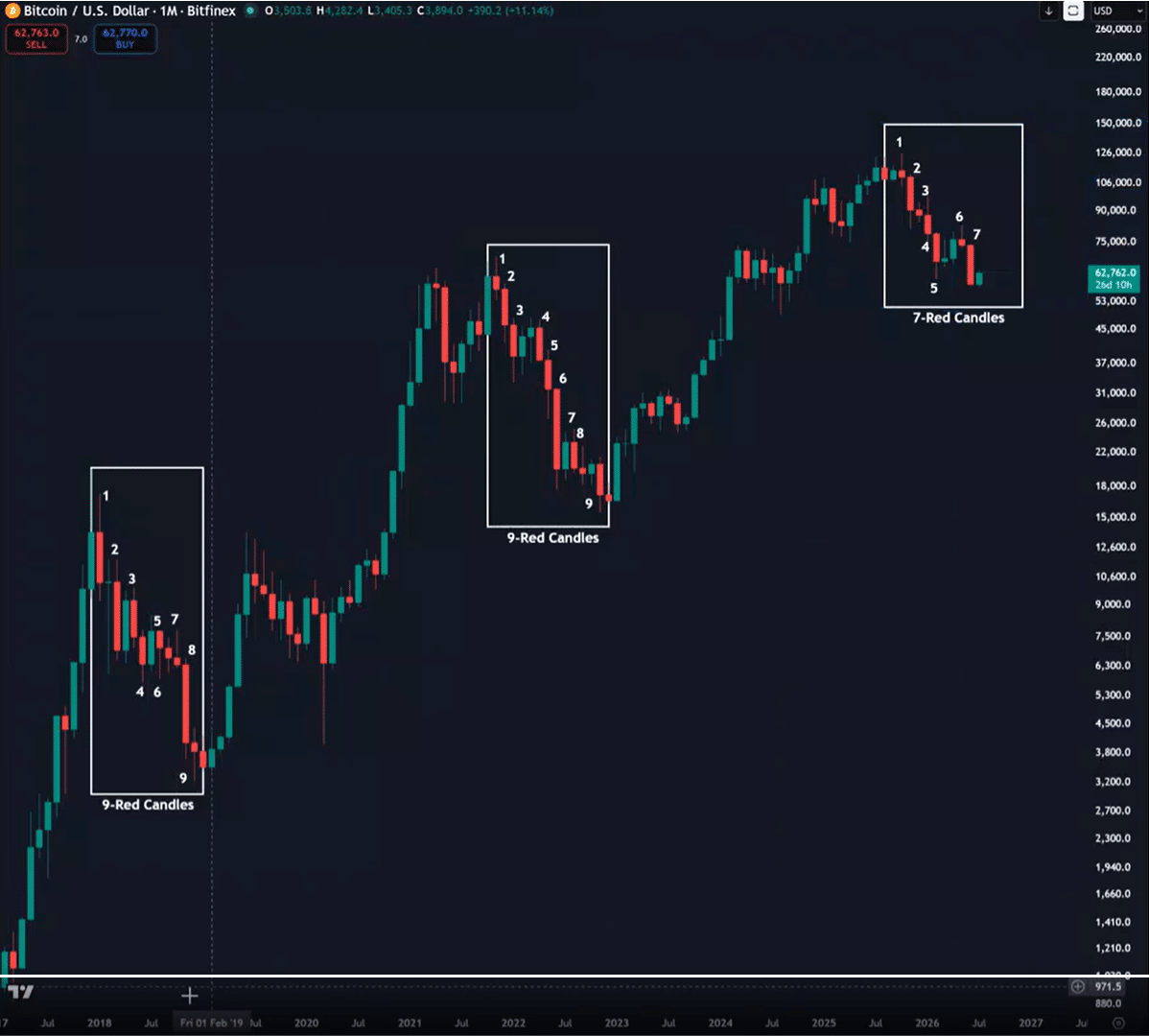
As the chart above shows, both the 2018 and 2022 bear cycles didn’t bottom until BTC had printed nine consecutive monthly red candles. The current cycle has produced seven so far. If the historical pattern holds, Bitcoin’s capitulation phase may still have room to run before a durable bottom is established.

That’s where the expanding pool of underwater long-term holders meets an increasingly uncertain macro backdrop. If this cycle follows the same script, long-term holder capitulation could mark Bitcoin’s final washout, potentially sending BTC toward the $50,000 region by the end of Q3 before a bottom takes shape. 

Final Summary

  • Long-term holders are still accumulating, but rising macro risks could test their conviction.
  • If past cycles repeat, Bitcoin may see one final capitulation before finding a bottom.
0
0

Disclaimer: The content of this article solely reflects the author's opinion and does not represent the platform in any capacity. This article is not intended to serve as a reference for making investment decisions.

Understand the market, then trade.
Bitget offers one-stop trading for cryptocurrencies, stocks, and gold.
Trade now!

You may also like

Wall Street giants collectively raise rate hike forecasts, US Treasury futures continue to fall, gold drops over 1% to break 4000

After the US October CPI exceeded expectations, Goldman Sachs and Nomura added a forecast for an interest rate hike in March next year, while Deutsche Bank included a forecast for a rate hike in January next year. Currently, the market has fully priced in a 25 basis point rate hike in December, with a 13% probability for a 50 basis point hike. On Wednesday, the US Treasury spot market was closed, but Treasury futures continued to fall, with corresponding yields rising by about 2 to 4 basis points, and spot gold came under pressure, dropping by 1.1%.

华尔街见闻•2026/11/11 21:18
Wall Street giants collectively raise rate hike forecasts, US Treasury futures continue to fall, gold drops over 1% to break 4000

No Need to Worry About the Cooling Down of AI Data Center Construction? The US Import Boom Is Unlikely to Subside in the Short Term, Real Impact May Come in 2029

It takes an average of 4.8 years from finalizing investment to starting construction of a data center project, and an additional 2.6 years from construction start to becoming operational. Servers usually cannot be installed until after the building structure and racks are completed. For trade partners such as Taiwan (China), South Korea, and Mexico who rely on US data center supply chain demand, the inertia in construction timelines provides at least a one- to two-year buffer for future exports.

华尔街见闻•2026/11/11 21:18
No Need to Worry About the Cooling Down of AI Data Center Construction? The US Import Boom Is Unlikely to Subside in the Short Term, Real Impact May Come in 2029

Federal Reserve Major Debate: When Should the Tenure of “Number Three” Williams End?

The main point of contention is whether Williams should step down in June 2028, upon completing a full 10-year term, or in June 2027, when he reaches the mandatory retirement age of 65. Analysts point out that the Federal Reserve Board holds ultimate discretion; if he leaves early, Fed Chair Waller would be able to assert greater control over the appointment to this critical position. However, forcing Williams to shorten his term could easily be interpreted as political manipulation. Williams himself is expected to serve until June 2028.

华尔街见闻•2026/11/11 21:18
Federal Reserve Major Debate: When Should the Tenure of “Number Three” Williams End?


