
Nonfarm Payrolls Reverse Policy Logic; Bonds and Gold Enter Window of Opportunity

Huitong Net, July 6—Entering the second half of 2026, under the leadership of the new Federal Reserve Chair Walsh, the direction of monetary policy returns to the core logic of dominating global asset pricing.
Before the release of June's Non-Farm Payrolls data, the Federal Reserve maintained a hawkish tone overall, staying highly vigilant towards labor market resilience and sticky inflation. This judgment became the market’s core basis for anticipating the possibility of further rate hikes from the Fed.
At that time, the Fed’s policy stance generally leaned towards preventing an inflation rebound and consolidating anti-inflation achievements, without any signal of rate cuts, maintaining a narrative of high rates or even moderate hikes, firmly dominating the mainstream market outlook.

Core of the Old Policy Logic: Strong Labor Market Supporting Tightening Expectations
The main reason supporting the Fed’s hawkish judgment was the continued strength of previous US employment data.
Based on this logic of strong employment and sticky inflation, the market had previously even priced in two possible Fed rate hikes within the year. Many investment banks predicted a cumulative 75 basis point hike by year-end, with tightening expectations continuing to suppress global bond and gold prices.
This formed the market’s basis for high expectations of US employment data.
From the changes in US Treasury interest rate terms, it can be seen that long-term inflation expectations had already rapidly declined even before the US-Iran peace talks began. Long-term Treasury yields fell sharply, while short-term yields remained elevated mainly due to a strong labor market. The current Non-Farm Payrolls data may also push down short-term Treasury yields, forming a steep bull-flattening curve in US Treasuries. At such times, funds tend to prioritize buying Treasuries, TIPS, and gold.
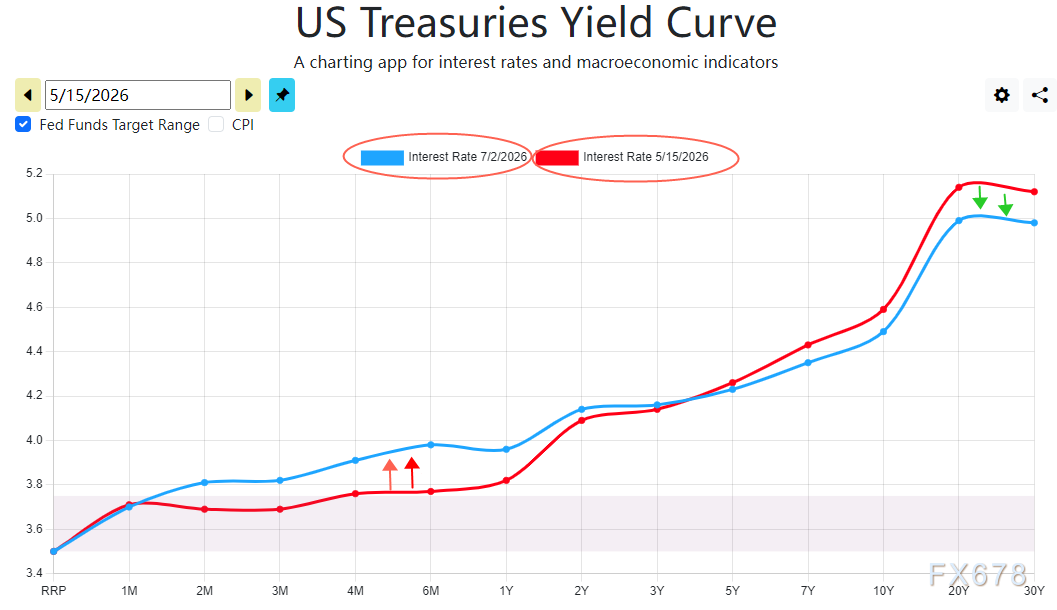
(US Treasury futures and spot premium comparison chart, Source: Federal Reserve)
Expectations Gap: A Shocking Non-Farm Print Shatters Tightening Foundation
But the latest June Non-Farm Payrolls data has completely broken the original policy logic,
Data shows US Non-Farm Payroll additions in June were only 57,000, far below market expectations, while prior employment data for April and May were also significantly revised down, completely ending the previous narrative of labor market resilience.
This upset in the data suggests the US labor market has shifted from resilience to a marked cooling, with domestic employment demand continuously weakening. The core employment logic supporting the Fed’s hawkish stance and rate hike expectations is now directly challenged.
Previously, the policy confidence in the minutes was entirely based on a strong labor market and the economy’s ability to withstand high rates—even further tightening; now, the substantial weakening of employment fundamentals directly undermines that data support for the old framework.
Even if the textual tone of the minutes remains hawkish, the reality underneath has disappeared. The rationale for the Fed to continue a tough tightening stance or deliver more rate hikes drops sharply, the probability of a further hike this year falls further, and the policy focus officially shifts from “guarding against inflation rebound, preparing for hikes” to “watching the data, balancing the economy and inflation.”
Asset Allocation Opportunities: Bonds and Gold See a Window of Certainty
This fundamental reversal in policy rationale creates clear market opportunities now: bonds and gold assets are seeing the best configuration window.
Overall, the reversal of employment data has reshaped the Fed’s policy path, and market uncertainty has now become certainty for trading bonds and gold assets.
But it’s also important to be aware of risks, as one major current driver of Treasury yields is the boom in AI demand. Expectations for high capital expenditure in AI directly push up the US rate center.
From a technical perspective, last Friday’s light-volume bullish candle suggests there is not much disagreement among funds, but insufficient turnover, which can result in sharp up-and-down moves ahead, with good entry opportunities during periods of consolidation.
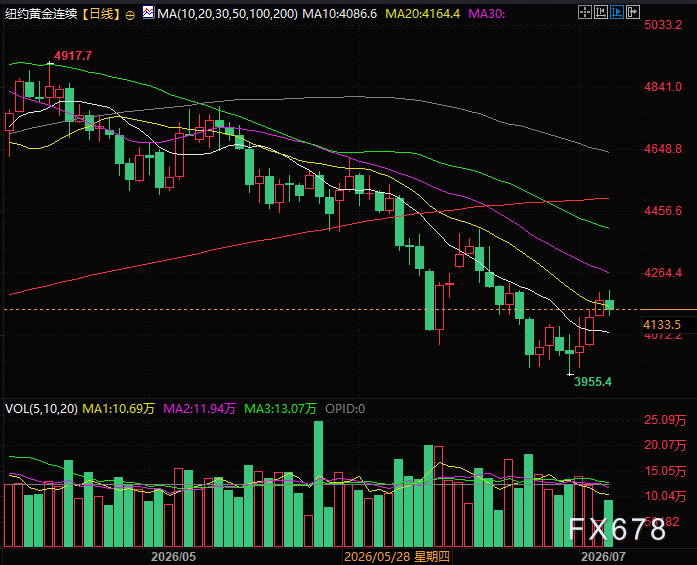
(New York Gold Futures, continuous, Source: Easy Huitong)
At 18:08 Beijing time, New York gold futures last traded at $4156.2/oz.
Disclaimer: The content of this article solely reflects the author's opinion and does not represent the platform in any capacity. This article is not intended to serve as a reference for making investment decisions.
You may also like

Wall Street giants collectively raise rate hike forecasts, US Treasury futures continue to fall, gold drops over 1% to break 4000
After the US October CPI exceeded expectations, Goldman Sachs and Nomura added a forecast for an interest rate hike in March next year, while Deutsche Bank included a forecast for a rate hike in January next year. Currently, the market has fully priced in a 25 basis point rate hike in December, with a 13% probability for a 50 basis point hike. On Wednesday, the US Treasury spot market was closed, but Treasury futures continued to fall, with corresponding yields rising by about 2 to 4 basis points, and spot gold came under pressure, dropping by 1.1%.

No Need to Worry About the Cooling Down of AI Data Center Construction? The US Import Boom Is Unlikely to Subside in the Short Term, Real Impact May Come in 2029
It takes an average of 4.8 years from finalizing investment to starting construction of a data center project, and an additional 2.6 years from construction start to becoming operational. Servers usually cannot be installed until after the building structure and racks are completed. For trade partners such as Taiwan (China), South Korea, and Mexico who rely on US data center supply chain demand, the inertia in construction timelines provides at least a one- to two-year buffer for future exports.

Federal Reserve Major Debate: When Should the Tenure of “Number Three” Williams End?
The main point of contention is whether Williams should step down in June 2028, upon completing a full 10-year term, or in June 2027, when he reaches the mandatory retirement age of 65. Analysts point out that the Federal Reserve Board holds ultimate discretion; if he leaves early, Fed Chair Waller would be able to assert greater control over the appointment to this critical position. However, forcing Williams to shorten his term could easily be interpreted as political manipulation. Williams himself is expected to serve until June 2028.

Crypto prices
More


