
Here’s why DeXe price is rallying

DeXe price extended its rally on Sunday after breaking above a key technical resistance level, with growing investor interest pushing the AI-focused governance token to its highest price in months.
- DeXe price jumped more than 15% after strong on-chain activity and renewed interest in AI governance tokens fueled buying.
- A technical breakout and short squeeze helped propel DEXE above key resistance toward multi-month highs.
- Traders are now watching whether DEXE can hold above its breakout zone and challenge the $30 psychological level.
According to crypto.news price data, DeXe (DEXE) price climbed more than 15% to an intraday high of $28.09 on July 6, marking its strongest daily performance in weeks. The rally came as CoinGecko highlighted DeXe as one of the best-performing AI-focused cryptocurrencies over the past week, drawing renewed attention to the protocol’s governance and decentralized autonomous organization ecosystem.
The surge also coincided with record on-chain activity. Blockchain data showed all-time highs in whale transactions, new wallet creation, and active addresses, suggesting both large investors and retail participants were accumulating the token.
Because a substantial share of DEXE’s supply remains locked in protocol treasuries, ecosystem allocations, and DAO-controlled wallets, relatively limited exchange liquidity amplified the impact of the buying pressure and accelerated the move higher.
Why is DeXe outperforming the broader crypto market?
Beyond project-specific catalysts, DeXe also benefited from a notable shift in the macroeconomic backdrop. A weaker-than-expected U.S. Nonfarm Payrolls report released on July 3 strengthened expectations that the Federal Reserve could adopt a more accommodative stance in the coming months.
Falling Treasury yields and a softer U.S. dollar subsequently improved sentiment across risk assets, encouraging capital to rotate back into cryptocurrencies and decentralized finance projects.
Unlike many altcoins that struggled throughout June, DeXe entered the rebound with strong protocol fundamentals. The project currently supports more than 100 decentralized autonomous organizations while securing roughly $1.7 billion in total value locked, giving investors exposure to both AI governance infrastructure and the expanding DAO sector.
As traders searched for projects backed by measurable on-chain activity rather than speculation alone, DEXE emerged as one of the primary beneficiaries.
Derivatives positioning likely added further momentum to the rally. As the token cleared several technical resistance levels, traders holding leveraged short positions were forced to cover, creating additional buy pressure that complemented the growing spot demand. The combination of organic accumulation and forced liquidations helped accelerate the move beyond the previous resistance zone.
What does the DEXE chart suggest next?
The daily chart shows DeXe confirming a powerful continuation breakout after spending several sessions consolidating around the $22-$24 region. Sunday’s rally pushed the token to a fresh multi-month high near $28 while producing one of the strongest bullish candles of the current uptrend, with buyers maintaining control into the session close.
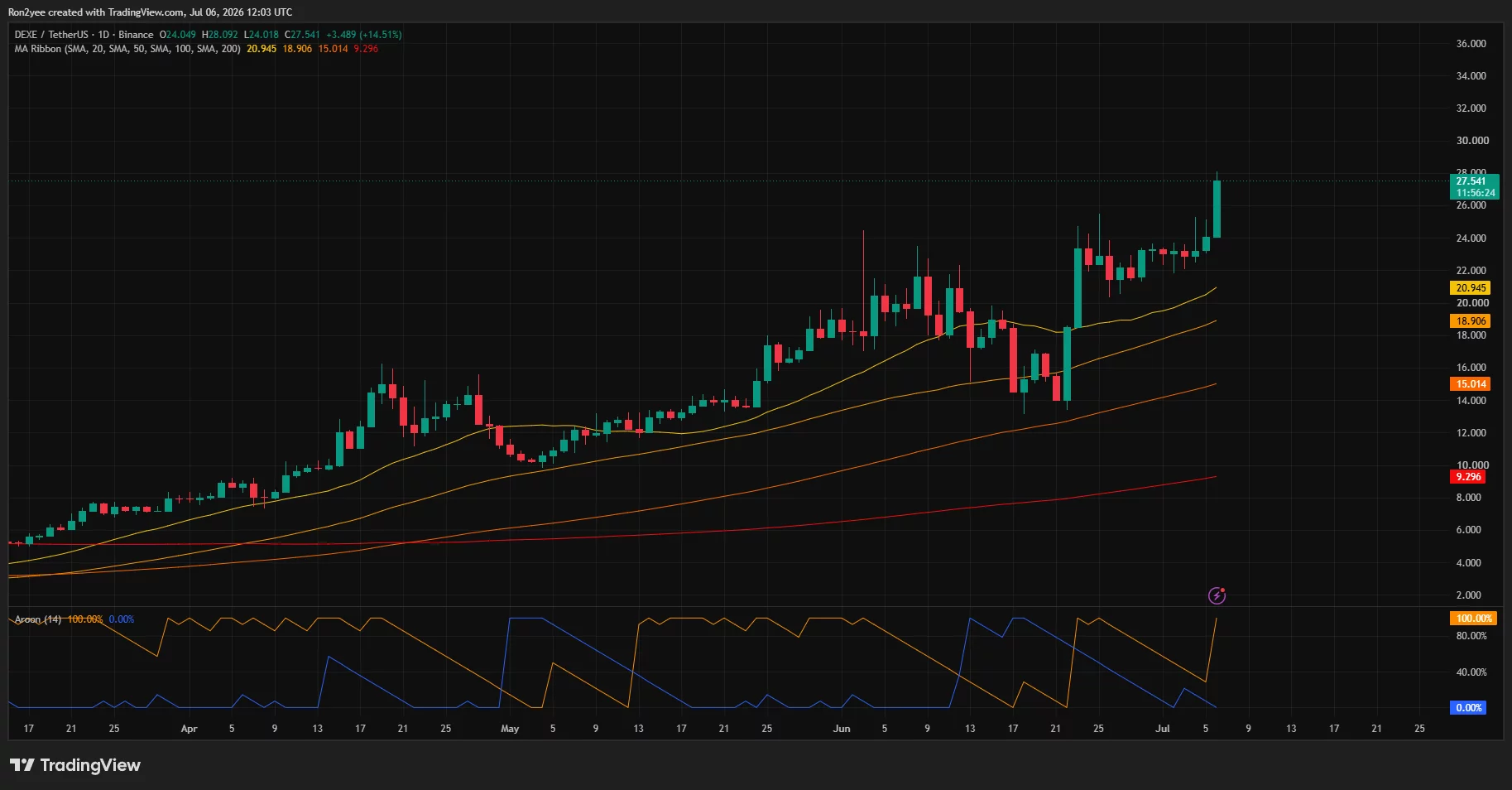 DeXe daily price chart — July 6 | Source:
The broader trend also remains firmly constructive. DEXE continues to trade well above its 20-, 50-, 100-, and 200-day simple moving averages, which remain aligned in a classic bullish configuration. The Aroon indicator further reinforces the strength of the trend, with Aroon Up reading 100% and Aroon Down at 0%, indicating that buyers continue to dominate price action.
That said, the rally has become increasingly extended. DEXE now trades roughly 30% above its 20-day moving average, a gap that could encourage short-term profit-taking after such a rapid advance.
If buyers maintain control, the next major psychological target sits near $30, followed by the 2021 highs around $32. On the downside, the former breakout zone between approximately $24 and $25 represents the first important support area, while a deeper pullback could bring the rising 20-day moving average near $21 back into focus.
Disclaimer: The content of this article solely reflects the author's opinion and does not represent the platform in any capacity. This article is not intended to serve as a reference for making investment decisions.
You may also like

Wall Street giants collectively raise rate hike forecasts, US Treasury futures continue to fall, gold drops over 1% to break 4000
After the US October CPI exceeded expectations, Goldman Sachs and Nomura added a forecast for an interest rate hike in March next year, while Deutsche Bank included a forecast for a rate hike in January next year. Currently, the market has fully priced in a 25 basis point rate hike in December, with a 13% probability for a 50 basis point hike. On Wednesday, the US Treasury spot market was closed, but Treasury futures continued to fall, with corresponding yields rising by about 2 to 4 basis points, and spot gold came under pressure, dropping by 1.1%.

No Need to Worry About the Cooling Down of AI Data Center Construction? The US Import Boom Is Unlikely to Subside in the Short Term, Real Impact May Come in 2029
It takes an average of 4.8 years from finalizing investment to starting construction of a data center project, and an additional 2.6 years from construction start to becoming operational. Servers usually cannot be installed until after the building structure and racks are completed. For trade partners such as Taiwan (China), South Korea, and Mexico who rely on US data center supply chain demand, the inertia in construction timelines provides at least a one- to two-year buffer for future exports.

Federal Reserve Major Debate: When Should the Tenure of “Number Three” Williams End?
The main point of contention is whether Williams should step down in June 2028, upon completing a full 10-year term, or in June 2027, when he reaches the mandatory retirement age of 65. Analysts point out that the Federal Reserve Board holds ultimate discretion; if he leaves early, Fed Chair Waller would be able to assert greater control over the appointment to this critical position. However, forcing Williams to shorten his term could easily be interpreted as political manipulation. Williams himself is expected to serve until June 2028.

Crypto prices
More


