
Citadel Strategy Chief: The Market Underestimates the Possibility of a Fed Rate Hike in July

The Federal Reserve’s policy framework is shifting from “inertia” to “adaptability”, and the fixed income market may be facing a brutal summer.
On July 5th, Citadel Securities’ Head of Macro Strategy Frank Flight warned in his latest report that the market is currently severely underestimating the probability of a rate hike by the Federal Reserve at its July meeting. He maintains his baseline forecast of two rate hikes this year, but thinks investors are still constrained by an "inertia policy framework", mistakenly assuming that the Fed will only act when data unequivocally force its hand.
Flight emphasized that Federal Reserve Chair Walsh delivered for an “A+” performance at the June FOMC meeting—breakeven inflation rates trended downward, the yield curve flattened, the dollar strengthened, and any brief pullback in risk assets was quickly absorbed. This market reaction indicates that consecutive and rapid “credibility rate hikes” are tolerable for markets, even if not fully priced in beforehand. At the same time, his cross-asset macro framework and U.S. Treasury cash flow data both point to upside risks in yields, meaning the pressure on the fixed income market may persist.
From “Inertia” to “Adaptability”: Market Underestimates Policy Framework Shift
Flight believes the core misjudgment in current market pricing is that investors are still using the old “inertia policy framework”—that is, assuming the Fed will act only slowly and passively when data accumulation is substantial. He argues that the Fed’s shift to an “adaptability policy framework” is real and far from fully recognized by the market.
Under the adaptability policy framework, the central bank’s optimal strategy is to respond quickly as soon as deviation from its dual mandate appears, preventing such deviations from becoming entrenched. This mechanism can guide wage and price-setting behavior to embed 2% inflation expectations, thus increasing the likelihood of achieving targets and reducing the magnitude of tightening ultimately required compared to the “slam-on-the-brakes-after-delay” path inherent in the inertia framework.
He especially emphasized that if the Federal Reserve forfeits its first chance to “match words with actions” at the July meeting, it will make Chair Walsh’s remarks at the June press conference appear superficial and could lead the market to give back some of the hard-won credibility premium already priced in.
Cross-Asset Signals and Treasury Cash Flow Both Point to Rising Yields
On a technical and capital flow level, Citadel Securities’ quantitative signals also support the case for higher yields.
Flight recalled that on May 19th he warned of rapid strengthening risk in global duration, triggered by two factors at the time:
First, the growth factor (PC1) in the cross-asset decomposition model reached the mean-reversion threshold of +2 standard deviations, suggesting downside risk for yields; second, U.S. Treasury cash flow data showed a sharp rise in net buying intensity. May 19th subsequently became a staged high point for yields this year.
However, both factors supporting long duration have now fully reversed. In recent weeks, the PC1 factor in the macro framework has moved more than 3 standard deviations, with the current reading at -1.17 standard deviations; meanwhile, U.S. Treasury cash flow data now shows a clear step up in net selling intensity.
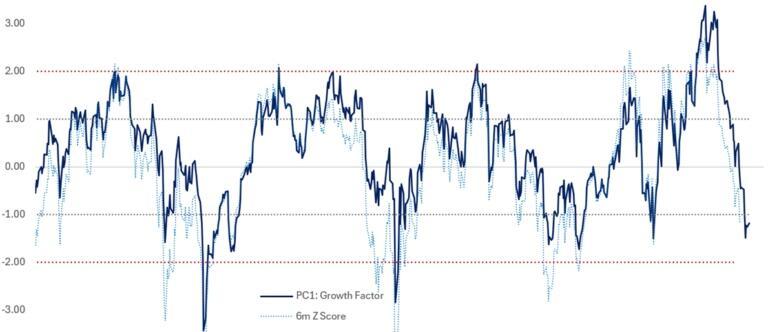
Flight concluded that these signals collectively point to further upside risks for yields, and that pressure on the fixed income market may intensify throughout the summer.
Disclaimer: The content of this article solely reflects the author's opinion and does not represent the platform in any capacity. This article is not intended to serve as a reference for making investment decisions.
You may also like

Wall Street giants collectively raise rate hike forecasts, US Treasury futures continue to fall, gold drops over 1% to break 4000
After the US October CPI exceeded expectations, Goldman Sachs and Nomura added a forecast for an interest rate hike in March next year, while Deutsche Bank included a forecast for a rate hike in January next year. Currently, the market has fully priced in a 25 basis point rate hike in December, with a 13% probability for a 50 basis point hike. On Wednesday, the US Treasury spot market was closed, but Treasury futures continued to fall, with corresponding yields rising by about 2 to 4 basis points, and spot gold came under pressure, dropping by 1.1%.

No Need to Worry About the Cooling Down of AI Data Center Construction? The US Import Boom Is Unlikely to Subside in the Short Term, Real Impact May Come in 2029
It takes an average of 4.8 years from finalizing investment to starting construction of a data center project, and an additional 2.6 years from construction start to becoming operational. Servers usually cannot be installed until after the building structure and racks are completed. For trade partners such as Taiwan (China), South Korea, and Mexico who rely on US data center supply chain demand, the inertia in construction timelines provides at least a one- to two-year buffer for future exports.

Federal Reserve Major Debate: When Should the Tenure of “Number Three” Williams End?
The main point of contention is whether Williams should step down in June 2028, upon completing a full 10-year term, or in June 2027, when he reaches the mandatory retirement age of 65. Analysts point out that the Federal Reserve Board holds ultimate discretion; if he leaves early, Fed Chair Waller would be able to assert greater control over the appointment to this critical position. However, forcing Williams to shorten his term could easily be interpreted as political manipulation. Williams himself is expected to serve until June 2028.

Crypto prices
More


