Bitget App
Trade smarter
Buy cryptoMarketsTradeFuturesStocksEarnInstitutionAI & More
Bitcoin: Here’s why Bitcoin’s Q3 price rally could face a liquidity test

Bitcoin: Here’s why Bitcoin’s Q3 price rally could face a liquidity test

AMBCryptoAMBCrypto2026/07/05 09:01
By:AMBCrypto

The pain for Bitcoin [BTC] bulls may be nearing its end.

Notably, Bitcoin’s latest on-chain data suggests the market is entering the final stage of its bearish phase. During this period, investors typically realize heavy losses as they sell below their cost basis. As this selling pressure fades, Bitcoin has historically found a bottom before rebounding.

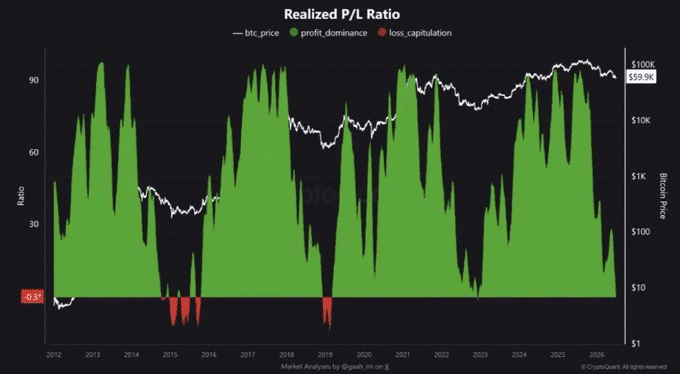
Supporting this view, Bitcoin’s Realized P/L Ratio has fallen to -0.35, its lowest level in 43 months. The indicator measures realized profits against realized losses. A deeply negative reading shows that losses are dominating, signaling widespread capitulation. In previous market cycles, similar levels have often coincided with major Bitcoin bottoms, making the metric a closely watched signal for long-term investors.
@media only screen and (min-width: 0px) and (min-height: 0px) { div[id^="bsa-zone_1774359638628-7_123456"] { min-height: 50px; transition: min-height 0.3s ease; } } @media only screen and (min-width: 640px) and (min-height: 0px) { div[id^="bsa-zone_1774359638628-7_123456"] { min-height: 90px; } }
AD

Bitcoin: Here’s why Bitcoin’s Q3 price rally could face a liquidity test image 0 Source: CryptoQuant

The shift in ETF flows also supports this view, suggesting that selling pressure may be easing. 

In the latest trading session, U.S. spot Bitcoin ETFs recorded $223 million in net inflows, marking a return of institutional demand after recent outflows. Most of the capital flowed into FBTC, which attracted $166 million, followed by ARKB with $91.8 million, indicating that investors are once again allocating capital to BTC through regulated investment vehicles.

This supports the view that Bitcoin may be entering the final stage of its bear cycle. While on-chain data still shows elevated unrealized losses, the return of ETF inflows indicates demand is starting to match supply. If this trend holds, Bitcoin’s $60k support could strengthen, improving the chances of a recovery in Q3. 

However, one key metric highlights that the recovery is not yet fully supported. 

Bitcoin’s recovery hinges on whether liquidity can catch up

The market continues to face a liquidity constraint.

In a typical bull market, stablecoin supply expands as new capital enters the crypto ecosystem. That additional liquidity increases buying power, helping absorb selling pressure and sustain higher prices.

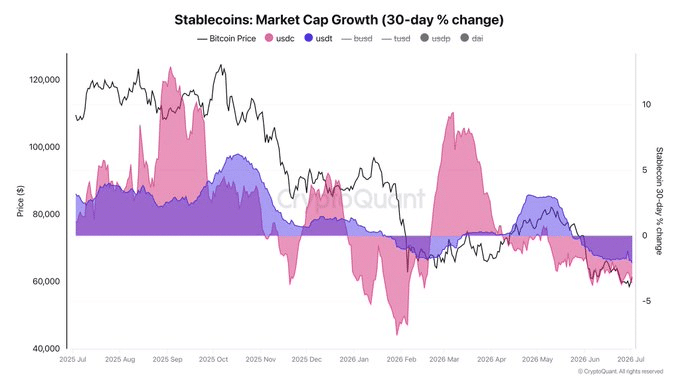
This time, however, the pattern is different. Despite the return of ETF inflows, liquidity continues to contract, with $1 billion+ leaving the market this week alone. Over the past thirty days, the market cap of USDC and USDT have fallen by 3.6% and 2%, respectively, extending a trend that has persisted since November 2025. The divergence suggests that while demand is improving, the market liquidity is not.
Bitcoin: Here’s why Bitcoin’s Q3 price rally could face a liquidity test image 1 Source: CryptoQuant

This makes Bitcoin’s leverage profile increasingly important.

Following the recent deleveraging event, Bitcoin has re-entered the “slight leverage” zone, indicating that traders are rebuilding leveraged positions as confidence in a market bottom grows. However, leverage is increasing while market liquidity continues to contract. 

If stablecoin liquidity continues to decline, there may not be enough spot demand to support the rally. Therefore, Bitcoin could become more vulnerable to a liquidation-driven correction as leveraged positions build.

As a result, Bitcoin’s Q3 rally could struggle to sustain its momentum, leaving it exposed to sharp pullbacks.

Final Summary

  • Bitcoin’s bottom signals are improving as ETF inflows return and on-chain metrics point to easing selling pressure.
  • Weak liquidity remains the biggest risk. If stablecoin flows don’t recover, Bitcoin’s Q3 rally could struggle to hold its momentum.


 

0
0

Disclaimer: The content of this article solely reflects the author's opinion and does not represent the platform in any capacity. This article is not intended to serve as a reference for making investment decisions.

Understand the market, then trade.
Bitget offers one-stop trading for cryptocurrencies, stocks, and gold.
Trade now!

You may also like

Wall Street giants collectively raise rate hike forecasts, US Treasury futures continue to fall, gold drops over 1% to break 4000

After the US October CPI exceeded expectations, Goldman Sachs and Nomura added a forecast for an interest rate hike in March next year, while Deutsche Bank included a forecast for a rate hike in January next year. Currently, the market has fully priced in a 25 basis point rate hike in December, with a 13% probability for a 50 basis point hike. On Wednesday, the US Treasury spot market was closed, but Treasury futures continued to fall, with corresponding yields rising by about 2 to 4 basis points, and spot gold came under pressure, dropping by 1.1%.

华尔街见闻•2026/11/11 21:18
Wall Street giants collectively raise rate hike forecasts, US Treasury futures continue to fall, gold drops over 1% to break 4000

No Need to Worry About the Cooling Down of AI Data Center Construction? The US Import Boom Is Unlikely to Subside in the Short Term, Real Impact May Come in 2029

It takes an average of 4.8 years from finalizing investment to starting construction of a data center project, and an additional 2.6 years from construction start to becoming operational. Servers usually cannot be installed until after the building structure and racks are completed. For trade partners such as Taiwan (China), South Korea, and Mexico who rely on US data center supply chain demand, the inertia in construction timelines provides at least a one- to two-year buffer for future exports.

华尔街见闻•2026/11/11 21:18
No Need to Worry About the Cooling Down of AI Data Center Construction? The US Import Boom Is Unlikely to Subside in the Short Term, Real Impact May Come in 2029

Federal Reserve Major Debate: When Should the Tenure of “Number Three” Williams End?

The main point of contention is whether Williams should step down in June 2028, upon completing a full 10-year term, or in June 2027, when he reaches the mandatory retirement age of 65. Analysts point out that the Federal Reserve Board holds ultimate discretion; if he leaves early, Fed Chair Waller would be able to assert greater control over the appointment to this critical position. However, forcing Williams to shorten his term could easily be interpreted as political manipulation. Williams himself is expected to serve until June 2028.

华尔街见闻•2026/11/11 21:18
Federal Reserve Major Debate: When Should the Tenure of “Number Three” Williams End?

