
After accurately predicting the plunge in "US stock momentum stocks," Goldman Sachs sees signs of "buying the dip"

Goldman Sachs High Beta Momentum Basket (GSPRHIMO) has plunged a cumulative 18% over the past two trading days, marking the largest two-day drop since 2020. This rapid decline reflects the resonance of three pressures: liquidity contraction, excessive position concentration, and seasonal weakness.
Just hours before the crash, Goldman Sachs issued a "summer doldrums" warning, explicitly alerting to the risk of a July momentum factor pullback. Although the magnitude of the current decline has created room for a short-term tactical rebound—historical data shows that buying into momentum factors during pullbacks has often resulted in positive returns.
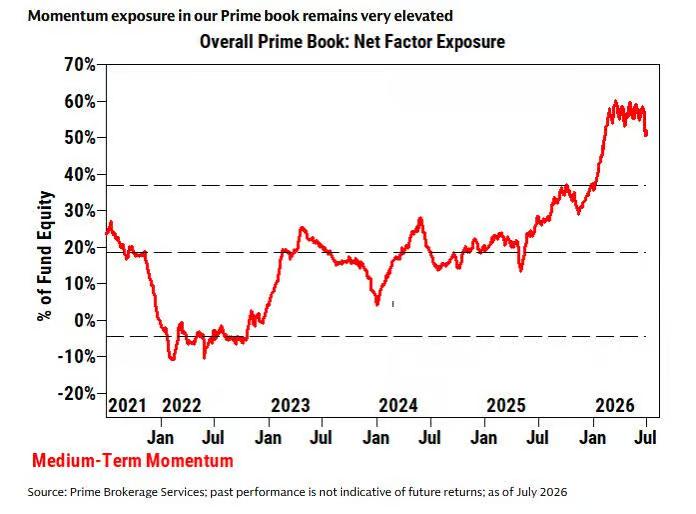
Goldman Sachs’ trading desk also emphasized that momentum factor positions remain extremely crowded. If the deleveraging trend continues, the maximum potential drawdown could still be twice the current loss. Overall, the market is in the early stages of position unwinding for momentum strategies, and the key to subsequent developments lies in the interplay between liquidity conditions and the pace of sentiment recovery.
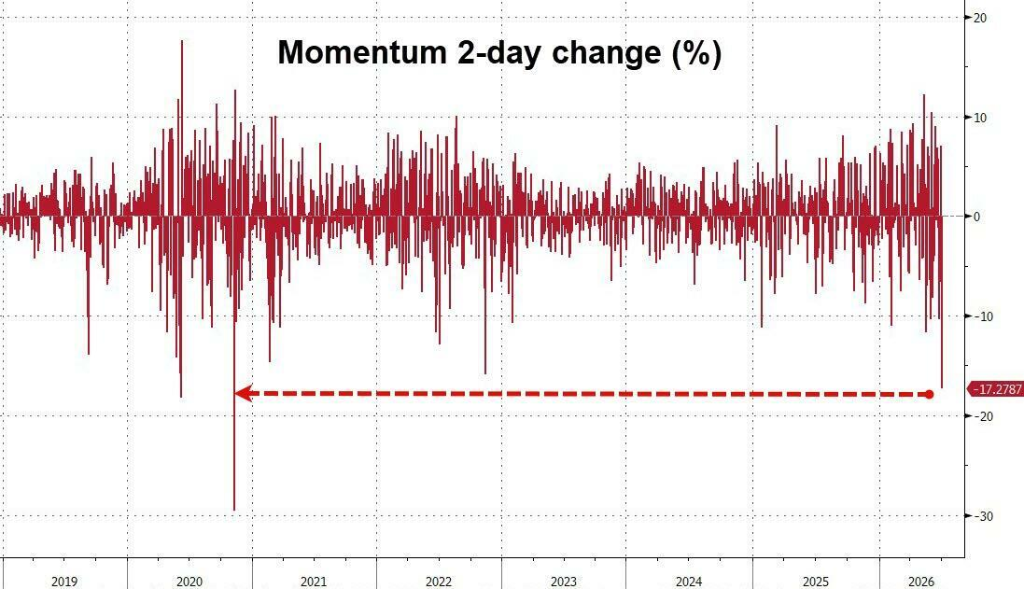
The largest decline in recent years, multiple factors amplify volatility
Goldman Sachs strategist Guillaume Soria stated in the latest report that this round of sharp momentum factor drawdown was not triggered by a single catalyst, but was the result of multiple negative conditions resonating.
Substantial unrealized gains from strong first-half performance, a clear contraction in market liquidity ahead of the holiday weekend, factor volatility soaring to a five-year high, and the quarter-end’s customary position rebalancing pressure have together pushed the adjustment amplitude of high-beta momentum strategies to extreme levels.
Data shows that since its peak, the momentum factor has fallen 24%, marking the largest drawdown since Q1 2023, significantly higher than the historical average of about 12%. In terms of correction duration, the historical average is about 24 days, while the current period has lasted only 10 days.
Notably, the Korean market saw record net foreign outflows during this period, while domestic institutions actively bought in to hedge external selling pressure, reflecting that this round of momentum selling has shown distinct global linkage characteristics.
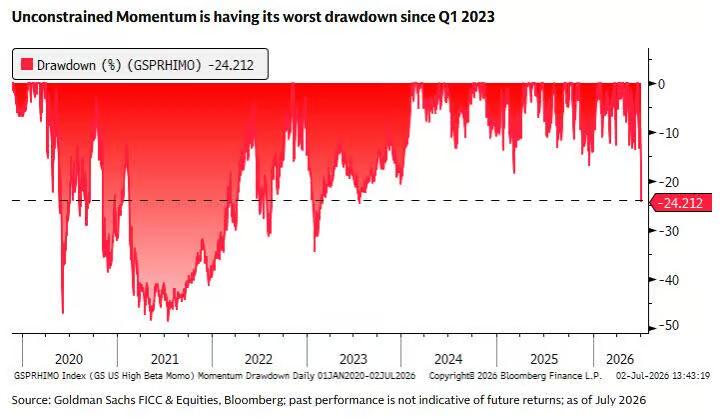
Momentum factors present tactical rebound opportunities, but deleveraging risk and AI narrative uncertainties remain
Goldman Sachs’ trading desk maintains a cautiously optimistic view on the short-term outlook. The bank points out that since 2026, high-beta momentum strategies have repeatedly experienced drops of more than 10% in two days, which were followed by varying degrees of recovery. The current market pattern is highly consistent with previous episodes.
The bank believes that the amplified decline this time is mainly due to structural factors such as low liquidity and weak summer trading, rather than a fundamental shift in underlying trends. Historically, buy-the-dip strategies have seen significantly improved win rates after the Federal Reserve pivoted towards easing (such as during the pandemic).
Goldman Sachs has already detected preliminary buy-the-dip signals, suggesting that momentum factors have a basis for tactical rebounds. But risks must not be overlooked. Despite a sharp pullback, momentum factor positioning remains extremely crowded. Goldman Sachs clearly points out that if the deleveraging process continues, the factor’s potential maximum drawdown could reach 50%, roughly twice the current loss.
At the same time, the momentum factor has still recorded a positive return of about 27% year-to-date, if there is a significant shift in the AI narrative, considerable unrealized gains could still be pressured into realization.
Goldman Sachs specifically mentioned that market doubts about META’s capital expenditure return rate amid its pivot to cloud services are similar to past episodes where such concerns impacted market sentiment. However, the bank’s trading desk currently assesses that there have not yet been enough structural changes in the core AI narrative to drive a deeper correction.
Disclaimer: The content of this article solely reflects the author's opinion and does not represent the platform in any capacity. This article is not intended to serve as a reference for making investment decisions.
You may also like

Wall Street giants collectively raise rate hike forecasts, US Treasury futures continue to fall, gold drops over 1% to break 4000
After the US October CPI exceeded expectations, Goldman Sachs and Nomura added a forecast for an interest rate hike in March next year, while Deutsche Bank included a forecast for a rate hike in January next year. Currently, the market has fully priced in a 25 basis point rate hike in December, with a 13% probability for a 50 basis point hike. On Wednesday, the US Treasury spot market was closed, but Treasury futures continued to fall, with corresponding yields rising by about 2 to 4 basis points, and spot gold came under pressure, dropping by 1.1%.

No Need to Worry About the Cooling Down of AI Data Center Construction? The US Import Boom Is Unlikely to Subside in the Short Term, Real Impact May Come in 2029
It takes an average of 4.8 years from finalizing investment to starting construction of a data center project, and an additional 2.6 years from construction start to becoming operational. Servers usually cannot be installed until after the building structure and racks are completed. For trade partners such as Taiwan (China), South Korea, and Mexico who rely on US data center supply chain demand, the inertia in construction timelines provides at least a one- to two-year buffer for future exports.

Federal Reserve Major Debate: When Should the Tenure of “Number Three” Williams End?
The main point of contention is whether Williams should step down in June 2028, upon completing a full 10-year term, or in June 2027, when he reaches the mandatory retirement age of 65. Analysts point out that the Federal Reserve Board holds ultimate discretion; if he leaves early, Fed Chair Waller would be able to assert greater control over the appointment to this critical position. However, forcing Williams to shorten his term could easily be interpreted as political manipulation. Williams himself is expected to serve until June 2028.

Crypto prices
More


