
BTC, ETH, DOGE: Crypto Prices Continue to Rise to Start the Third Quarter

Cryptocurrency investors have their fingers crossed that the worst of the downturn in digital assets might be coming to an end.
4th of July Sale - 70% Off
- Unlock powerful investing tools and data-driven insights with TipRanks Premium for more confident investment decisions.
- Discover top stock picks and new investment opportunities through TipRanks' Smart Investor Newsletter.
Hope is spreading among crypto bulls as the prices of Bitcoin (BTC), Ethereum (ETH), Dogecoin (DOGE) and other digital tokens continues to rise to begin the year’s third quarter. While the U.S. stock market is closed on July 3, crypto continues to trade, with prices rising further to start the new month and quarter.
In afternoon trading on July 3, BTC was trading at $62,128, having gained 1% in the last 24 hours. Bitcoin’s price is at its highest level in several weeks and back above the key support level of $60,000 that analysts say is critically important for a sustained rally. A week ago, Bitcoin was trading at $58,000, near a two-year low.
Other Digital Assets Rise Too
Other cryptocurrencies are rebounding even more than Bitcoin. Ethereum’s price is up 3% over the past 24 hours to $1,740. And the price of Dogecoin (DOGE) has gained 4% to change hands at $0.08. Heading into the July 4th holiday weekend, crypto prices were gaining ground as investors rotate capital out of high-flying microchip and semiconductor stocks such as Micron Technology (MU).
Adding to the bullish sentiment around crypto is news that exchange-traded funds (ETFs) that track the spot price of Bitcoin have seen an influx of capital following a 10-day losing streak. Bitcoin ETFs attracted $221.7 million of capital on July 2, their biggest inflow in two months, according to market data. The inflows end a difficult 10-day outflow streak that saw investors pull $2.73 billion from the funds.
Institutional investors have been blamed for pulling money from the ETFs as Bitcoin’s price steadily declined this year to a 21-month low of $58,000 at the end of June.
BTC’s Three-Month Performance
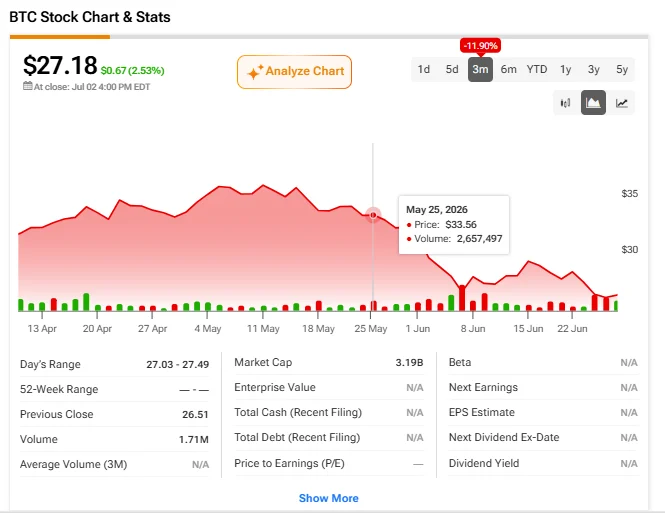
Not enough analysts cover Bitcoin, so we’ll look instead at its three-month performance. As one can see in the chart below, Bitcoin’s price has declined 12% in the past 12 weeks.
Copyright © 2026, TipRanks. All rights reserved.
Disclaimer: The content of this article solely reflects the author's opinion and does not represent the platform in any capacity. This article is not intended to serve as a reference for making investment decisions.
You may also like

Wall Street giants collectively raise rate hike forecasts, US Treasury futures continue to fall, gold drops over 1% to break 4000
After the US October CPI exceeded expectations, Goldman Sachs and Nomura added a forecast for an interest rate hike in March next year, while Deutsche Bank included a forecast for a rate hike in January next year. Currently, the market has fully priced in a 25 basis point rate hike in December, with a 13% probability for a 50 basis point hike. On Wednesday, the US Treasury spot market was closed, but Treasury futures continued to fall, with corresponding yields rising by about 2 to 4 basis points, and spot gold came under pressure, dropping by 1.1%.

No Need to Worry About the Cooling Down of AI Data Center Construction? The US Import Boom Is Unlikely to Subside in the Short Term, Real Impact May Come in 2029
It takes an average of 4.8 years from finalizing investment to starting construction of a data center project, and an additional 2.6 years from construction start to becoming operational. Servers usually cannot be installed until after the building structure and racks are completed. For trade partners such as Taiwan (China), South Korea, and Mexico who rely on US data center supply chain demand, the inertia in construction timelines provides at least a one- to two-year buffer for future exports.

Federal Reserve Major Debate: When Should the Tenure of “Number Three” Williams End?
The main point of contention is whether Williams should step down in June 2028, upon completing a full 10-year term, or in June 2027, when he reaches the mandatory retirement age of 65. Analysts point out that the Federal Reserve Board holds ultimate discretion; if he leaves early, Fed Chair Waller would be able to assert greater control over the appointment to this critical position. However, forcing Williams to shorten his term could easily be interpreted as political manipulation. Williams himself is expected to serve until June 2028.

Crypto prices
More


