
Here’s why LAB price plunged over 60% in a week

LAB price has suffered one of the steepest collapses in the crypto market this week, losing more than 60% of its value as concerns over insider holdings, token transparency, and heavy derivatives liquidations sparked a wave of panic selling.
- LAB price crashed more than 60% in a week as insider ownership concerns triggered panic selling.
- Heavy derivatives liquidations and a 23% drop in open interest accelerated the token’s decline.
- Weak crypto market sentiment and uncertainty over token unlocks added to the selling pressure.
According to crypto.news data, LAB (LAB) plunged to an intraday low of $7.50 on July 3, down more than 60% from its recent high near $20 on June 27. The sell-off erased billions in market value in less than a week as investors rushed to exit amid growing uncertainty surrounding the project’s tokenomics and insider ownership.
The biggest catalyst appears to be mounting concerns over LAB’s token distribution. Community discussions intensified after on-chain investigator ZachXBT previously alleged that insiders controlled more than 95% of the token supply, while also raising concerns over token allocation transparency, private OTC agreements, changing vesting schedules, and large insider wallet movements before major price swings.
These remain public allegations that have not been established in court, and the LAB team has disputed or not publicly accepted many of the claims.
Additional attention came from crypto community member Zetoshi, who summarized the controversy and highlighted LAB’s reported institutional backers, including Animoca Brands, OKX, Lemniscap, GSR, Amber Group, Mirana Ventures, Gate, and KuCoin, although Zetoshi’s suggestion that these relationships explain the lack of public action against the project represents personal opinion rather than verified fact.
Why did the LAB sell-off accelerate so quickly?
Once confidence weakened, technical factors amplified the decline. As LAB broke below major support around the $12 region, leveraged long positions began unwinding rapidly, triggering a liquidation cascade across derivatives markets.
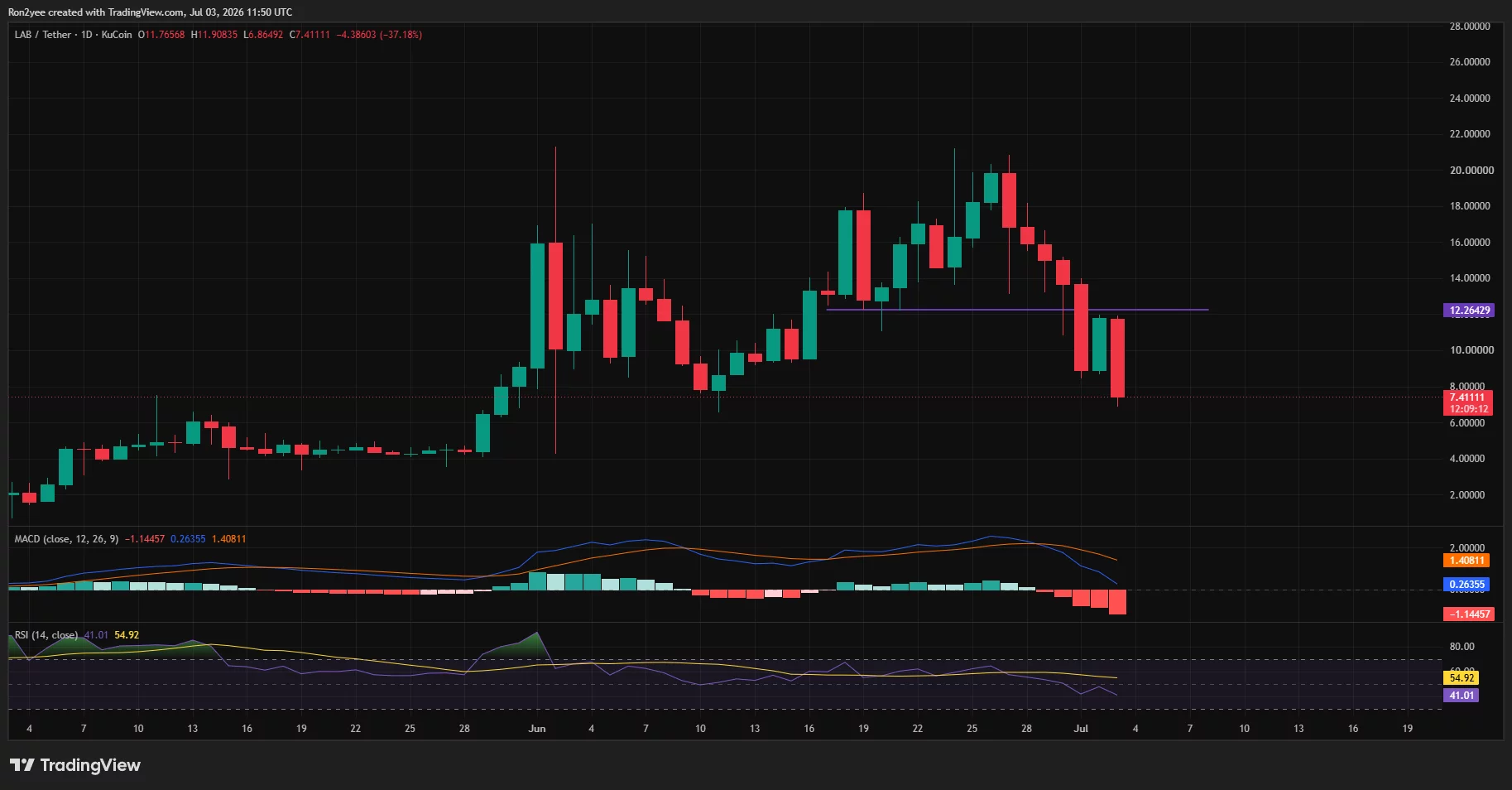 LAB 1-day price chart — July 3 | Source: crypto.news
Open interest dropped roughly 23% to $130.39 million, signaling that traders were closing positions instead of adding fresh bullish bets. At the same time, funding rates turned negative across perpetual futures markets, indicating that bearish traders had taken control and that demand for short exposure outweighed buying interest.
Momentum indicators also reflected the sharp deterioration in sentiment. The MACD histogram expanded further into negative territory, reinforcing the growing downside momentum as automated liquidations and stop-loss orders accelerated the move toward the $7.50 support area.
Could broader market conditions have made the decline worse?
The LAB-specific concerns also coincided with a difficult backdrop for digital assets. During late June and early July, investors broadly reduced exposure to riskier cryptocurrencies as global central banks maintained restrictive monetary policies and capital rotated away from speculative altcoins.
The broader market weakness became an additional headwind as corrections in Bitcoin and Ethereum reduced overall risk appetite. With liquidity already thinning across the altcoin market, LAB’s structural concerns left few buyers willing to absorb heavy selling pressure from early investors and whales taking profits after the token’s remarkable rally from roughly $0.10 to nearly $27 earlier this year.
For now, traders will likely watch whether LAB can stabilize above the $7.50-$7.65 support zone. A sustained recovery may depend not only on improving crypto market sentiment but also on greater transparency from the project regarding token ownership, vesting schedules, and future token unlocks.
Disclaimer: The content of this article solely reflects the author's opinion and does not represent the platform in any capacity. This article is not intended to serve as a reference for making investment decisions.
You may also like

Wall Street giants collectively raise rate hike forecasts, US Treasury futures continue to fall, gold drops over 1% to break 4000
After the US October CPI exceeded expectations, Goldman Sachs and Nomura added a forecast for an interest rate hike in March next year, while Deutsche Bank included a forecast for a rate hike in January next year. Currently, the market has fully priced in a 25 basis point rate hike in December, with a 13% probability for a 50 basis point hike. On Wednesday, the US Treasury spot market was closed, but Treasury futures continued to fall, with corresponding yields rising by about 2 to 4 basis points, and spot gold came under pressure, dropping by 1.1%.

No Need to Worry About the Cooling Down of AI Data Center Construction? The US Import Boom Is Unlikely to Subside in the Short Term, Real Impact May Come in 2029
It takes an average of 4.8 years from finalizing investment to starting construction of a data center project, and an additional 2.6 years from construction start to becoming operational. Servers usually cannot be installed until after the building structure and racks are completed. For trade partners such as Taiwan (China), South Korea, and Mexico who rely on US data center supply chain demand, the inertia in construction timelines provides at least a one- to two-year buffer for future exports.

Federal Reserve Major Debate: When Should the Tenure of “Number Three” Williams End?
The main point of contention is whether Williams should step down in June 2028, upon completing a full 10-year term, or in June 2027, when he reaches the mandatory retirement age of 65. Analysts point out that the Federal Reserve Board holds ultimate discretion; if he leaves early, Fed Chair Waller would be able to assert greater control over the appointment to this critical position. However, forcing Williams to shorten his term could easily be interpreted as political manipulation. Williams himself is expected to serve until June 2028.

Crypto prices
More


