Bitget App
Trade smarter
Buy cryptoMarketsTradeFuturesStocksEarnInstitutionAI & More
Is a CeFi-to-DeFi rotation signaling crypto’s Q3 bottom? The data says…

Is a CeFi-to-DeFi rotation signaling crypto’s Q3 bottom? The data says…

AMBCryptoAMBCrypto2026/07/03 04:03
By:AMBCrypto

FUD hit the crypto market in Q2 following a massive shakeout in TVL. 

Notably, this wasn’t just the result of weaker price action. Instead, back-to-back protocol exploits resulted in more than $600 million in cumulative losses, triggering widespread capital outflows as users rushed to unstake assets and reduce their exposure to DeFi protocols. 

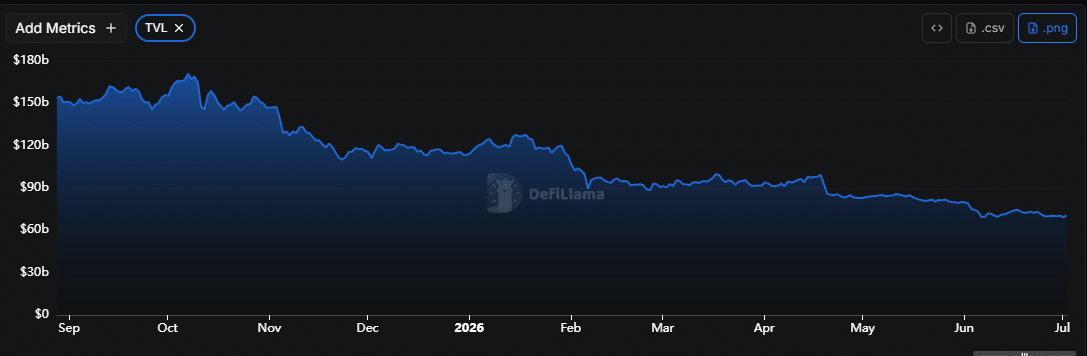
To put the scale of the drawdown into perspective, more than $20 billion exited DeFi protocols during the quarter, pushing total value locked (TVL) down to roughly $70 billion from its pre-October 2025 high of around $150 billion. That represents the sharpest quarter-over-quarter decline in TVL since 2021, highlighting just how quickly market participants shifted into a risk-off stance. 
@media only screen and (min-width: 0px) and (min-height: 0px) { div[id^="bsa-zone_1774359638628-7_123456"] { min-height: 50px; transition: min-height 0.3s ease; } } @media only screen and (min-width: 640px) and (min-height: 0px) { div[id^="bsa-zone_1774359638628-7_123456"] { min-height: 90px; } }
AD

Is a CeFi-to-DeFi rotation signaling crypto’s Q3 bottom? The data says… image 0 Source: DeFiLlama

Aave [AAVE], the largest lending protocol, was a prime example of this trend. 

As AMBCrypto reported, following the KelpDAO exploit, Aave’s TVL dropped roughly 18% to $17.8 billion within 24 hours, as users rapidly withdrew liquidity from the protocol. The selloff wasn’t limited to Aave, though. Fear quickly spread across DeFi, driving liquidity out of other protocols and pushing Ethereum’s TVL down by more than $10 billion. 

Now, however, the trend may be starting to reverse. Aave on Ethereum recently recorded 1,806 new wallet addresses in a single day, its strongest network growth since October 2021. While one day of data isn’t enough to confirm a recovery, it does suggest that interest in DeFi is picking up again. 

Naturally, the question is: Is this the first sign that the market is bottoming ahead of a potential Q3 rally?

DeFi rebounds as stablecoin inflows signal returning risk appetite
 

Stablecoins are often one of the clearest indicators of where capital is flowing.

Notably, that trend is already emerging in Q3. Stablecoin liquidity has been building across several major L1 networks. Solana ended Q2 2026 with a record $16.6 billion in stablecoin supply. Stellar also saw momentum pick up, with its 30-day stablecoin transfer volume rising 32.6%. Cardano is showing a similar pattern. According to DefiLlama, the network’s native stablecoin supply has grown 20%+ over the past week.

Taken together, these metrics paint a clear picture. Stablecoins are moving back on-chain, TVL is beginning to recover, and activity across major DeFi protocols is picking up. That view gains further support from CryptoQuant’s latest report, which showed CeFi lending contracted 6% quarter-over-quarter to $23.3 billion, its first decline since Q3 2024.

Is a CeFi-to-DeFi rotation signaling crypto’s Q3 bottom? The data says… image 1 Source: CryptoQuant

The takeaway is fairly straightforward.

As activity slowed on centralized lending platforms, liquidity appears to be finding its way back into DeFi, suggesting investors are becoming more comfortable deploying capital on-chain again. 

If sustained, this CeFi-to-DeFi rotation could mark one of the first measurable signs that Q2’s risk-off sentiment is fading, potentially laying the groundwork for a broader crypto recovery in Q3.

Final Summary

  • DeFi is showing signs of recovery as stablecoin inflows increase and Aave’s network activity rebounds.
  • Falling CeFi lending and rising on-chain liquidity suggested that capital may be rotating back into DeFi ahead of Q3.

0
0

Disclaimer: The content of this article solely reflects the author's opinion and does not represent the platform in any capacity. This article is not intended to serve as a reference for making investment decisions.

Understand the market, then trade.
Bitget offers one-stop trading for cryptocurrencies, stocks, and gold.
Trade now!

You may also like

Wall Street giants collectively raise rate hike forecasts, US Treasury futures continue to fall, gold drops over 1% to break 4000

After the US October CPI exceeded expectations, Goldman Sachs and Nomura added a forecast for an interest rate hike in March next year, while Deutsche Bank included a forecast for a rate hike in January next year. Currently, the market has fully priced in a 25 basis point rate hike in December, with a 13% probability for a 50 basis point hike. On Wednesday, the US Treasury spot market was closed, but Treasury futures continued to fall, with corresponding yields rising by about 2 to 4 basis points, and spot gold came under pressure, dropping by 1.1%.

华尔街见闻•2026/11/11 21:18
Wall Street giants collectively raise rate hike forecasts, US Treasury futures continue to fall, gold drops over 1% to break 4000

No Need to Worry About the Cooling Down of AI Data Center Construction? The US Import Boom Is Unlikely to Subside in the Short Term, Real Impact May Come in 2029

It takes an average of 4.8 years from finalizing investment to starting construction of a data center project, and an additional 2.6 years from construction start to becoming operational. Servers usually cannot be installed until after the building structure and racks are completed. For trade partners such as Taiwan (China), South Korea, and Mexico who rely on US data center supply chain demand, the inertia in construction timelines provides at least a one- to two-year buffer for future exports.

华尔街见闻•2026/11/11 21:18
No Need to Worry About the Cooling Down of AI Data Center Construction? The US Import Boom Is Unlikely to Subside in the Short Term, Real Impact May Come in 2029

Federal Reserve Major Debate: When Should the Tenure of “Number Three” Williams End?

The main point of contention is whether Williams should step down in June 2028, upon completing a full 10-year term, or in June 2027, when he reaches the mandatory retirement age of 65. Analysts point out that the Federal Reserve Board holds ultimate discretion; if he leaves early, Fed Chair Waller would be able to assert greater control over the appointment to this critical position. However, forcing Williams to shorten his term could easily be interpreted as political manipulation. Williams himself is expected to serve until June 2028.

华尔街见闻•2026/11/11 21:18
Federal Reserve Major Debate: When Should the Tenure of “Number Three” Williams End?


