
Harsh criticism of big AI model giants! Palantir CEO: Their business models have huge problems, they “tax” enterprises without considering corporate risks

Palantir CEO Alex Karp launched a fierce attack against leading AI labs such as OpenAI and Anthropic, directly pointing out fundamental flaws in their business models. He warned that enterprise customers are paying escalating token costs for limited value while putting their core data and intellectual property at risk.
On Wednesday, in a strongly worded interview with CNBC, Karp called the business models of top AI labs "completely crazy," and accused Anthropic and OpenAI of misleading enterprise partners—exaggerating AI risks while selling their most powerful models to enterprises and governments worldwide.
He characterized this phenomenon as enterprises being forced to pay a "wealth tax," effectively giving away their competitive advantage to third parties. When CNBC host Becky Quick commented, "You sound very angry," Karp responded, "That's the voice of American business, and I'm conveying it."
These remarks reflect the growing dissatisfaction among enterprise customers toward American AI labs. Rising costs, questionable investment returns, and increasing regulatory pressures have already driven some major American businesses toward more affordable Chinese alternatives, putting additional pressure on institutions like OpenAI and Anthropic.
“Something Seriously Wrong Somewhere”
Karp targeted the token-based billing model used by Anthropic and OpenAI. "I'm not attacking them specifically, but there’s something seriously wrong somewhere," he said. "Most businesses in this country feel that I'm just burning time and wasting resources on tokens."
He believes that AI labs are heavily promoting powerful models while exaggerating risks, and that enterprise clients are essentially paying a "wealth tax," transferring their "alpha"—i.e., their core competitive advantages—to outside parties. On matters of national security, his language became even stronger: "Are we really going to outsource the country’s battlefields to Silicon Valley’s mainstream consensus? That’s completely crazy."
Nine-Point “AI Sovereignty” Declaration
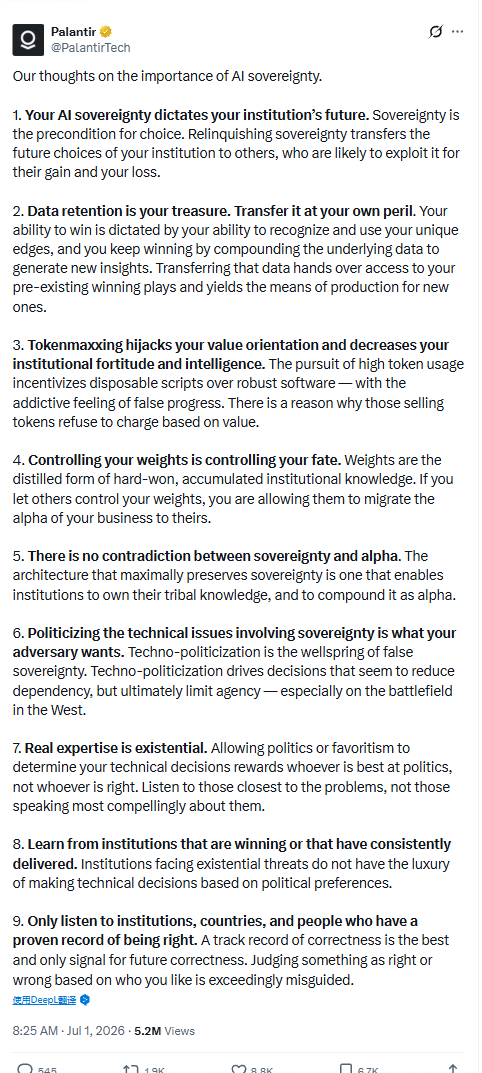
Karp’s public comments are not isolated. Just a day before the interview, Palantir released a nine-point “AI Sovereignty” declaration on X, systematically detailing its critical stance on the current AI ecosystem.
The declaration is centered on "sovereignty": if institutions give up control over their own data, model weights, and competitive advantages, they are handing future choice away to others who will likely profit from it. The declaration points out that the incentives of "tokenmaxxing" lead to disposable scripts rather than robust software systems, and create an “addiction to false progress”—"Those selling tokens refuse to charge based on value, and there is a reason for that."
The declaration also stresses that controlling model weights means controlling the fate of an institution. "Weights are the essence of the knowledge an organization has painstakingly accumulated. If you let others control your weights, you are allowing them to transfer your business alpha to themselves."
Snapshot of the Enterprise “Rebellion” Wave
Karp's criticism is not an isolated case, but rather a concentrated reflection of the broader dissatisfaction among enterprise customers with US AI labs. High usage costs, hard-to-measure actual returns, and increasingly complex regulatory environments are collectively eroding enterprise trust in mainstream AI platforms.
Some major US companies have already begun turning to more cost-effective Chinese AI alternatives, a trend that puts direct commercial pressure on organizations like OpenAI and Anthropic. Palantir’s stance is clear: data should be regarded as a core asset, and AI sovereignty as a prerequisite for institutional survival, rather than entrusting fate to the "consensus judgments" of external platforms.
Disclaimer: The content of this article solely reflects the author's opinion and does not represent the platform in any capacity. This article is not intended to serve as a reference for making investment decisions.
You may also like

Wall Street giants collectively raise rate hike forecasts, US Treasury futures continue to fall, gold drops over 1% to break 4000
After the US October CPI exceeded expectations, Goldman Sachs and Nomura added a forecast for an interest rate hike in March next year, while Deutsche Bank included a forecast for a rate hike in January next year. Currently, the market has fully priced in a 25 basis point rate hike in December, with a 13% probability for a 50 basis point hike. On Wednesday, the US Treasury spot market was closed, but Treasury futures continued to fall, with corresponding yields rising by about 2 to 4 basis points, and spot gold came under pressure, dropping by 1.1%.

No Need to Worry About the Cooling Down of AI Data Center Construction? The US Import Boom Is Unlikely to Subside in the Short Term, Real Impact May Come in 2029
It takes an average of 4.8 years from finalizing investment to starting construction of a data center project, and an additional 2.6 years from construction start to becoming operational. Servers usually cannot be installed until after the building structure and racks are completed. For trade partners such as Taiwan (China), South Korea, and Mexico who rely on US data center supply chain demand, the inertia in construction timelines provides at least a one- to two-year buffer for future exports.

Federal Reserve Major Debate: When Should the Tenure of “Number Three” Williams End?
The main point of contention is whether Williams should step down in June 2028, upon completing a full 10-year term, or in June 2027, when he reaches the mandatory retirement age of 65. Analysts point out that the Federal Reserve Board holds ultimate discretion; if he leaves early, Fed Chair Waller would be able to assert greater control over the appointment to this critical position. However, forcing Williams to shorten his term could easily be interpreted as political manipulation. Williams himself is expected to serve until June 2028.

Crypto prices
More


