
Franc: After the Safe Haven Aura Fades

The "strongest currency in the world," the Swiss franc, has recently encountered some trouble.
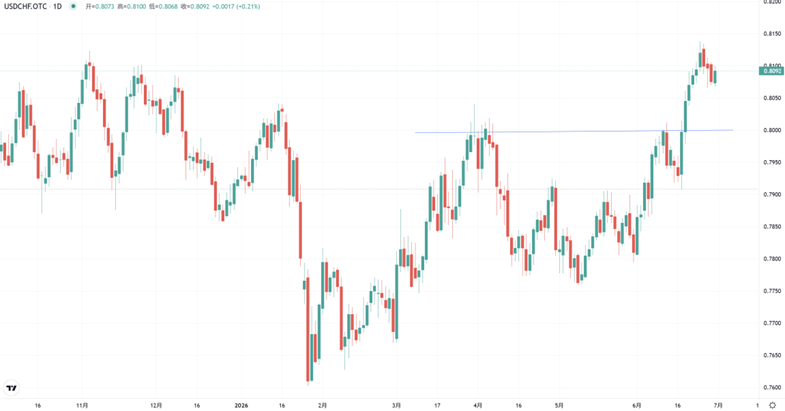
In January this year, USDCHF once fell below 0.78, hitting an 11-year low. At that time, the Middle East was engulfed in warfare and global safe-haven funds flooded into the Swiss franc. The Swiss National Bank was not facing inflation or growth issues, but rather a "happy problem": the local currency was too strong.
However, by June, the situation changed drastically. On June 18th, USDCHF soared past the 0.80 mark, reaching as high as 0.8016, then oscillated between 0.80 and 0.81. In just five months, the Swiss franc depreciated nearly 3% against the US dollar.
Recent USDCHF Trend
What happened? The author believes there are three core drivers:
First, a systemic retreat in safe-haven demand. The US-Iran war, the blockade of the Hormuz Strait, and skyrocketing oil prices—all drove capital into the Swiss franc, the "ultimate safe haven." However, the cease-fire agreement in April, the reopening of the Hormuz Strait, and the sharp decline in oil prices undermined the very foundation of the safe-haven logic. Capital flowed out of safe-haven assets, with the Swiss franc taking the lead.
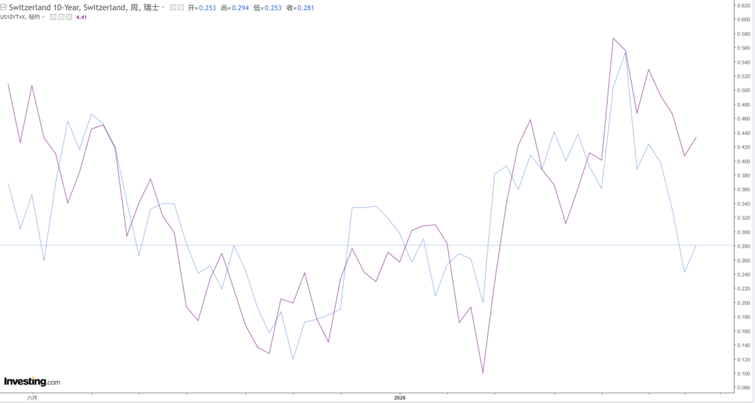
Second, the interest rate differential disadvantage has become increasingly prominent. On June 18th, the Federal Reserve maintained its 3.50%-3.75% rate, and in his first press conference, new chair Walsh further reinforced the hawkish "Higher for Longer" expectations. On the same day, the Swiss National Bank kept its policy rate at 0% as expected, bringing the US-Swiss interest rate differential to over 350 basis points, making the opportunity cost of holding CHF extremely high. When risk-off sentiment subsides, speculative funds naturally flow back to high-yielding currencies.
10Y Swiss Government Bonds (Blue) VS 10Y US Treasuries (Purple)
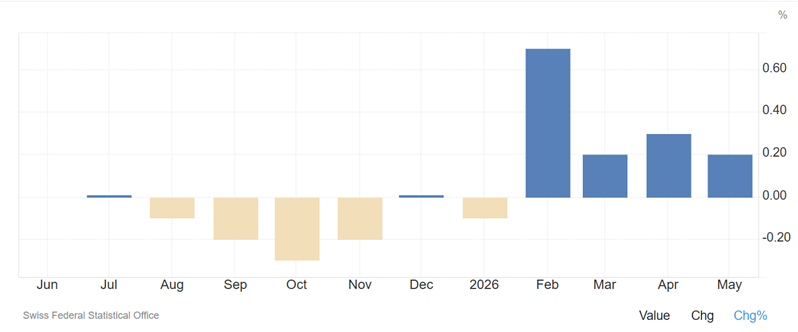
Third, concerns within the Swiss economy itself. In May, CPI was just 0.2%, far from the central bank's 2% upper limit, and even hinting at deflation risks. In its June statement, the Swiss National Bank anchored its 2026-2027 inflation forecasts at 0.6%—in other words, there is no reason to raise rates in the foreseeable future, and they may even welcome a weaker franc if depreciation goes too far. Projected GDP growth is only 1%, meaning Switzerland, the "top performer," is going through a period of sluggish low growth.
Swiss CPI Data Over the Past Year
But will the Swiss franc keep weakening? The author does not believe this is a certainty.
In its June statement, the Swiss National Bank unusually emphasized that it would "intensify foreign exchange interventions when necessary," with the market generally viewing 0.7780-0.7800 as the SNB's implicit intervention threshold. This is a "ceiling" from the franc's perspective and a "floor" from the USDCHF perspective. Looking upward, many institutions have set short-term targets in the 0.82-0.825 range; if US economic data remains robust, reaching this level is very possible.
From a medium-term perspective, it should be noted that the safe-haven properties of the Swiss franc have never disappeared—they're just "dormant." Whenever geopolitical tension resurfaces, the franc could be instantly reactivated as a haven for capital. Moreover, Switzerland's longstanding current account surplus, low government debt, and political stability—these structural advantages have not changed.
For corporate clients with CHF payment or receipt demands, the author suggests that since USDCHF is currently relatively high for the year, it's a favorable window to lock in forwards if you need to buy francs; conversely, if you have CHF income needing to be converted into USD or RMB, there is no rush—you can wait for better rates or settle in batches to smooth out volatility.
To summarize today’s insights:
1. The core drivers behind the recent weakness of the Swiss franc are the fading of risk-off sentiment, a more than 350bp disadvantage in the US-Swiss interest rate differential, and a policy divergence between a hawkish Fed and dovish SNB;
2. USDCHF has already broken through the 0.80 mark, with a short-term target in the 0.82-0.825 range. However, the SNB’s implicit red line at 0.7780-0.7800 limits the downside for the franc;
3. The safe-haven characteristic of the franc is "dormant," not "gone," and could be reactivated by renewed geopolitical or recession risks. Corporate clients should manage FX risk according to their particular pay/receive directions.
Disclaimer: The content of this article solely reflects the author's opinion and does not represent the platform in any capacity. This article is not intended to serve as a reference for making investment decisions.
You may also like

Wall Street giants collectively raise rate hike forecasts, US Treasury futures continue to fall, gold drops over 1% to break 4000
After the US October CPI exceeded expectations, Goldman Sachs and Nomura added a forecast for an interest rate hike in March next year, while Deutsche Bank included a forecast for a rate hike in January next year. Currently, the market has fully priced in a 25 basis point rate hike in December, with a 13% probability for a 50 basis point hike. On Wednesday, the US Treasury spot market was closed, but Treasury futures continued to fall, with corresponding yields rising by about 2 to 4 basis points, and spot gold came under pressure, dropping by 1.1%.

No Need to Worry About the Cooling Down of AI Data Center Construction? The US Import Boom Is Unlikely to Subside in the Short Term, Real Impact May Come in 2029
It takes an average of 4.8 years from finalizing investment to starting construction of a data center project, and an additional 2.6 years from construction start to becoming operational. Servers usually cannot be installed until after the building structure and racks are completed. For trade partners such as Taiwan (China), South Korea, and Mexico who rely on US data center supply chain demand, the inertia in construction timelines provides at least a one- to two-year buffer for future exports.

Federal Reserve Major Debate: When Should the Tenure of “Number Three” Williams End?
The main point of contention is whether Williams should step down in June 2028, upon completing a full 10-year term, or in June 2027, when he reaches the mandatory retirement age of 65. Analysts point out that the Federal Reserve Board holds ultimate discretion; if he leaves early, Fed Chair Waller would be able to assert greater control over the appointment to this critical position. However, forcing Williams to shorten his term could easily be interpreted as political manipulation. Williams himself is expected to serve until June 2028.

Crypto prices
More


