
US Market Shift: From "Compute" to "Storage," Up 764% in 6 Months! S&P 500 Top 10 Revealed: AI Storage Chain Dominates, Q2 Hits 4-Year High.
 2026/07/02 23:56
I. Q2 Explosion: S&P 500 Delivers Strongest Quarterly Performance Since 2020
The S&P 500 rose approximately 9% in the first half of the year. Although geopolitical tensions (related to Iran) caused volatility in Q1, the index rebounded strongly in Q2 with a quarterly gain of around 15%—its best performance since 2020. The index successfully breached key psychological barriers at 7,000 and 7,500 points, signaling a significant回暖 in market confidence.
Broadly speaking, 62% of constituent stocks posted positive returns. This rally was not driven by a handful of mega-caps but featured broader market participation compared previous highly concentrated trends.
In short, this performance was fueled by better-than-expected corporate earnings and substantial upward revisions to EPS forecasts by analysts, rather than mere speculative sentiment.
II. Clear Driving Logic: AI Data Center "Storage Power" Demand Skyrockets Storage and Hardware Stocks
Unlike the previous rally led by Mag7 software giants, this wave of gains was concentrated in the underlying hardware infrastructure of AI, particularly storage, memory, and supporting equipment. As AI model training, inference, and practical applications require massive data access, storage speed and capacity have become critical bottlenecks, leading to a collective surge in related stocks.
The top ten performers were dominated by IT and tech stocks:
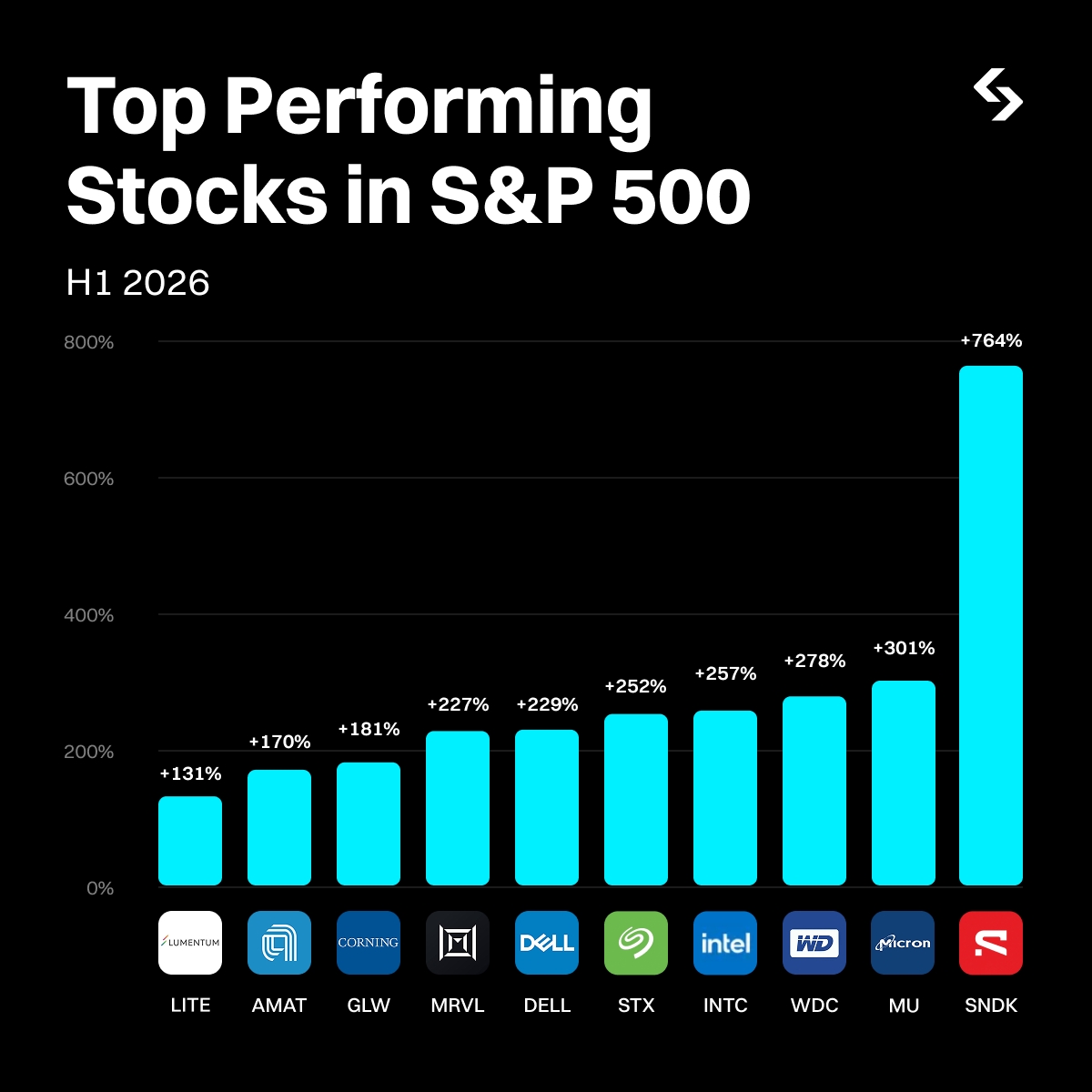
- SanDisk (SNDK): +764% (Enterprise SSD market share rose to 8%; triple-level and quad-level cell memory technologies landed)
- Micron (MU): +301%
- Western Digital (WDC): +278%
- Intel (INTC): +257%
- Seagate (STX): +252%
- Dell (DELL): +229%
- Marvell (MRVL): +227%
- Followed by Applied Materials (AMAT): +170% and Lumentum (LITE): +131%.
While the previous cycle chased GPU computing power, this round saw a catch-up surge across the entire supply chain—including memory, SSDs, HDDs, servers, and semiconductor equipment—with profit expectations significantly revised upward (e.g., SanDisk’s EPS forecast was上调 nearly 10-fold). Beyond the storage chain, the energy sector also performed strongly due to geopolitical factors, becoming one of the best-performing sectors in H1.
III. Key Catalysts Investors Are Watching in H2
Market focus in the second half will center on several key issues:
- Q2 Earnings Season: Kicking off in mid-to-late July, can these AI hardware companies continue to deliver impressive numbers and validate the sustainability of demand?
- Hyperscaler Capex: Will tech giants like Microsoft, Google, Amazon, and Meta maintain high-intensity AI capital expenditure plans, or will there be marginal slowdowns?
- Infrastructure Bottlenecks: Can power supply, cooling systems, and supply chain constraints facing large-scale data center construction be effectively resolved? These issues may cap growth potential.
Additionally, macroeconomic data (such as employment and inflation), the Federal Reserve’s interest rate path, and broader evidence of AI implementation and ROI in enterprise settings will directly impact risk appetite.
Overall, although valuations have been partially digested by earnings revisions (S&P 500 forward P/E is approx. 20.3), structural opportunities within the AI theme remain. It is advisable to focus on supply chain stocks with high order visibility and solid fundamentals, while avoiding pure concept speculation.
Summary
The market’s real gains in the first half tell us that AI has moved from the conceptual stage to a period of tangible infrastructure investment. The storage and semiconductor equipment chains have emerged as the biggest winners due to explosive rigid demand.
While short-term volatility remains inevitable (due to geopolitics, macro data, etc.), supply chain opportunities driven by technological progress are worth tracking for the medium to long term.
Investors are advised to monitor these themes dynamically according to their risk preferences to capture structural market opportunities!
Disclaimer: The content of this article solely reflects the author's opinion and does not represent the platform in any capacity. This article is not intended to serve as a reference for making investment decisions.
You may also like
Wall Street giants collectively raise rate hike forecasts, US Treasury futures continue to fall, gold drops over 1% to break 4000
After the US October CPI exceeded expectations, Goldman Sachs and Nomura added a forecast for an interest rate hike in March next year, while Deutsche Bank included a forecast for a rate hike in January next year. Currently, the market has fully priced in a 25 basis point rate hike in December, with a 13% probability for a 50 basis point hike. On Wednesday, the US Treasury spot market was closed, but Treasury futures continued to fall, with corresponding yields rising by about 2 to 4 basis points, and spot gold came under pressure, dropping by 1.1%.

No Need to Worry About the Cooling Down of AI Data Center Construction? The US Import Boom Is Unlikely to Subside in the Short Term, Real Impact May Come in 2029
It takes an average of 4.8 years from finalizing investment to starting construction of a data center project, and an additional 2.6 years from construction start to becoming operational. Servers usually cannot be installed until after the building structure and racks are completed. For trade partners such as Taiwan (China), South Korea, and Mexico who rely on US data center supply chain demand, the inertia in construction timelines provides at least a one- to two-year buffer for future exports.

Crypto prices
More


