
IMF says tokenization could transform settlement and financial stability

The International Monetary Fund (IMF) says tokenization could fundamentally reshape how financial markets operate, marking one of the strongest acknowledgments yet from a global policymaker that blockchain-based infrastructure is moving into the financial mainstream.
In a blog published Thursday, Tobias Adrian, the IMF’s financial counselor and director of its Monetary and Capital Markets Department, said tokenization is more than a niche crypto innovation. By bringing assets, settlement and recordkeeping onto a shared ledger, tokenization could compress today’s multi-day settlement process into near-instant transactions.
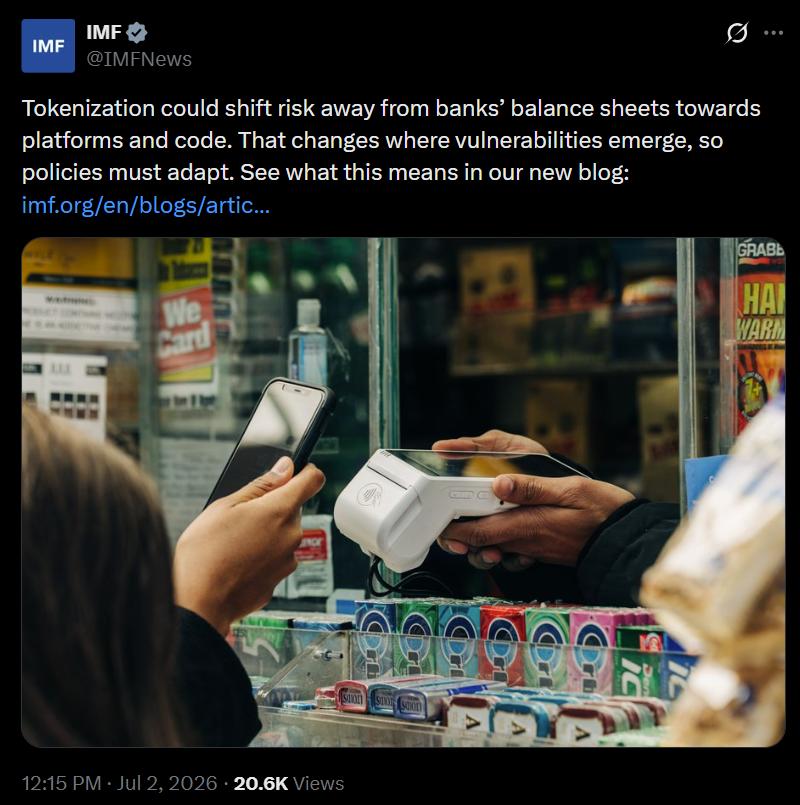
Adrian also warned that tokenization shifts risks away from traditional financial intermediaries and toward the underlying infrastructure, including smart contracts, distributed ledgers and service providers. Without common standards and coordinated regulation, tokenized financial markets could become fragmented across incompatible platforms, creating new sources of systemic risk.
The report comes as financial institutions accelerate efforts to integrate tokenization into traditional markets. The Clearing House, whose owners include JPMorgan Chase, Bank of America, and Barclays, reportedly plans to launch a tokenized deposit network in early 2027 to keep deposits within the regulated banking system while enabling faster, programmable payments.
The IMF’s assessment aligns with recent research from PwC, which found that tokenization could address longstanding inefficiencies in traditional finance, including payment settlement and the transfer of asset ownership. It also follows a May report from Moody’s showing that traditional financial institutions are actively preparing for a shift toward tokenized finance.
Related: Tokenization makes finance more efficient but introduces risks: IMF
Regulators race to define tokenized finance
The IMF report emphasized the growing role of regulators in shaping tokenized finance. Adrian said policymakers have a narrow window to determine how tokenized markets evolve, arguing that decisions on settlement assets, governance, interoperability and the role of central banks will help determine whether tokenization makes the financial system more efficient or introduces new systemic risks.
In the United States, the Securities and Exchange Commission has taken steps to clarify how existing securities laws apply to tokenized assets rather than creating a separate regulatory framework.

The agency has also signaled it is considering an “innovation exemption” that could allow market participants to test blockchain-based trading platforms for tokenized securities while a longer-term regulatory framework is developed.
Magazine: Can Robinhood or Kraken’s tokenized stocks ever be truly decentralized?
Disclaimer: The content of this article solely reflects the author's opinion and does not represent the platform in any capacity. This article is not intended to serve as a reference for making investment decisions.
You may also like

Wall Street giants collectively raise rate hike forecasts, US Treasury futures continue to fall, gold drops over 1% to break 4000
After the US October CPI exceeded expectations, Goldman Sachs and Nomura added a forecast for an interest rate hike in March next year, while Deutsche Bank included a forecast for a rate hike in January next year. Currently, the market has fully priced in a 25 basis point rate hike in December, with a 13% probability for a 50 basis point hike. On Wednesday, the US Treasury spot market was closed, but Treasury futures continued to fall, with corresponding yields rising by about 2 to 4 basis points, and spot gold came under pressure, dropping by 1.1%.

No Need to Worry About the Cooling Down of AI Data Center Construction? The US Import Boom Is Unlikely to Subside in the Short Term, Real Impact May Come in 2029
It takes an average of 4.8 years from finalizing investment to starting construction of a data center project, and an additional 2.6 years from construction start to becoming operational. Servers usually cannot be installed until after the building structure and racks are completed. For trade partners such as Taiwan (China), South Korea, and Mexico who rely on US data center supply chain demand, the inertia in construction timelines provides at least a one- to two-year buffer for future exports.

Crypto prices
More


