Bitget App
Trade smarter
Buy cryptoMarketsTradeFuturesStocksEarnInstitutionAI & More
TRON hits 385M transactions, goes quantum-ready – Can TRX keep up?

TRON hits 385M transactions, goes quantum-ready – Can TRX keep up?

AMBCryptoAMBCrypto2026/07/02 15:03
By:AMBCrypto

TRON could be emerging as one of the strongest Layer 1 contenders heading into Q3.

From a technical perspective, TRX closed June down 10.35%, largely in line with the broader market’s risk-off move that erased $500 billion from the market. Even so, its relative strength stood out.

Despite Solana benefiting from renewed interest in tokenized assets following the SPCX launch, TRX still outperformed SOL.

@media only screen and (min-width: 0px) and (min-height: 0px) { div[id^="bsa-zone_1774359638628-7_123456"] { min-height: 50px; transition: min-height 0.3s ease; } } @media only screen and (min-width: 640px) and (min-height: 0px) { div[id^="bsa-zone_1774359638628-7_123456"] { min-height: 90px; } }
AD

That resilience becomes even more compelling when viewed alongside TRON’s on-chain data. As the chart below shows, the network processed 385.77 million transactions and recorded 26.97 million active accounts in June, both new monthly records, according to Lookonchain.
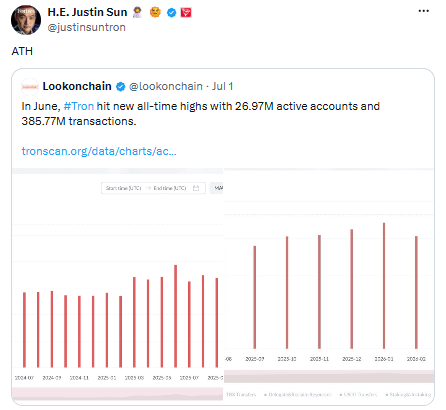
TRON hits 385M transactions, goes quantum-ready – Can TRX keep up? image 0 Source: X

Notably, the momentum was just as evident on a daily basis. 

On the 10th of June, TRON processed 14.55 million transactions and recorded 5.8 million active accounts, both all-time daily highs, according to Tronscan. With activity reaching record levels across the board, many in the market are calling June Tron’s “strongest month” on record. 

And it doesn’t look like a one-off spike.

According to DeFiLlama, TRON [TRX] has once again pulled ahead of Ethereum [ETH] in USDT transfer volume. The network now hosts over $86 billion in USDT, more than any other blockchain, reinforcing Tron’s role as one of crypto’s largest settlement layers. 

With the market starting to tilt back into a risk-on phase, TRON looks well-positioned to extend this momentum into the second half of the year.

In that context, Tron’s recent quantum upgrade also stands out as a forward-looking move, strengthening its positioning among competing L1s as the cycle develops. 

Quantum resistance adds a new layer to TRON’s utility story 

As a Layer 1 network, TRON’s growth is no longer just about on-chain activity.

The focus is shifting toward long-term security, with quantum resistance becoming a major trend across L1s in 2026. Networks like Solana [SOL] have already sparked interest with their post-quantum roadmap.

TRON now looks to be following the same direction. 

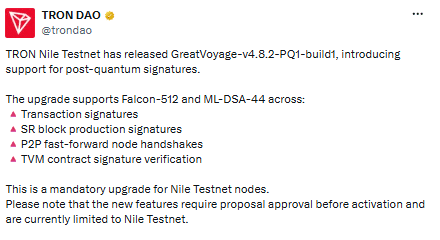
Notably, the TRON Nile Testnet has launched GreatVoyage-v4.8.2-PQ1-build1, adding support for post-quantum signatures. The upgrade includes Falcon-512 and ML-DSA-44, covering transactions, block production, node communication, and contract verification. It is currently live on the Nile Testnet and still needs governance approval before any mainnet rollout.
TRON hits 385M transactions, goes quantum-ready – Can TRX keep up? image 1 Source: X

From an investor’s point of view, this move signals TRON is getting ahead of the curve on long-term security.

Sure, it’s still in the testnet phase, but the push into post-quantum infrastructure adds a stronger long-term narrative to TRON’s ecosystem. The timing also looks intentional, given TRX’s strong on-chain activity and steady stablecoin flows, which continue to reinforce network usage and demand. 

Hence, TRON’s edge is no longer just about technical. Instead, it’s increasingly tied to its fundamental roadmap as well, putting the network in a relatively strong position heading into H2.

Final Summary

  • TRON held up well in a weak market, with record on-chain activity and strong USDT usage supporting its L1 strength.
  • Its move toward quantum resistance adds a long-term upgrade narrative, improving its H2 outlook among Layer 1s.


0
0

Disclaimer: The content of this article solely reflects the author's opinion and does not represent the platform in any capacity. This article is not intended to serve as a reference for making investment decisions.

Understand the market, then trade.
Bitget offers one-stop trading for cryptocurrencies, stocks, and gold.
Trade now!

You may also like

Wall Street giants collectively raise rate hike forecasts, US Treasury futures continue to fall, gold drops over 1% to break 4000

After the US October CPI exceeded expectations, Goldman Sachs and Nomura added a forecast for an interest rate hike in March next year, while Deutsche Bank included a forecast for a rate hike in January next year. Currently, the market has fully priced in a 25 basis point rate hike in December, with a 13% probability for a 50 basis point hike. On Wednesday, the US Treasury spot market was closed, but Treasury futures continued to fall, with corresponding yields rising by about 2 to 4 basis points, and spot gold came under pressure, dropping by 1.1%.

华尔街见闻•2026/11/11 21:18
Wall Street giants collectively raise rate hike forecasts, US Treasury futures continue to fall, gold drops over 1% to break 4000

No Need to Worry About the Cooling Down of AI Data Center Construction? The US Import Boom Is Unlikely to Subside in the Short Term, Real Impact May Come in 2029

It takes an average of 4.8 years from finalizing investment to starting construction of a data center project, and an additional 2.6 years from construction start to becoming operational. Servers usually cannot be installed until after the building structure and racks are completed. For trade partners such as Taiwan (China), South Korea, and Mexico who rely on US data center supply chain demand, the inertia in construction timelines provides at least a one- to two-year buffer for future exports.

华尔街见闻•2026/11/11 21:18
No Need to Worry About the Cooling Down of AI Data Center Construction? The US Import Boom Is Unlikely to Subside in the Short Term, Real Impact May Come in 2029

Federal Reserve Major Debate: When Should the Tenure of “Number Three” Williams End?

The main point of contention is whether Williams should step down in June 2028, upon completing a full 10-year term, or in June 2027, when he reaches the mandatory retirement age of 65. Analysts point out that the Federal Reserve Board holds ultimate discretion; if he leaves early, Fed Chair Waller would be able to assert greater control over the appointment to this critical position. However, forcing Williams to shorten his term could easily be interpreted as political manipulation. Williams himself is expected to serve until June 2028.

华尔街见闻•2026/11/11 21:18
Federal Reserve Major Debate: When Should the Tenure of “Number Three” Williams End?


