
Solana Foundation launches framework for protocol-level governance

The Solana Foundation, the Swiss organization that supports the Solana network’s development, launched a new framework for protocol-level governance that enables proposing and voting on governance decisions for the Solana blockchain.
The Solana Governance Proposals (SGPs) establish a standard that enables validators to submit core protocol proposals and vote onchain, with voting power based on their delegated Solana (SOL) stake, the Foundation announced in a Thursday X post.
“An SGP captures a stake-weighted directional decision. It records what the community wants. It is not strictly focused on the technical detail of how to build the feature,” according to the GitHub repository, launched on Thursday.
The new framework offers Solana a transparent, community-driven way to make major protocol decisions, reducing reliance on centralized coordination while keeping technical implementations, or Solana Improvement Documents (SIMDs), separate from community governance.
Other blockchain networks with similar stake-weighted governance mechanisms include Polkadot, Cosmos, Cardano, Tezos and Avalanche.
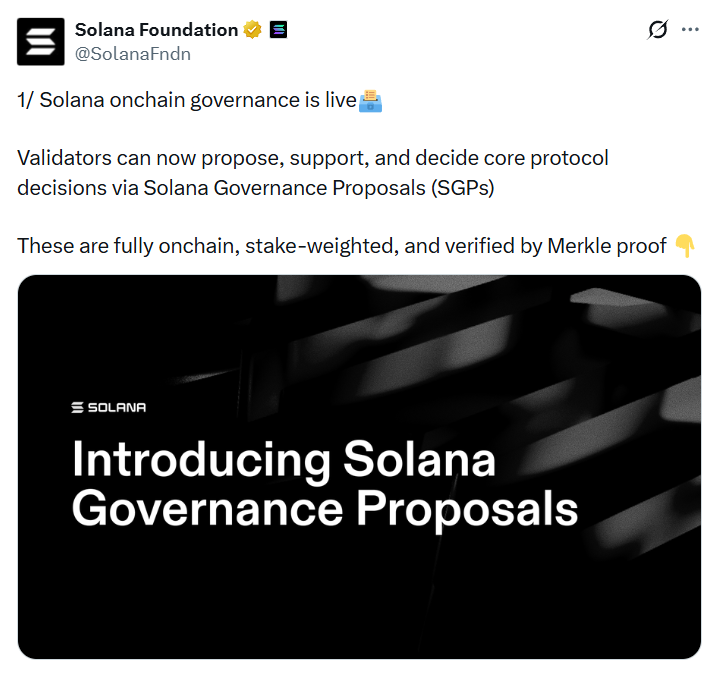
Source: Solana Foundation on X.com
Proposals require minimum 15% support
A proposal must receive endorsements from validators representing at least 15% of actively staked Solana tokens to qualify for a formal onchain vote, a measure that seeks to filter out low-quality proposals.
Validators with at least 100,000 SOL delegated can open a new governance proposal via SGP. SOL stakers can delegate their stake to validators, allowing them to participate in the governance process on their behalf.
Delegators who disagree with how their validator has voted can now override the validator and submit their own vote on the proposal, hence overriding the validator’s vote for that proposal.
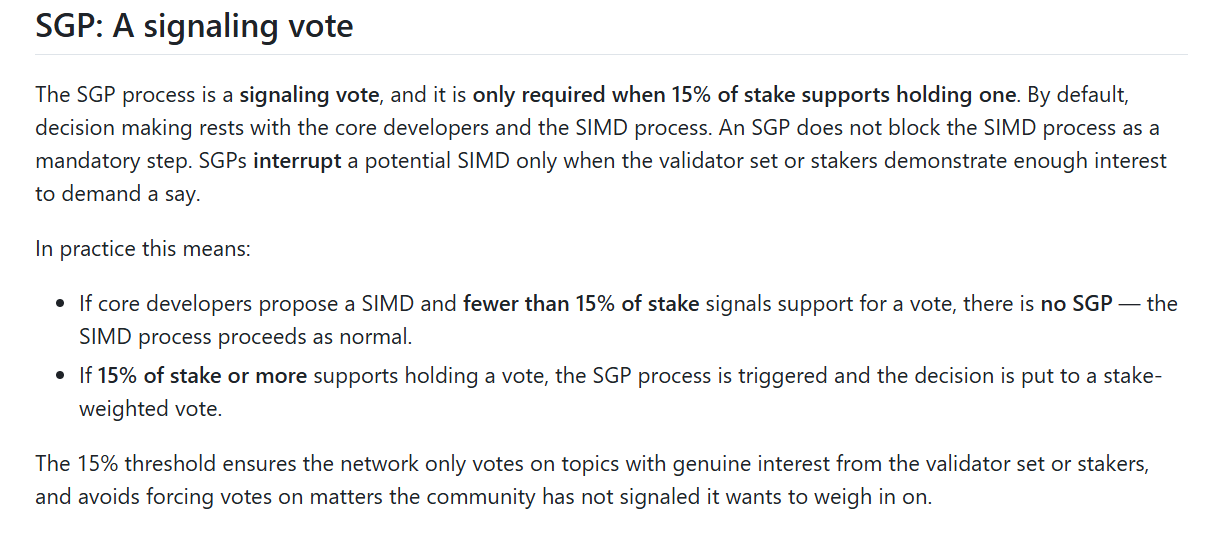
SGP voting information, minimum threshold. Source:
The Solana Foundation said that governance-level proposals will be SGPs, while smaller SIMD proposals will focus on technical protocol upgrades.
“SIMDs should focus on protocol changes, SGPs should be signals from the ecosystem,” wrote the Foundation.
Related:
In April, the Solana Foundation introduced a new security auditing framework and incident-response network for Solana-based protocols, in partnership with Web3 security firm Asymmetric Research.
The new initiative, the Solana Trust, Resilience and Infrastructure for DeFi Enterprises (STRIDE), is a “structured program for evaluating, monitoring and escalating security across Solana projects,” according to the April announcement.
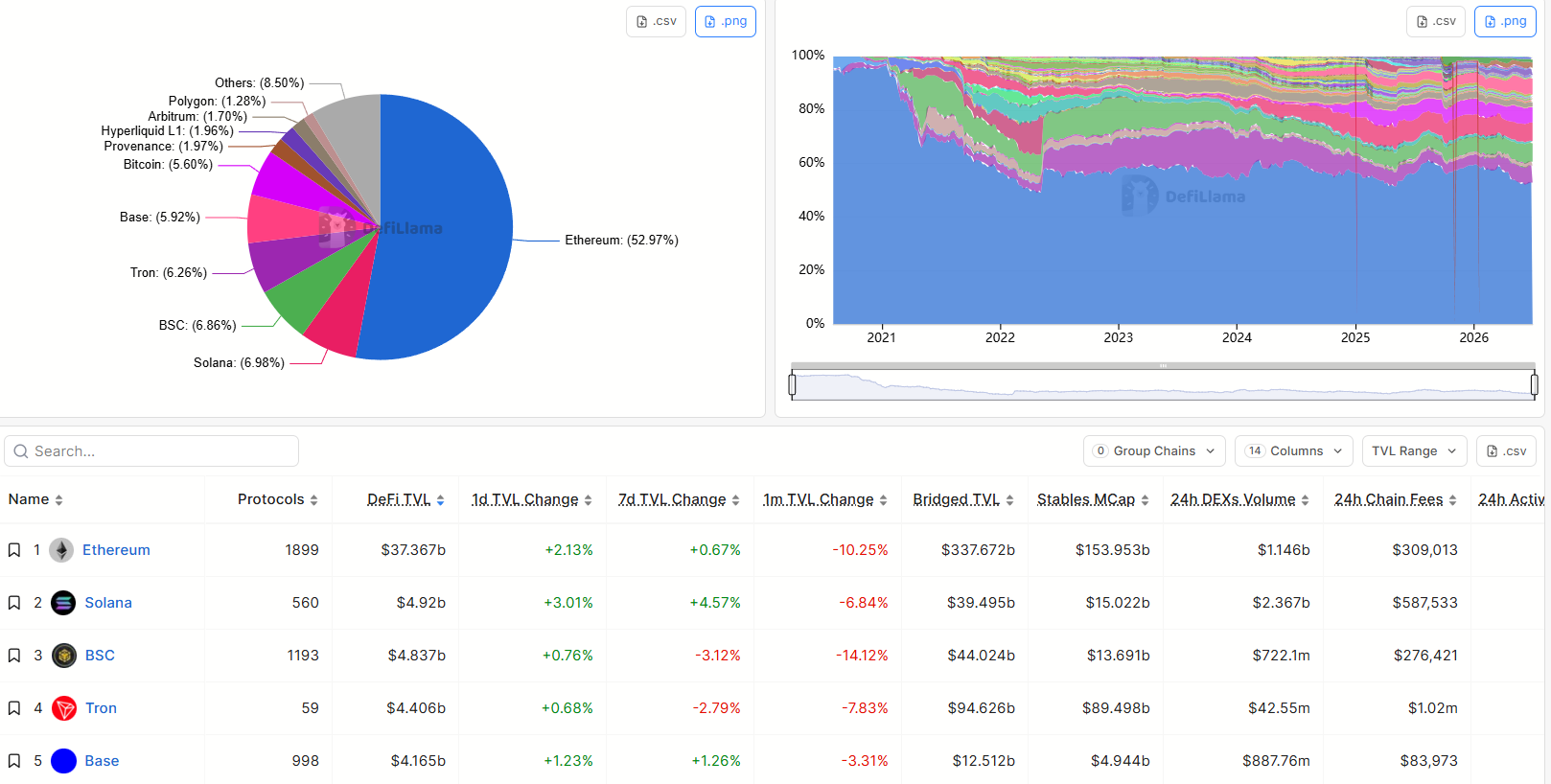
Top blockchain networks by TVL. Source: DefiLlama
Solana ranks as the second-largest blockchain network with $4.92 billion in total value locked (TVL), behind Ethereum's $37.3 billion. Solana generated over $587,000 in blockchain fees during the past 24 hours.
Magazine:
Disclaimer: The content of this article solely reflects the author's opinion and does not represent the platform in any capacity. This article is not intended to serve as a reference for making investment decisions.
You may also like
After the Midterm Election Turbulence, the US Dollar Stabilizes: Strategists Say Core Support Remains, Options Market Signals Bullish Sentiment
Forex strategists say that although the US midterm election results briefly weighed on the dollar, the factors driving the dollar's strength over the past few months have remained largely unchanged.

Major capital shift! Investors in Hong Kong and parts of Shanghai turn bearish on storage
A Bank of America roadshow indicates that Hong Kong investors have become noticeably bearish on storage stocks, with some having already reduced their holdings early. Meanwhile, after visiting Shanghai, analyst Jukan straightforwardly stated he has "lost the conviction to hold"—local veteran investors pointed out that even if the P/E ratio of storage stocks is only 3, should prices fall below the LTA in 2028 and trigger a default, the actual valuation would soar to 7.8 to 10 times, which is not cheap.
After the "bloodbath" in tech stocks, Anthropic IPO faces a crisis: Is it still worth $1.5 trillion? Should it go public at this moment?
As $2.5 trillion was wiped out from tech stocks in a single day, the IPO plans of AI star Anthropic are on shaky ground. Three major investors have explicitly questioned the $1.5 trillion target valuation, with some parties believing its actual value is closer to $1 trillion. Doubts have also emerged over whether the November roadshow will proceed as planned. Ongoing losses, missing key revenue data, and sudden shifts in AI policy—all add up to multiple headwinds, causing this listing, once poised to set the record for the largest IPO in history, to now face three tough choices: a discounted valuation, a reduced offering, or outright postponement.
Crypto prices
More


