
HSBC warns of "black swan" events in the FX market in the second half of the year! The US dollar's "explosive" rally could become the biggest pain trade

HSBC Holdings Plc stated that the sharp appreciation of the US dollar could become one of the biggest “pain trades” in the second half of the year.
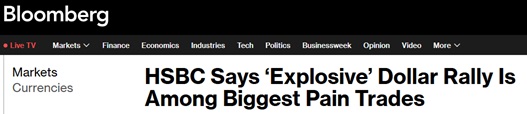
(Screenshot source: Bloomberg)
The bank forecasts that the dollar will gradually strengthen until the first half of 2027, but if the Federal Reserve signals that its rate hikes may exceed market expectations, or if geopolitical tensions escalate again, this rally could become “explosive.”
Since the Federal Reserve’s June meeting, such risks have increased; at the time, policymakers kept their focus squarely on inflation with little forward guidance, prompting the market to refocus on interest rate differentials and driving the dollar to strengthen against all major currencies over the past two weeks.
The HSBC analyst team, including Paul Mackel, wrote in a June 29 report: “The strengthening of the dollar will bring pain, but we believe the ‘pain trade’ in the FX market may manifest as an even more explosive period of dollar appreciation.”
The Bloomberg Dollar Index climbed to a seven-month high earlier in June, buoyed by hawkish signals from the Federal Reserve and robust US economic data.
Meanwhile, tightening expectations in other economies are fading: Europe’s outlook has weakened due to falling oil prices, and the yen has dropped to a 40-year low as the market fears Japan’s government wants the Bank of Japan to slow its pace of rate hikes.
Bullish sentiment on the dollar is also rising in speculative markets, with hedge funds pushing net long bets on the dollar to a 16-month high, indicating investors are increasingly expecting the dollar to keep rising.
Another “pain trade” flagged by HSBC comes from a reversal in the US Treasury market. At the start of this year, markets widely expected Federal Reserve rate cuts to steepen the yield curve, but due to stubborn inflation, a strong labor market, and the Fed’s hawkish stance, the curve has instead flattened.
The yield on the two-year Treasury, most sensitive to Fed policy, has risen by more than 60 basis points this year, compared to just about 20 basis points for the 10-year yield.
Bloomberg strategist Kristine Aquino stated: “While the strength of the dollar against most G10 currencies this year is undeniable, its upward path could be volatile.”
Disclaimer: The content of this article solely reflects the author's opinion and does not represent the platform in any capacity. This article is not intended to serve as a reference for making investment decisions.
You may also like
CoreWeave's surge gives AI cloud a breather, now all eyes are on the Anthropic IPO and Nvidia
CoreWeave’s Q3 revenue and guidance both exceeded expectations, with its stock price surging 25% in a single day and the new cloud sector soaring over 12%. Reports of Anthropic’s potential $1.5 trillion IPO valuation, OpenAI’s quarterly revenue surpassing $10 billion for the first time, and these three positive catalysts together have boosted confidence in the AI computing power industry chain, which was previously troubled by doubts about AI returns. Next week’s Nvidia earnings report and Anthropic’s IPO will be the true test of whether this rally can continue.
AI Computing Power and Semiconductors Stage a Strong Rebound—Why Is Wall Street Cautious About U.S. Stocks? Key Indicators Reveal the Bottom Hasn't Been Reached
The sharp volatility in the US stock market has prompted investors to carefully analyze various data to determine whether the sell-off has ended. Early indicators suggest that it may be too soon to declare that the market has resumed its normal upward trajectory.
Nvidia (NVDA.US) Governance Crisis Escalates: Jensen Huang Exposed for Another Affair, Board Considers Dismissal, and Wall Street Begins Pricing in a “No Jensen” Scenario
The world's most valuable semiconductor company is experiencing the most severe corporate governance crisis since its establishment.
Crypto prices
More


