
Financial companies join forces for US dollar stablecoin, keeping reserve earnings

More than 140 companies have signed onto a US dollar-pegged stablecoin project that allows them to “receive all of the earnings” from its reserves.
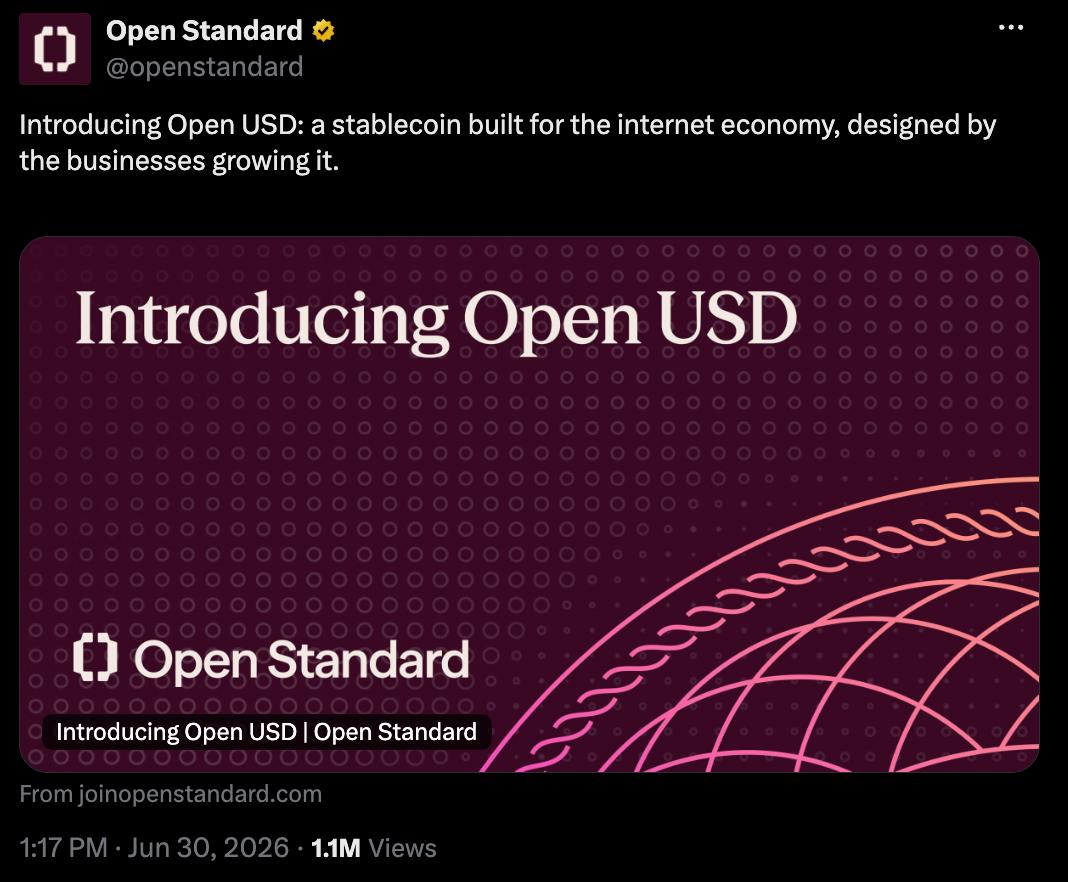
In a Tuesday notice, Open Standard said it was launching the Open USD (OUSD) stablecoin, a US dollar-pegged coin supported by financial companies including Visa and Mastercard, as well as crypto companies Coinbase, Ripple, OKX and Bybit. The project will allow businesses to mint OUSD “at no cost and with no artificial limits on volume,” and keep earnings from the coin’s reserves.
“When Visa, Stripe, Mastercard, Coinbase and Google coordinate on a new stablecoin, the signal is unmistakable,” said Rhino.fi co-founder and CEO Will Harborne. “Open USD is the first launch with a real chance to win share from USDT and USDC, because reserve revenue flows back to everyone who holds it. But that same incentive is what drives fragmentation at scale.”
Source: Open Standard
Because it’s backed by so many high profile companies, the coin could be in a position to challenge Tether’s USDT and Circle’s USDC, currently the two largest stablecoins by market capitalization. The share price of Circle Internet Group dropped by more than 16% on Tuesday to $63.63.
Related: Business use of stablecoins set for growth surge: Cybrid report
According to Open Standard, OUSD will launch “later this year.” The current size of the stablecoin market, according to DefiLlama, is more than $312 billion and projected to reach up to $4 trillion by 2030.
In a Tuesday X post following the announcement, Circle CEO Jeremy Allaire said that the company welcomed “continued innovation and competition in the space,” adding that it would soon expand support for US dollar-pegged and non-US dollar stablecoins.
“[We] look forward to remaining laser-focused on building the best stablecoin infrastructure possible and driving more customer and partner success,” said Allaire.
Stablecoin launch comes under US law favorable to the industry
US President Donald Trump signed a bill to establish a regulatory framework for payment stablecoins, called the GENIUS Act, into law last year. Many experts expect that the legislation, awaiting federal authorities finalizing regulations for implementation, could pave the way for the stablecoin market to grow as companies potentially begin issuing and accepting digital assets more easily.
Magazine: Does ‘Paper Bitcoin’ mean there’s an unlimited supply of BTC?
Disclaimer: The content of this article solely reflects the author's opinion and does not represent the platform in any capacity. This article is not intended to serve as a reference for making investment decisions.
You may also like
CoreWeave's surge gives AI cloud a breather, now all eyes are on the Anthropic IPO and Nvidia
CoreWeave’s Q3 revenue and guidance both exceeded expectations, with its stock price surging 25% in a single day and the new cloud sector soaring over 12%. Reports of Anthropic’s potential $1.5 trillion IPO valuation, OpenAI’s quarterly revenue surpassing $10 billion for the first time, and these three positive catalysts together have boosted confidence in the AI computing power industry chain, which was previously troubled by doubts about AI returns. Next week’s Nvidia earnings report and Anthropic’s IPO will be the true test of whether this rally can continue.

AI Computing Power and Semiconductors Stage a Strong Rebound—Why Is Wall Street Cautious About U.S. Stocks? Key Indicators Reveal the Bottom Hasn't Been Reached
The sharp volatility in the US stock market has prompted investors to carefully analyze various data to determine whether the sell-off has ended. Early indicators suggest that it may be too soon to declare that the market has resumed its normal upward trajectory.
Nvidia (NVDA.US) Governance Crisis Escalates: Jensen Huang Exposed for Another Affair, Board Considers Dismissal, and Wall Street Begins Pricing in a “No Jensen” Scenario
The world's most valuable semiconductor company is experiencing the most severe corporate governance crisis since its establishment.
Crypto prices
More


