
Inbound tourism recovery boosts RMB appreciation

In recent years, as more countries expand their visa-free policies and cross-border travel continues to become more convenient, China's inbound tourism market has experienced sustained high growth, with a significant expansion in the scale of foreign tourists visiting China for sightseeing, business, and shopping. Taking Shanghai as an example, its inbound tourist numbers have grown for three consecutive years, and in April this year, the number of inbound tourists surpassed 1.1 million in a single month, setting a new historical record.
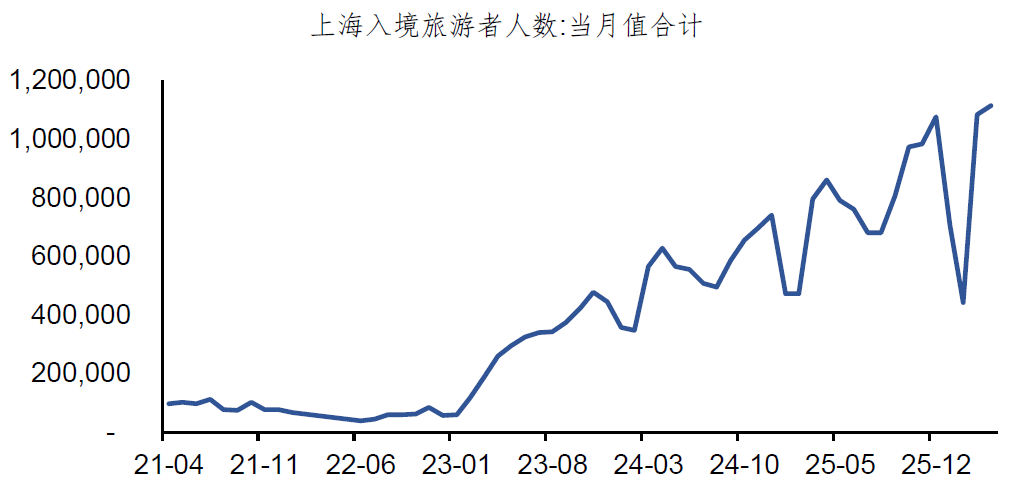
So does the increase in inbound tourists impact the RMB exchange rate? The answer is obvious. Foreign tourists exchange RMB or use cards for spending within China, resulting in a large amount of tourism-related foreign currency settlements. From the perspective of the balance of payments, all expenses by foreign tourists in China—such as food and accommodation, transportation, sightseeing, and retail shopping—are classified under the "Current Account—Trade in Services—Travel" credit item, which is a typical service export and represents a new source of foreign currency supply in the domestic forex market.
In 2025, China’s travel service exports are expected to reach $55.16 billion, a year-on-year increase of 49.1%, significantly outpacing overall service export growth. In the first quarter of 2026, travel service exports will continue to grow by 32.3% year-on-year, further narrowing the long-standing deficit in the trade in services. In the past, China’s deficit in trade in services was mainly due to outbound tourism and foreign exchange purchases by residents. Now, the surge in inbound tourism-generated foreign exchange has effectively offset outbound spending, further strengthening the overall resilience of the current account surplus.
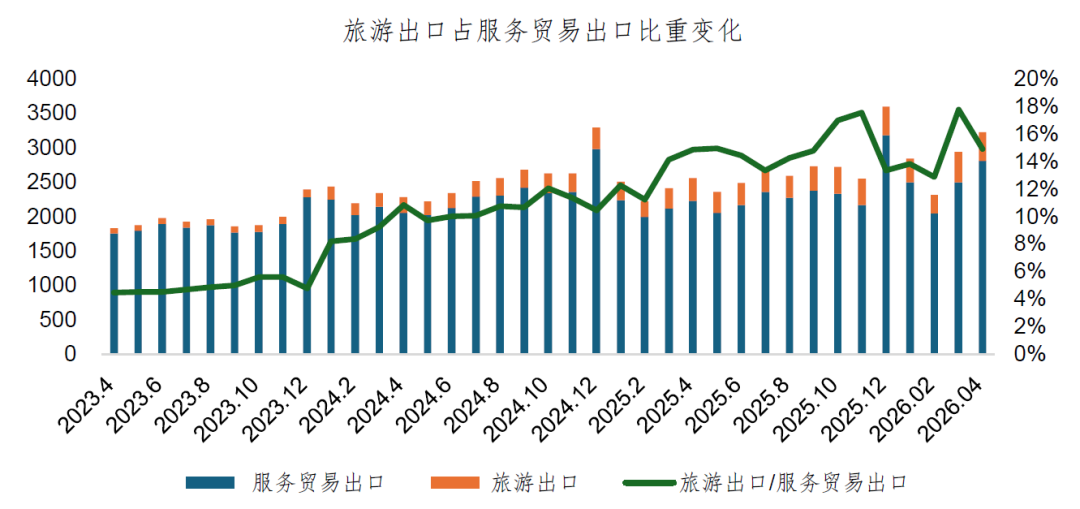
The foreign currencies brought by inbound tourists create demand for RMB through bank settlements, increasing the market supply of US dollars and simultaneously pushing up demand for RMB. Previously, the main support for the RMB came from a large surplus in goods trade, but now the service surplus generated by inbound tourism provides an additional tailwind.
From the transmission chain: growth in inbound tourists → increase in total foreign consumption → expansion of tourism-related foreign exchange settlements → rise in foreign currency deposits in the banking system → weakening pressure to buy US dollars and sell RMB, which, coupled with increased corporate foreign currency settlements at higher rates, collectively strengthen the fundamentals of the RMB exchange rate. Market data show that in the first three quarters of 2025, inbound tourism brought nearly $38.2 billion in cross-border capital inflows, continuously injecting liquidity into the forex market.
However, it should be noted that inbound tourism is only a supplementary support for RMB appreciation, not the primary driver. Compared with the hundreds of billions of dollars monthly surplus from goods trade, the annual foreign currency generation by tourism is relatively limited at several tens of billions of dollars, only marginally boosting and consolidating exchange rate expectations, not enough to independently steer the currency trend.
Meanwhile, RMB appreciation and increased service exports are mutually influential: a moderately stronger RMB may slightly raise costs for inbound tourists, possibly flattening the long-term growth rate of inbound tourism. But as inbound tourism remains vibrant, it will continue to provide incremental foreign exchange settlements, offsetting pressure for RMB depreciation and forming a dynamic balance.
In summary, the recent strong recovery of inbound tourism has led to a significant increase in tourism-related foreign exchange settlements, which, by improving the balance of trade in services and increasing foreign currency supply in the forex market, has provided a marginal support to the recent RMB appreciation. However, this impact is secondary and incremental; the trend of the exchange rate is still mainly determined by the US dollar cycle, goods trade, and cross-border capital flows. Going forward, it will be important to continually track inbound tourism spending and monthly foreign currency settlement data, using them as supplementary indicators for observing the current account and judging medium- to long-term RMB trends, in order to objectively grasp new shifts in forex earnings and expenditure brought about by opening up the cultural and tourism sectors.
Disclaimer: The content of this article solely reflects the author's opinion and does not represent the platform in any capacity. This article is not intended to serve as a reference for making investment decisions.
You may also like
The AI boom may follow the path of the 19th-century railway bubble, and builders may not be the ultimate winners
Goldman Sachs analyst Bobby Molavi compared the current situation to the 19th-century British railway mania: 500 companies spent more than the nation's annual income building 8,000 miles of railway, with most early investors losing out, while the real beneficiaries were the later "passengers." He pointed out that the current AI craze is driven by both debt and momentum, and that the S&P 500’s forward P/E ratio of 18x is only "a bit cheaper." Whether the builders can retain value is uncertain, and history does not offer an optimistic answer.

If Anthropic's IPO goes smoothly and the stock price rises next week, then everything remains the same for AI. Otherwise, some companies will go bankrupt.
The shrinking valuations of two major giants have triggered a chain reaction—investors are adopting more conservative revenue multiples for AI startups and are directly halting high-valuation financing for companies with zero revenue. Multiple venture capital firms have advised their portfolio companies to lower valuation expectations and to quickly build up cash reserves. Market participants warn that the outcome of Anthropic’s IPO will be a barometer for the industry: if successful, the boom will continue; if it fails, some companies may face elimination.
After the Brazilian election, political discount deepens; Morgan Stanley remains bullish on Petrobras (PBR.US), focusing on fuel pricing and dividends
Morgan Stanley still maintains its most optimistic "Overweight" rating, but has lowered its year-end 2027 target price from $31 to $25.

Corning (GLW.US) receives initial "Buy" rating from Jefferies! AI factories driving a fiber optic rush, with a potential global supply gap of up to 30%
For Corning, the recent profit growth mainly comes from the expansion of AI clusters. As the number of optical links crossing cabinets and campuses increases, customers need to deploy more optical fibers within limited conduit and cabinet space, thus driving demand for high-density optical cables and connection systems.

Crypto prices
More


