
Chainlink joins European and Korean bank consortia to develop FX settlement network

Chainlink has joined a working group with European and South Korean banking organizations to explore the use of stablecoins for foreign exchange (FX) settlement, underscoring how blockchain technology is increasingly being tested to modernize legacy financial infrastructure.
On Tuesday, Chainlink announced Project Pangea alongside South Korean digital asset infrastructure company FairSquareLab, the Unified Korea Alliance (UniKA) — a consortium that includes more than a dozen Korean commercial banks — and Qivalis, a euro stablecoin consortium backed by 37 European banks.
Project Pangea aims to bring together financial institutions across Europe and South Korea to evaluate direct, atomic swaps of euro- and South Korean won-denominated stablecoins using Chainlink’s data infrastructure alongside FairSquareLab’s onchain foreign exchange settlement technology.
The initiative is another example of financial institutions evaluating stablecoins for wholesale financial infrastructure rather than consumer payments. According to the Bank for International Settlements, the global foreign exchange market processes roughly $9.6 trillion in daily trading volume.
Project Pangea is a working group rather than a live payment network, and no production implementation timeline has been announced. The initiative reflects a broader trend of banks experimenting with tokenized deposits and regulated stablecoins to improve cross-border payments and settlement.
Similar initiatives are also emerging. Fintech startup OpenFX recently raised $94 million to expand its stablecoin-based payments network, with an initial focus on Southeast Asia and Latin America.
Related: Brazil bars crypto settlement in regulated cross-border payment rails
Stablecoins gain traction among banks and corporations
Global financial institutions are increasingly exploring stablecoins to improve corporate payments, cross-border settlements and foreign exchange transactions, aided by clearer regulatory frameworks in the United States, Europe and other major financial hubs.
Ripple CEO Brad Garlinghouse recently described stablecoins as having a “ChatGPT moment” as more financial institutions evaluate how the technology could fit into their operations. The trend helps explain why Citigroup projects the global stablecoin market will grow to $1.9 trillion by 2030, up from roughly $315 billion today.
According to Citigroup, that expansion will be driven by continued adoption within crypto markets, a gradual shift from physical US dollar banknotes to digital dollars and the growing use of stablecoins as a store of short-term liquidity in both US dollars and local currencies.
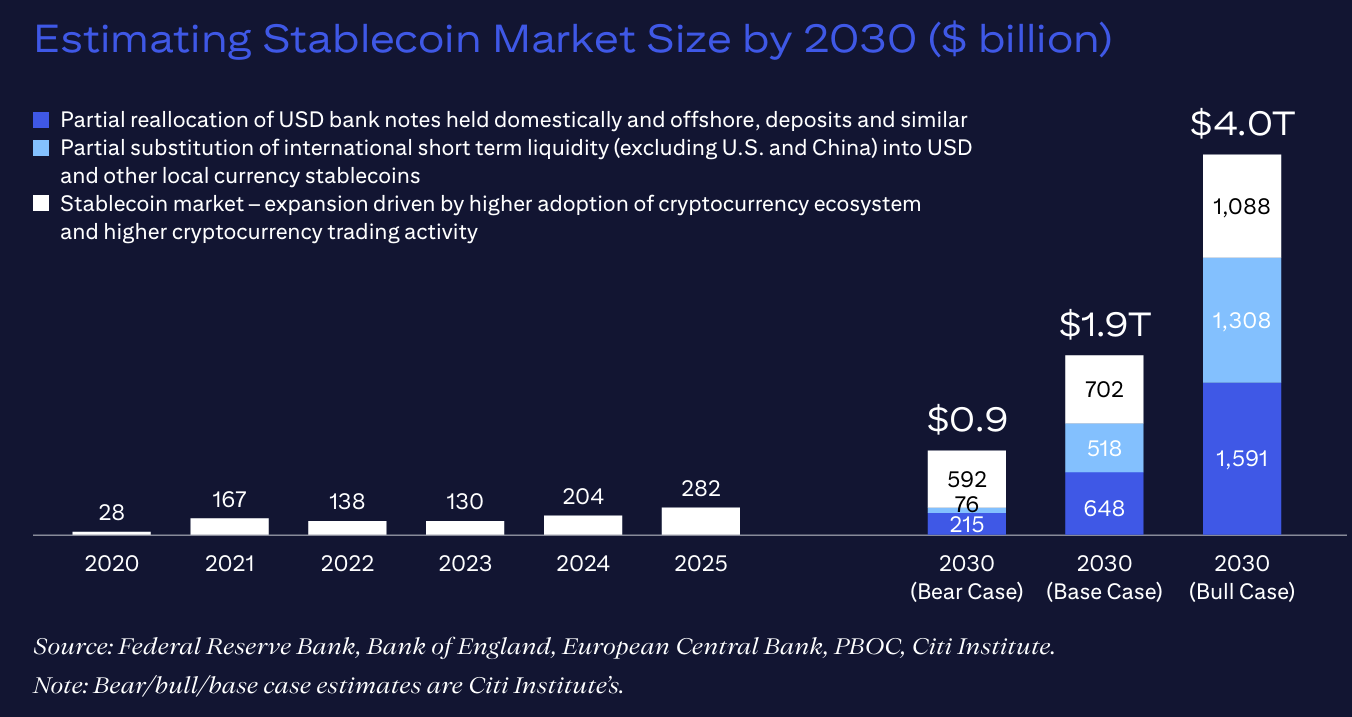
Citigroup estimates the stablecoin market could grow to as much as $4 trillion by 2030 in its most optimistic forecast. Source: Citigroup
Related: Malta proposes DeFi rulebook covering DAOs under MiCA-era framework
Disclaimer: The content of this article solely reflects the author's opinion and does not represent the platform in any capacity. This article is not intended to serve as a reference for making investment decisions.
You may also like
The AI boom may follow the path of the 19th-century railway bubble, and builders may not be the ultimate winners
Goldman Sachs analyst Bobby Molavi compared the current situation to the 19th-century British railway mania: 500 companies spent more than the nation's annual income building 8,000 miles of railway, with most early investors losing out, while the real beneficiaries were the later "passengers." He pointed out that the current AI craze is driven by both debt and momentum, and that the S&P 500’s forward P/E ratio of 18x is only "a bit cheaper." Whether the builders can retain value is uncertain, and history does not offer an optimistic answer.

If Anthropic's IPO goes smoothly and the stock price rises next week, then everything remains the same for AI. Otherwise, some companies will go bankrupt.
The shrinking valuations of two major giants have triggered a chain reaction—investors are adopting more conservative revenue multiples for AI startups and are directly halting high-valuation financing for companies with zero revenue. Multiple venture capital firms have advised their portfolio companies to lower valuation expectations and to quickly build up cash reserves. Market participants warn that the outcome of Anthropic’s IPO will be a barometer for the industry: if successful, the boom will continue; if it fails, some companies may face elimination.
After the Brazilian election, political discount deepens; Morgan Stanley remains bullish on Petrobras (PBR.US), focusing on fuel pricing and dividends
Morgan Stanley still maintains its most optimistic "Overweight" rating, but has lowered its year-end 2027 target price from $31 to $25.

Corning (GLW.US) receives initial "Buy" rating from Jefferies! AI factories driving a fiber optic rush, with a potential global supply gap of up to 30%
For Corning, the recent profit growth mainly comes from the expansion of AI clusters. As the number of optical links crossing cabinets and campuses increases, customers need to deploy more optical fibers within limited conduit and cabinet space, thus driving demand for high-density optical cables and connection systems.

Crypto prices
More


