
Nakamoto closes clinics as Bitcoin pivot becomes full business focus

Nakamoto Inc. has closed its legacy healthcare clinics, ending patient-facing operations tied to the former KindlyMD business.
- Nakamoto closed its healthcare clinics after completing its transition toward Bitcoin-focused operating businesses in 2026.
- Nakamoto raised $540 million through PIPE financing to fund Bitcoin purchases directly.
- NAKA traded near $4.09 while BitcoinTreasuries listed Nakamoto with 4,467 BTC this week on Nasdaq.
The company said the clinics concluded operations on June 19, while remaining administrative work linked to the wind-down should finish in the third quarter of 2026.
“With our healthcare clinics now closed, Nakamoto continues to be focused on executing its strategy as a Bitcoin operating company,” Chairman and CEO David Bailey said.
The closure marks a clean shift away from healthcare and toward a business model built around Bitcoin media, asset management, financial services, consulting and advisory work.
Bitcoin business replaces legacy clinics
Nakamoto says it now operates as a Bitcoin company with three main lines of business. Those areas are media and information services, asset management and financial services, and consulting and advisory services. The company says the model is designed to generate recurring revenue and support growth across those verticals.
The company is also the parent of BTC Inc., the media business behind Bitcoin Magazine, The Bitcoin Conference and Bitcoin for Corporations. It also owns UTXO Management, a Bitcoin-native asset manager that focuses on public and private market investments tied to the Bitcoin ecosystem.
Merger and treasury strategy remain central
The pivot follows Nakamoto’s merger with healthcare operator KindlyMD. As previously reported, the merged company raised about $540 million through PIPE financing, with proceeds set aside for Bitcoin purchases.
Moreover, the company made an early large purchase after the merger, acquiring more than 5,700 BTC. At the time, that purchase placed KindlyMD among the larger public corporate Bitcoin holders and showed that the new Nakamoto strategy centered on treasury accumulation.
The latest clinic closure removes the last operating piece of the old healthcare business. KindlyMD’s healthcare operations had continued through Kindly LLC, a wholly owned subsidiary, until the June 19 closure.
NAKA stock and Bitcoin holdings face market test
Nakamoto’s market backdrop remains difficult. NAKA traded near $4.09, after falling during Tuesday’s session. The stock has also faced pressure since the company announced its merger with KindlyMD and moved toward a Bitcoin accumulation strategy in 2025.
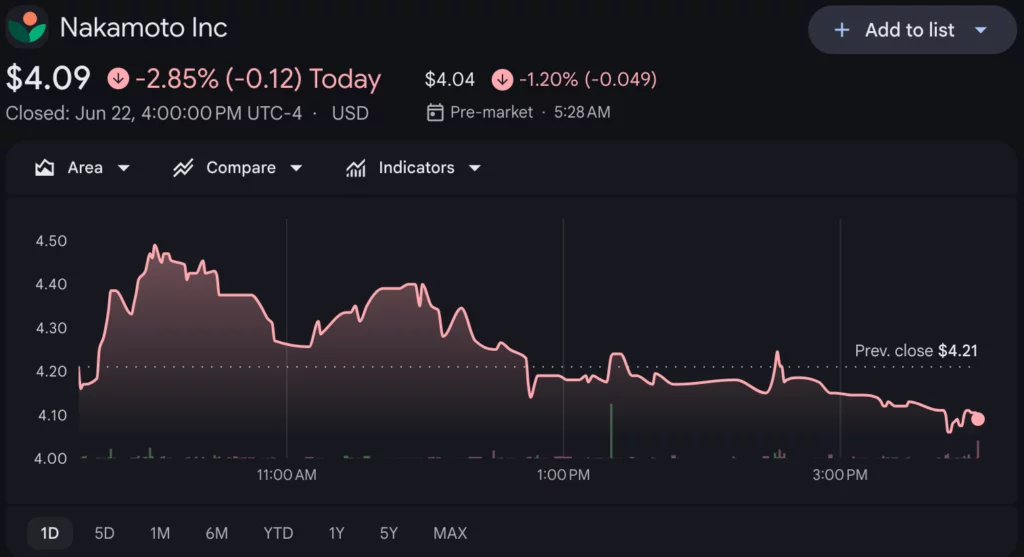 Source: Google finance
BitcoinTreasuries listed Nakamoto with 4,467 BTC, worth about $286.7 million as of June 23. That placed the company below larger public Bitcoin treasury names such as Strategy and Twenty One Capital, but still within the top group of listed corporate holders.
The Bitcoin treasury sector has also become more competitive. Twenty One Capital’s Tether-backed expansion plans include proposed links with Strike and Elektron Energy, as rivals try to build revenue lines around Bitcoin holdings.
Nakamoto also reported a $238.8 million net loss in the first quarter of 2026. The loss was tied mainly to non-cash changes linked to Bitcoin holdings and its investment portfolio, along with transaction and integration costs from recent acquisitions.
The company’s direction now depends on how well its Bitcoin businesses can produce revenue while managing balance sheet volatility. Bailey said Nakamoto has built a platform across media, asset management and advisory services. Investors will now watch whether that platform can offset the risks that come with a Bitcoin-heavy public company model.
Disclaimer: The content of this article solely reflects the author's opinion and does not represent the platform in any capacity. This article is not intended to serve as a reference for making investment decisions.
You may also like
The AI boom may follow the path of the 19th-century railway bubble, and builders may not be the ultimate winners
Goldman Sachs analyst Bobby Molavi compared the current situation to the 19th-century British railway mania: 500 companies spent more than the nation's annual income building 8,000 miles of railway, with most early investors losing out, while the real beneficiaries were the later "passengers." He pointed out that the current AI craze is driven by both debt and momentum, and that the S&P 500’s forward P/E ratio of 18x is only "a bit cheaper." Whether the builders can retain value is uncertain, and history does not offer an optimistic answer.

If Anthropic's IPO goes smoothly and the stock price rises next week, then everything remains the same for AI. Otherwise, some companies will go bankrupt.
The shrinking valuations of two major giants have triggered a chain reaction—investors are adopting more conservative revenue multiples for AI startups and are directly halting high-valuation financing for companies with zero revenue. Multiple venture capital firms have advised their portfolio companies to lower valuation expectations and to quickly build up cash reserves. Market participants warn that the outcome of Anthropic’s IPO will be a barometer for the industry: if successful, the boom will continue; if it fails, some companies may face elimination.
After the Brazilian election, political discount deepens; Morgan Stanley remains bullish on Petrobras (PBR.US), focusing on fuel pricing and dividends
Morgan Stanley still maintains its most optimistic "Overweight" rating, but has lowered its year-end 2027 target price from $31 to $25.

Corning (GLW.US) receives initial "Buy" rating from Jefferies! AI factories driving a fiber optic rush, with a potential global supply gap of up to 30%
For Corning, the recent profit growth mainly comes from the expansion of AI clusters. As the number of optical links crossing cabinets and campuses increases, customers need to deploy more optical fibers within limited conduit and cabinet space, thus driving demand for high-density optical cables and connection systems.
Crypto prices
More


