
Alternative Data Sounds the Alarm: Kalshi Bets Heavily on Nvidia Chip Price Cuts, Pricing Power "Myth" Faces Test

Nvidia's pricing power is facing direct market scrutiny. Trading data from the prediction market Kalshi shows that traders are generally betting that the rental price for Nvidia's flagship GPU chip B200 will not return to its recent highs before the end of Q2. This "alternative data" signal is resonating with Nvidia’s recent lackluster stock performance, making the market more cautious about the AI chip giant’s short-term outlook.
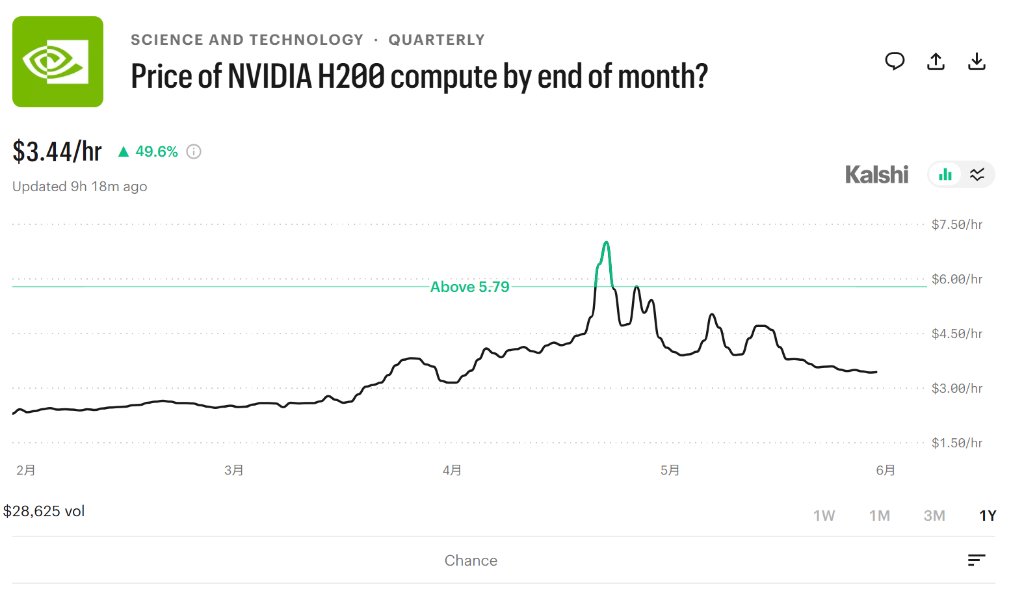
According to Ornn, a real-time GPU power price tracking platform, the hourly price for Nvidia's B200 chip peaked at $6.11 on May 30, the highest in nearly three months, before continuously falling to $4.22 as of June 21, marking a cumulative drop of over 30%. Meanwhile, Nvidia's stock is down about 3% over the past month, while the Philadelphia Semiconductor ETF (SMH) is up 15% during the same period. Memory chip stocks like Micron Technology and Sandisk have each soared nearly 60% over the last month.
The relevant contracts on the Kalshi platform will settle on June 30, using Ornn’s B200 power price as the benchmark. Current trader positioning indicates that the majority believe B200’s price is unlikely to exceed the late May peak before that date. This bearish bet directly targets the core question of whether Nvidia can maintain strong pricing power during the current AI infrastructure build-out cycle.
Stock Underperforms Peers, Nvidia Falls Into Relative Stagnation
Although Nvidia is still up about 12% year-to-date, its recent performance now clearly lags the broader semiconductor sector. SMH has surged 84% so far this year, including a 15% increase this month alone—a sharp contrast to Nvidia.
Market attention is shifting. Wall Street is currently focused on the next phase of memory chips and AI infrastructure. Micron Technology and Sandisk have become favored by inflows, both rallying nearly 60% in the past month. Nvidia, on the other hand, has clearly been marginalized in this rally, and investors are becoming increasingly sensitive to its lack of short-term catalysts.
B200 Power Price Drops; Uncertainty on Both Supply and Demand Sides
The downtrend in B200’s pricing reflects deep uncertainties on both supply and demand sides of the AI infrastructure market.
Seoyoung Kim, finance professor at Santa Clara University, told CNBC: "Many companies do not know how much computing power they will need in the next year, suppliers do not know how many GPUs to order or at what capacity to purchase, and manufacturers like Nvidia have no clear idea how much to produce." This three-fold information asymmetry makes GPU rental price fluctuations the norm and makes it difficult for the market to form stable revenue expectations for Nvidia.
Most enterprises rent GPU computing power via cloud providers or emerging "neocloud" platforms, with rental costs fluctuating with AI infrastructure demand. The B200’s price drop—over 30% from its peak—suggests that supply is relatively ample in the short term, or that demand growth has somewhat slowed.
Google-SpaceX Block Deal Boost, RBC Optimistic for Second Half
Despite the recent weak data, Nvidia still has fundamental support. Earlier this month, Google and SpaceX signed an agreement to pay $920 million per month from October 2026 to June 2029 to rent AI computing power, which will include about 110,000 Nvidia GPUs and related hardware.
Following the deal, RBC Capital Markets expressed optimism about Nvidia’s performance in the second half of 2026 and into 2027, stating Nvidia is "best positioned among its peers." Analysts wrote: "Whatever the specific reasons, these GPU leasing agreements should alleviate ongoing market fears that custom chips (ASICs) might erode Nvidia’s market share—at least in the short term."
Signal Value of Alternative Data
The reason Kalshi's betting data has garnered attention is that it offers a market signal independent from traditional sell-side research. The prediction market’s pricing mechanism directly reflects actual positions and probability judgments of trading participants, rather than the subjective forecasts of analysts.
Currently, trader positions on Kalshi are largely aligned with the belief that B200’s power price will not break May’s high before the end of Q2, a judgment corroborated by Nvidia’s recent stock performance. For investors, this means that while long-term optimism from large procurement deals like Google’s abounds, the market is still seeking a balance with short-term pricing pressures on computing power. Whether Nvidia’s pricing power can be validated in the next quarter will be a key indicator to watch regarding its fundamentals.
Disclaimer: The content of this article solely reflects the author's opinion and does not represent the platform in any capacity. This article is not intended to serve as a reference for making investment decisions.
You may also like
The AI boom may follow the path of the 19th-century railway bubble, and builders may not be the ultimate winners
Goldman Sachs analyst Bobby Molavi compared the current situation to the 19th-century British railway mania: 500 companies spent more than the nation's annual income building 8,000 miles of railway, with most early investors losing out, while the real beneficiaries were the later "passengers." He pointed out that the current AI craze is driven by both debt and momentum, and that the S&P 500’s forward P/E ratio of 18x is only "a bit cheaper." Whether the builders can retain value is uncertain, and history does not offer an optimistic answer.

If Anthropic's IPO goes smoothly and the stock price rises next week, then everything remains the same for AI. Otherwise, some companies will go bankrupt.
The shrinking valuations of two major giants have triggered a chain reaction—investors are adopting more conservative revenue multiples for AI startups and are directly halting high-valuation financing for companies with zero revenue. Multiple venture capital firms have advised their portfolio companies to lower valuation expectations and to quickly build up cash reserves. Market participants warn that the outcome of Anthropic’s IPO will be a barometer for the industry: if successful, the boom will continue; if it fails, some companies may face elimination.
After the Brazilian election, political discount deepens; Morgan Stanley remains bullish on Petrobras (PBR.US), focusing on fuel pricing and dividends
Morgan Stanley still maintains its most optimistic "Overweight" rating, but has lowered its year-end 2027 target price from $31 to $25.
Corning (GLW.US) receives initial "Buy" rating from Jefferies! AI factories driving a fiber optic rush, with a potential global supply gap of up to 30%
For Corning, the recent profit growth mainly comes from the expansion of AI clusters. As the number of optical links crossing cabinets and campuses increases, customers need to deploy more optical fibers within limited conduit and cabinet space, thus driving demand for high-density optical cables and connection systems.
Crypto prices
More


