
The largest lithium mine in the US is about to start production, reshaping the lithium supply chain

A clay-based lithium deposit that has never been mined on a large scale is becoming a key bet in America's effort to reshape its domestic metals supply chain.
According to the latest report from The Information, the Thacker Pass mine in Nevada, developed by Lithium Americas, is the largest known lithium deposit in the United States. The first phase of production at the mine is expected to begin by the end of next year, at which point the annual output will be ten times the current U.S. lithium production.
General Motors (GM) has already secured all of the production from the mine’s first phase for the next 20 years, which corresponds to battery demand for about 850,000 electric vehicles, or can be used equivalently in batteries for AI data centers, drones, robotics, and military equipment. Meanwhile, the U.S. government holds a 5% stake in Lithium Americas and a 5% direct interest in the Thacker Pass mine, and is providing a $2.2 billion low-interest loan through the Department of Energy, jointly funding the project alongside GM.
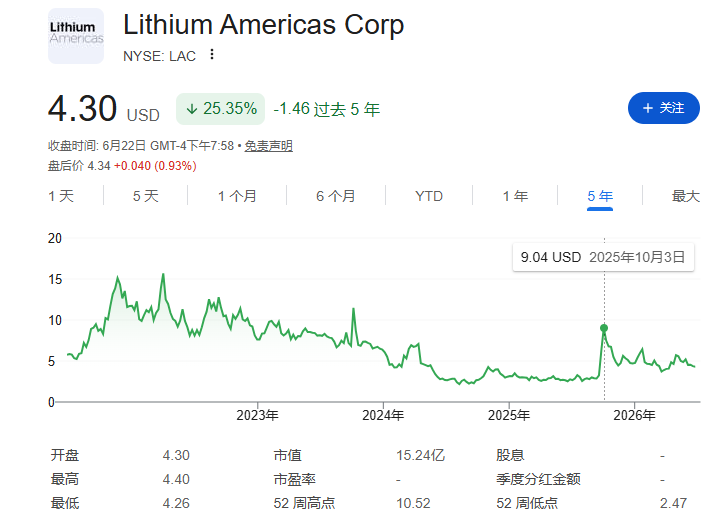
However, the share price of Lithium Americas has dropped a cumulative 56% from its peak of around $10 in October last year, with an 8.3% decline so far this year. Market concerns are focused on a single issue: the lithium resource in this mine is embedded in clay layers, and this extraction process has never been commercially proven at scale.
U.S. Government Takes Equity: Making Minerals a National Strategic Asset
The Trump administration designated the demand for metals from the defense sector and AI data centers as a new strategic priority and took a series of unusual measures—including directly taking equity ownership in metals companies.
In addition to Thacker Pass, the government also holds a 15% stake in rare earth metal developer MP Materials in Nevada. Lithium Americas CEO Jon Evans notes that this policy shift has fundamentally changed the market landscape: "From last summer to this summer, the entire situation is completely different. Now it’s more balanced, because it’s not just about EVs—we are now part of the energy security strategy."
GM's investment totals $625 million in return for a 38% equity stake in the mine. This funding is mainly used to purchase equipment to process ore into lithium carbonate—a core material for LFP batteries, which are widely used for data center energy storage and grid backup. Evans has also equipped the plant with a steam turbine capable of supplying about half of the plant’s electricity needs.
Lithium Extraction from Clay: The Core Technical Question
Currently, nearly all global lithium mining comes from two sources: hard-rock spodumene and brine from salt lakes. The lithium in Thacker Pass is embedded in clay, a third approach, but one that has never been proven at a commercial scale.
This is the biggest concern for investors. In comparison, Australian lithium miners Mineral Resources, PLS Group, and Liontown Resources have seen share price increases of 25%, 36%, and 22% respectively so far this year—all of which are traditional spodumene mining companies. Lithium Americas’ share price, in contrast, has moved in the opposite direction.
Evans admits that this uncertainty will continue to suppress the company’s valuation until actual production is achieved. He says candidly: "Once I produce the first ton of lithium, the valuation will be repriced, because the market always has that question: 'Can you really do it?'"
Chris Berry, president of metals research firm House Mountain Partners, shares the same assessment: "The market is waiting to see if there are any delays or teething problems during the initial run."
It is worth noting that Evans stated several independent due diligence experts, including those from the Department of Energy, have reviewed the company’s mining plan and deemed the technical approach feasible.
Phase Two: Demand Already in Line
Beyond Thacker Pass’s first phase, the second phase aims to extract and process another 40,000 tons of lithium over the next decade. GM holds the right of first refusal for 38% of output from this phase, along with an option to purchase the remaining production.
But demand is no longer limited to GM. Evans revealed that several companies have shown interest in second-phase supply, and one has even proposed a $100 million prepayment.
Berry stated: "There are many people in Washington closely watching Lithium Americas, and I believe the potential customer list will be long."
In addition, research from BloombergNEF points out that the continued decline in battery costs has brought the price of battery storage systems for grids and AI data centers down below that of gas turbines, and roughly on par with cheap coal-fired power generation. This trend further underscores the strategic value of lithium resources.
Disclaimer: The content of this article solely reflects the author's opinion and does not represent the platform in any capacity. This article is not intended to serve as a reference for making investment decisions.
You may also like
The AI boom may follow the path of the 19th-century railway bubble, and builders may not be the ultimate winners
Goldman Sachs analyst Bobby Molavi compared the current situation to the 19th-century British railway mania: 500 companies spent more than the nation's annual income building 8,000 miles of railway, with most early investors losing out, while the real beneficiaries were the later "passengers." He pointed out that the current AI craze is driven by both debt and momentum, and that the S&P 500’s forward P/E ratio of 18x is only "a bit cheaper." Whether the builders can retain value is uncertain, and history does not offer an optimistic answer.

If Anthropic's IPO goes smoothly and the stock price rises next week, then everything remains the same for AI. Otherwise, some companies will go bankrupt.
The shrinking valuations of two major giants have triggered a chain reaction—investors are adopting more conservative revenue multiples for AI startups and are directly halting high-valuation financing for companies with zero revenue. Multiple venture capital firms have advised their portfolio companies to lower valuation expectations and to quickly build up cash reserves. Market participants warn that the outcome of Anthropic’s IPO will be a barometer for the industry: if successful, the boom will continue; if it fails, some companies may face elimination.
After the Brazilian election, political discount deepens; Morgan Stanley remains bullish on Petrobras (PBR.US), focusing on fuel pricing and dividends
Morgan Stanley still maintains its most optimistic "Overweight" rating, but has lowered its year-end 2027 target price from $31 to $25.

Corning (GLW.US) receives initial "Buy" rating from Jefferies! AI factories driving a fiber optic rush, with a potential global supply gap of up to 30%
For Corning, the recent profit growth mainly comes from the expansion of AI clusters. As the number of optical links crossing cabinets and campuses increases, customers need to deploy more optical fibers within limited conduit and cabinet space, thus driving demand for high-density optical cables and connection systems.
Crypto prices
More


