
New York, Maryland and Utah to hold primaries with crypto PAC money hanging over voters

Political action committees (PACs) backed by cryptocurrency companies and aligned interest groups have bet more than $8 million to support candidates in Tuesday’s primaries across three US states, which could impact the makeup of the country’s Congress in 2027.
As of Monday, the Protect Progress PAC, an affiliate of Fairshake that supports Democratic candidates, reported spending more than $516,000 on media for April McClain Delaney, running in Maryland’s 6th congressional district. However, much of the PAC’s attention has been focused on two races in Maryland and New York, where it reported combined expenditures of more than $5.5 million and $1.4 million, respectively, for primary races in the states’ 5th and 15th congressional districts, for Adrian Boafo and Ritchie Torres.
Filings with the Federal Election Commission (FEC) showed that Protect Progress had spent about $24,000 on ads to oppose Quincy Bareebe and $74,000 for media opposing Harry Dunn, both running against Boafo in Maryland’s 5th district. Dunn and Bareebe, along with Rushern Baker, who is running in the same primary, issued a statement on June 15 against what they called the “influence of dark money and special interests” in the race:
“We are calling on Governor Moore, Senator Alsobrooks, and Congressman Hoyer to answer directly: Do you support nearly $8 million in outside spending from crypto billionaires and AIPAC in a Maryland Democratic primary? If not, they should say so publicly and call on Adrian Boafo to reject it.”
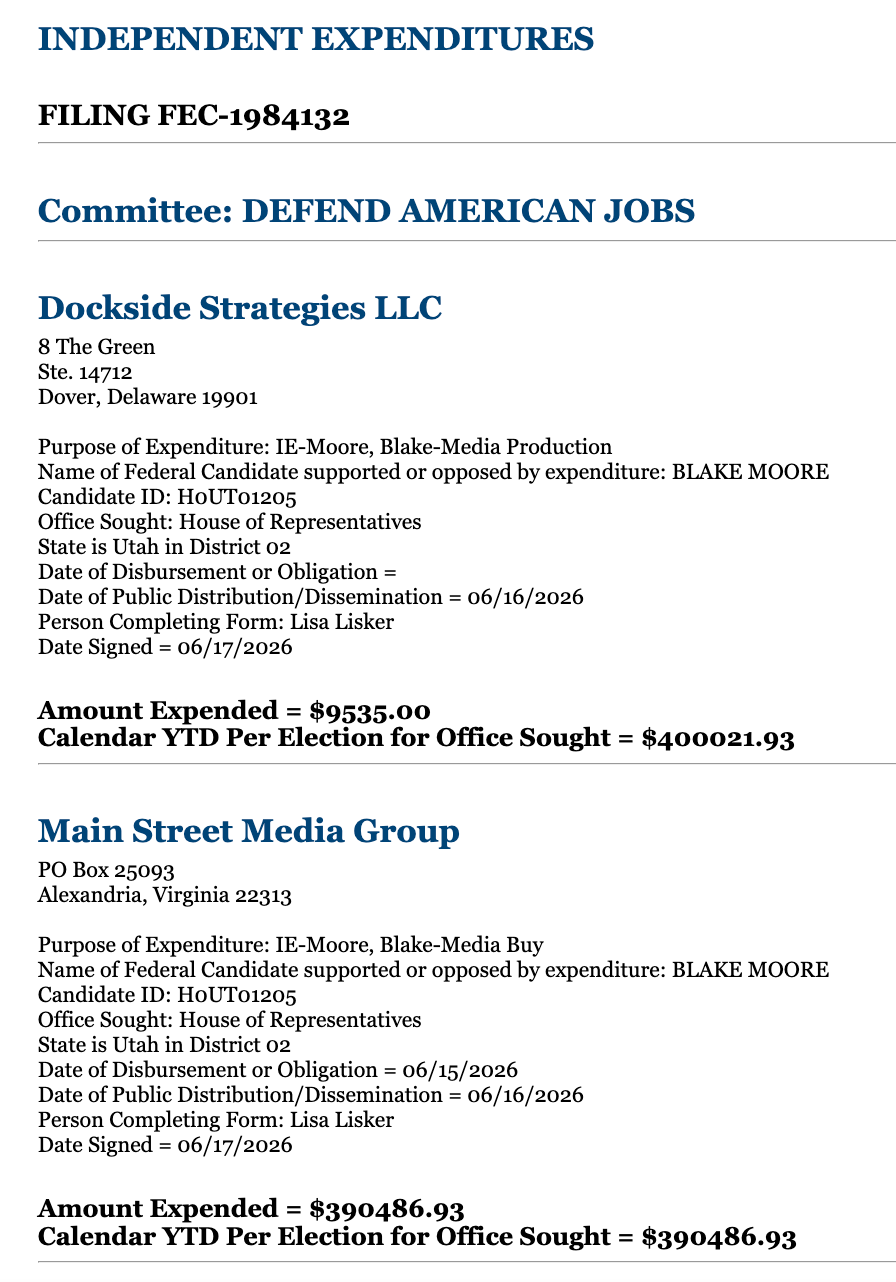
Defend American Jobs, another Fairshake affiliate, reported spending more than $400,000 on Republican Blake Moore’s primary in Utah’s 2nd congressional district. All expenditures followed what a Fairshake spokesperson called the “biggest spend of the cycle” in last week’s Alabama primary runoff, resulting in a win for Republican Barry Moore after the PAC spent more than $12 million on ads.
The Fellowship PAC, another committee backed by $11 million from Cantor Fitzgerald and Anchorage, disclosed $300,000 in spending to support Torres’ New York run.
Are Colorado and Arizona next?
With the three US state primaries to be decided on Tuesday, many expect Fairshake and other crypto-aligned PACs to turn their attention to Colorado and Arizona, which are scheduled to hold primaries on June 30 and July 21, respectively.
As of Monday, none of the PACs had disclosed significant spending in any congressional races in the two US states. However, in 2024, Fairshake and its affiliates poured more than $10 million into media to support Ruben Gallego’s Senate race in Arizona and $2.1 million for Democratic Representative Yadira Caraveo in Colorado’s 8th district.
Disclaimer: The content of this article solely reflects the author's opinion and does not represent the platform in any capacity. This article is not intended to serve as a reference for making investment decisions.
You may also like
The AI boom may follow the path of the 19th-century railway bubble, and builders may not be the ultimate winners
Goldman Sachs analyst Bobby Molavi compared the current situation to the 19th-century British railway mania: 500 companies spent more than the nation's annual income building 8,000 miles of railway, with most early investors losing out, while the real beneficiaries were the later "passengers." He pointed out that the current AI craze is driven by both debt and momentum, and that the S&P 500’s forward P/E ratio of 18x is only "a bit cheaper." Whether the builders can retain value is uncertain, and history does not offer an optimistic answer.

If Anthropic's IPO goes smoothly and the stock price rises next week, then everything remains the same for AI. Otherwise, some companies will go bankrupt.
The shrinking valuations of two major giants have triggered a chain reaction—investors are adopting more conservative revenue multiples for AI startups and are directly halting high-valuation financing for companies with zero revenue. Multiple venture capital firms have advised their portfolio companies to lower valuation expectations and to quickly build up cash reserves. Market participants warn that the outcome of Anthropic’s IPO will be a barometer for the industry: if successful, the boom will continue; if it fails, some companies may face elimination.
After the Brazilian election, political discount deepens; Morgan Stanley remains bullish on Petrobras (PBR.US), focusing on fuel pricing and dividends
Morgan Stanley still maintains its most optimistic "Overweight" rating, but has lowered its year-end 2027 target price from $31 to $25.
Corning (GLW.US) receives initial "Buy" rating from Jefferies! AI factories driving a fiber optic rush, with a potential global supply gap of up to 30%
For Corning, the recent profit growth mainly comes from the expansion of AI clusters. As the number of optical links crossing cabinets and campuses increases, customers need to deploy more optical fibers within limited conduit and cabinet space, thus driving demand for high-density optical cables and connection systems.
Crypto prices
More


