
SpaceX sparks valuation fears as analysts refuse stock target

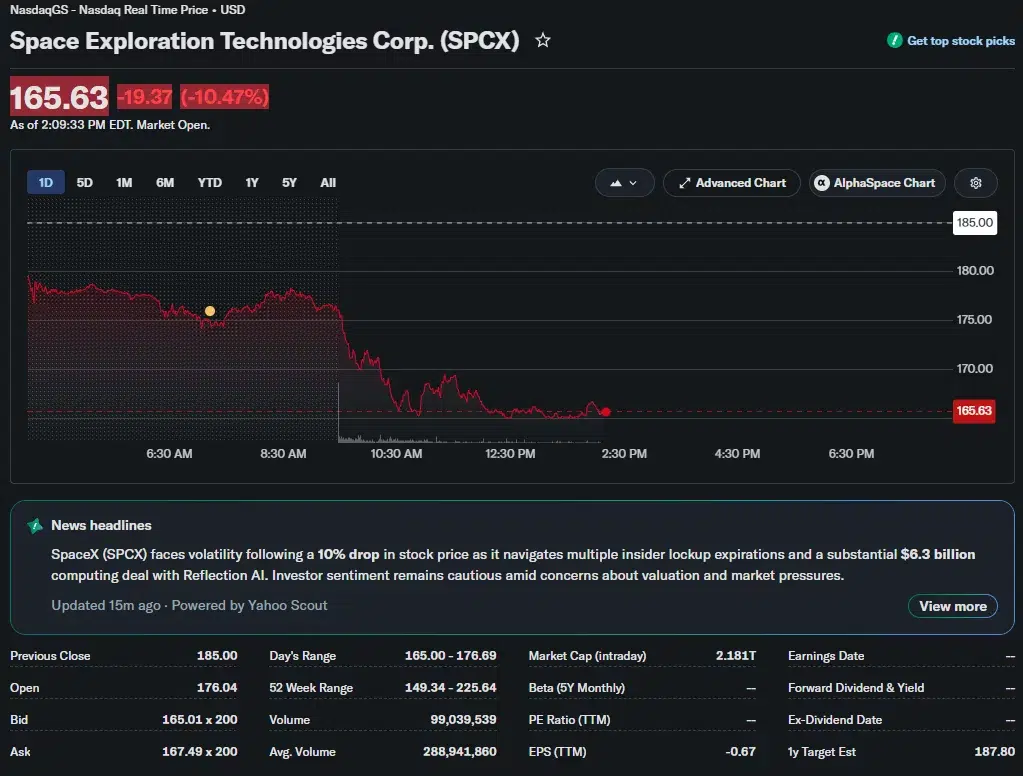
SpaceX stock has fallen more than 10% in early U.S. trading after analysts initiated coverage without assigning a price target, adding to investor concerns about the company’s valuation following its record-breaking market debut.
- SpaceX stock fell more than 10% after KeyBanc initiated coverage with a neutral rating and no price target.
- KeyBanc cited balanced risk-reward despite strong growth prospects from Starlink and AI-related opportunities.
- The decline coincided with SpaceX’s first bond offering as investors weighed valuation concerns after its blockbuster IPO.
According to a June 22 report from Barron’s, analysts at KeyBanc began coverage of SpaceX with a “Sector Weight” rating while declining to provide a target price for the stock.
The brokerage firm said SpaceX is likely to remain the dominant force in the space launch industry for years, but argued that much of the company’s future growth may already be reflected in its current valuation.
“SpaceX possesses significant disruptive growth avenues, though we believe this is reflected in current valuation and risk/reward appears balanced, in our view.”
SPCX shares traded around $165.63 at the time of writing, extending losses after one of the most successful public offerings in market history.
 Source:
The pullback has drawn attention because it follows a sharp post-listing surge that helped push SpaceX’s valuation to levels that some analysts consider difficult to justify.
Analysts point to valuation concerns despite growth outlook
In its coverage note, KeyBanc identified Starlink as one of SpaceX’s most important revenue engines and said advances in artificial intelligence could support future expansion. Even so, the firm maintained a cautious position, citing what it described as a balanced risk-reward profile at current prices.
Similar concerns have emerged elsewhere. As previously reported by crypto.news, analysts at Morningstar estimated a fair value of $63 per share and argued that SpaceX stock may be trading above levels supported by fundamentals.
The debate over valuation comes only weeks after the company’s blockbuster public debut generated enormous wealth for shareholders. Earlier reporting by crypto.news noted that the IPO pushed Elon Musk’s net worth above $1 trillion while creating a new group of billionaires among early investors, executives, and institutional backers tied to the company.
Investor attention has increasingly shifted from the scale of the listing toward whether the business can deliver enough growth to support its market capitalization.
Bond sale adds another layer to investor focus
While analysts weighed valuation questions, SpaceX also entered the debt market for the first time.
Barron’s also reported that the company is issuing senior unsecured notes as part of its first bond offering. The report stated that SpaceX currently holds approximately $100.8 billion in cash and intends to use proceeds from the sale primarily to repay bridge financing, with additional funds allocated for general corporate purposes.
The debt offering arrives shortly after the company’s June 12 IPO, which reportedly raised over $85 billion after underwriters exercised the greenshoe option.
Recent reports have also suggested that SpaceX could pursue significantly larger fundraising plans. Last week, reports indicated that the company was exploring a bond raise worth as much as $20 billion, highlighting continued demand from investors seeking exposure to Elon Musk’s space and artificial intelligence businesses.
With analysts split between long-term confidence in SpaceX’s market position and concerns over its valuation, traders are now assessing whether the stock’s latest decline represents a temporary reset after an extraordinary rally or the beginning of a longer adjustment period.
Disclaimer: The content of this article solely reflects the author's opinion and does not represent the platform in any capacity. This article is not intended to serve as a reference for making investment decisions.
You may also like
The AI boom may follow the path of the 19th-century railway bubble, and builders may not be the ultimate winners
Goldman Sachs analyst Bobby Molavi compared the current situation to the 19th-century British railway mania: 500 companies spent more than the nation's annual income building 8,000 miles of railway, with most early investors losing out, while the real beneficiaries were the later "passengers." He pointed out that the current AI craze is driven by both debt and momentum, and that the S&P 500’s forward P/E ratio of 18x is only "a bit cheaper." Whether the builders can retain value is uncertain, and history does not offer an optimistic answer.

If Anthropic's IPO goes smoothly and the stock price rises next week, then everything remains the same for AI. Otherwise, some companies will go bankrupt.
The shrinking valuations of two major giants have triggered a chain reaction—investors are adopting more conservative revenue multiples for AI startups and are directly halting high-valuation financing for companies with zero revenue. Multiple venture capital firms have advised their portfolio companies to lower valuation expectations and to quickly build up cash reserves. Market participants warn that the outcome of Anthropic’s IPO will be a barometer for the industry: if successful, the boom will continue; if it fails, some companies may face elimination.
After the Brazilian election, political discount deepens; Morgan Stanley remains bullish on Petrobras (PBR.US), focusing on fuel pricing and dividends
Morgan Stanley still maintains its most optimistic "Overweight" rating, but has lowered its year-end 2027 target price from $31 to $25.
Corning (GLW.US) receives initial "Buy" rating from Jefferies! AI factories driving a fiber optic rush, with a potential global supply gap of up to 30%
For Corning, the recent profit growth mainly comes from the expansion of AI clusters. As the number of optical links crossing cabinets and campuses increases, customers need to deploy more optical fibers within limited conduit and cabinet space, thus driving demand for high-density optical cables and connection systems.

Crypto prices
More


