
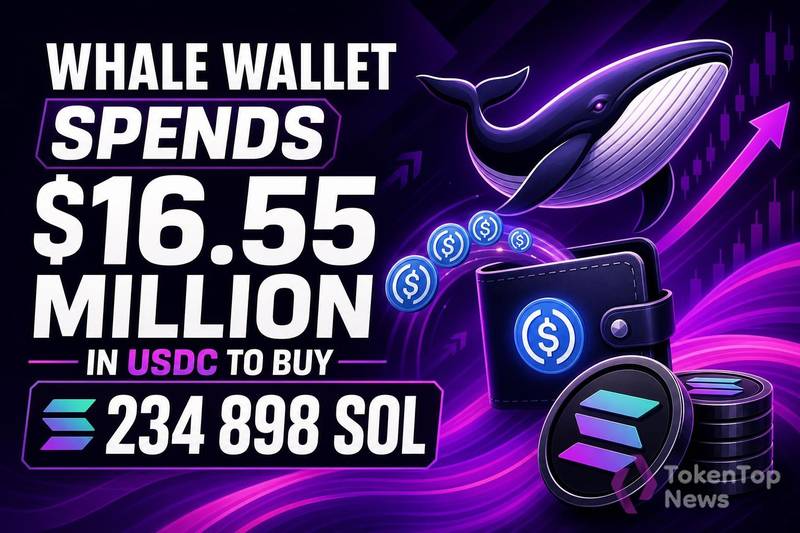
A whale wallet purchased 234,898 SOL using $16.55 million in USDC. This analysis outlines the transaction’s scale, its relevance to Solana watchers, and the key angles the article should cover.

A whale wallet is reported to have spent sixteen point fifty five million USDC to acquire two hundred thirty four thousand eight hundred ninety eight SOL, putting a large Solana accumulation claim in focus. Because the research brief supplies only one cited post, and no block explorer entry, the safe scope here is the reported purchase itself and the limits of what that evidence proves.
What the cited post establishes
Lookonchain said on X that $16.55 million in USDC was used to buy 234,898 SOL. Within the materials provided for this run, that post is the only readable external record attached to the headline claim.
The funding asset matters because the same Lookonchain post describes USDC on one side of the trade and SOL on the other, which supports a narrow characterization of the move as a stablecoin funded purchase. It does not, by itself, establish why the wallet made the trade or whether the buyer was positioning for a short term or long term hold.
What remains outside the evidence
The research brief does not include a Solscan transaction page, wallet labels, or a timestamp beyond the cited X report from Lookonchain. That means the wallet’s identity, the execution venue, and any claimed market impact cannot be independently verified from the source set used for this article.
That sourcing limit matters because on chain stories are strongest when readers can inspect an explorer record directly. Here, the available evidence remains the Lookonchain post, so the article cannot responsibly add sender and receiver addresses, a transaction signature, or an exact execution time.
A disclosed SOL allocation of that scale is enough to attract the same type of reader attention seen in Grant Cardone’s planned BTC treasury addition, Morgan Stanley’s reported Bitcoin ETF buying, and Arthur Hayes’ recent ETH accumulation. In this case, the only external proof offered in the brief is still the cited Lookonchain account, which supports attention on the purchase but not a prediction about what SOL must do next.
The use of USDC is also why this fits a stablecoin to SOL rotation angle rather than a generic whale transfer story. That distinction may interest readers already following capital allocation themes through Franklin Templeton’s bitcoin linked ETF filing and AllUnity’s SEKAU stablecoin launch, but this specific report is only supported by the single cited post.
Disclaimer: The content of this article solely reflects the author's opinion and does not represent the platform in any capacity. This article is not intended to serve as a reference for making investment decisions.
You may also like
The AI boom may follow the path of the 19th-century railway bubble, and builders may not be the ultimate winners
Goldman Sachs analyst Bobby Molavi compared the current situation to the 19th-century British railway mania: 500 companies spent more than the nation's annual income building 8,000 miles of railway, with most early investors losing out, while the real beneficiaries were the later "passengers." He pointed out that the current AI craze is driven by both debt and momentum, and that the S&P 500’s forward P/E ratio of 18x is only "a bit cheaper." Whether the builders can retain value is uncertain, and history does not offer an optimistic answer.

If Anthropic's IPO goes smoothly and the stock price rises next week, then everything remains the same for AI. Otherwise, some companies will go bankrupt.
The shrinking valuations of two major giants have triggered a chain reaction—investors are adopting more conservative revenue multiples for AI startups and are directly halting high-valuation financing for companies with zero revenue. Multiple venture capital firms have advised their portfolio companies to lower valuation expectations and to quickly build up cash reserves. Market participants warn that the outcome of Anthropic’s IPO will be a barometer for the industry: if successful, the boom will continue; if it fails, some companies may face elimination.
After the Brazilian election, political discount deepens; Morgan Stanley remains bullish on Petrobras (PBR.US), focusing on fuel pricing and dividends
Morgan Stanley still maintains its most optimistic "Overweight" rating, but has lowered its year-end 2027 target price from $31 to $25.
Corning (GLW.US) receives initial "Buy" rating from Jefferies! AI factories driving a fiber optic rush, with a potential global supply gap of up to 30%
For Corning, the recent profit growth mainly comes from the expansion of AI clusters. As the number of optical links crossing cabinets and campuses increases, customers need to deploy more optical fibers within limited conduit and cabinet space, thus driving demand for high-density optical cables and connection systems.
Crypto prices
More


