
Q2 2026 emerges as most-hacked quarter on record with 83 incidents

The second quarter of 2026 has already become the most-hacked quarter on record by incident count, with 83 exploits targeting cryptocurrency protocols, according to analysis by market insights platform Unfolded based on DefiLlama data.
However, the $755.3 million stolen during the quarter so far is significantly lower than the $3.56 billion lost in the fourth quarter of 2020, which remains the costliest quarter on record for crypto hacks.
KelpDAO’s $293 million hack and Drift Protocol’s $280 million exploit were the largest incidents of the quarter.
The figures suggest hacking activity is becoming more frequent, even as total losses remain below previous record levels.
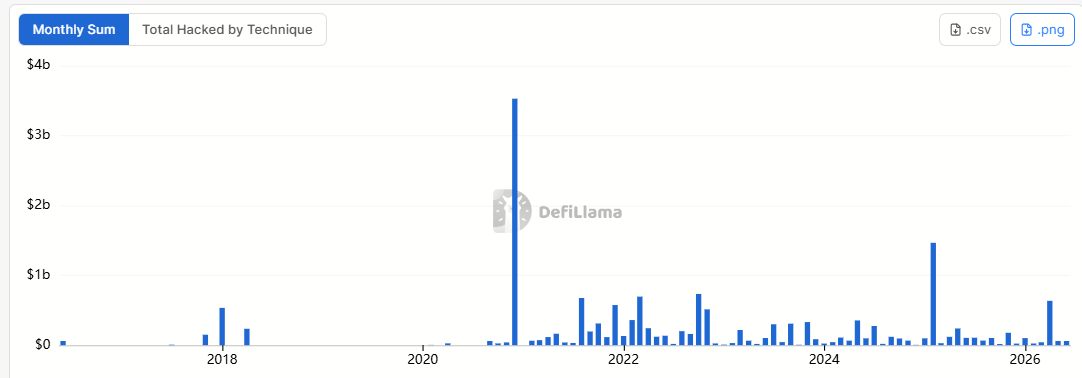
Cryptocurrency hacks by monthly sum, all-time chart. Source: DefiLlama
Bridge exploits emerged as leading attack vector in Q2 2026
Cross-chain bridge exploits emerged as the biggest attack vector of the quarter, with $351 million in value hacked from bridges alone.
The LayerZero OFT bridge exploit, which led to the $293 million KelpDAO hack, accounted for more than 38% of the value stolen during the quarter. Compromised admin attacks and fake token price manipulation accounted for 37% of losses, while private key compromises represented 5.66%.
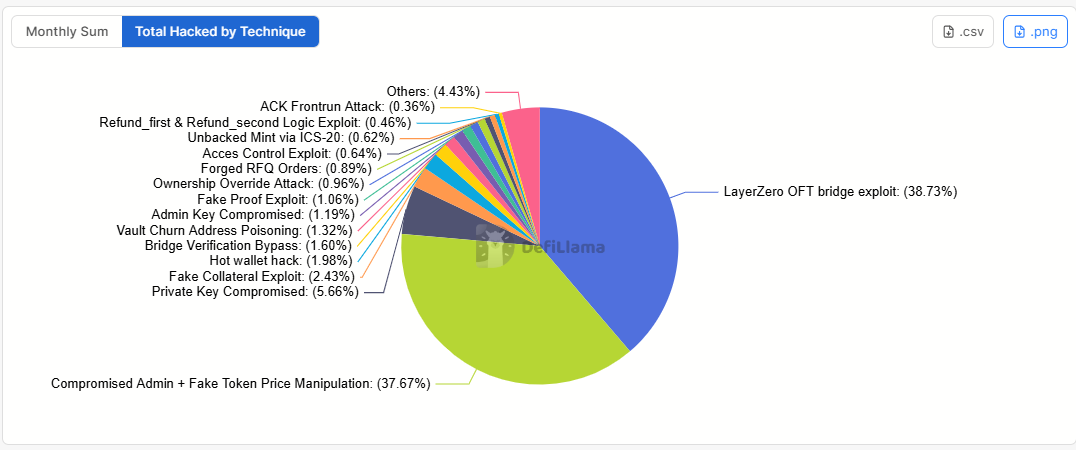
Total hacked by technique in Q2 2026. Source: DefiLlama
Ethereum layer-2 blockchain Taiko was the latest network to suffer an exploit on one of its bridge protocols, as hackers stole $1.7 million by compromising Taiko’s chain state verification mechanism.
Related: Humanity Protocol’s $36M loss tied to suspected North Korean hackers: Quantstamp
Other notable incidents of the past quarter include the $36 million stolen from Humanity Protocol on June 8 and the $10.7 million exploit on THORChain on May 15.
Other recent incidents include two exploits on Aztec Connect’s abandoned smart contracts, each resulting in $2.1 million stolen and $1.3 million stolen from decentralized exchange Raydium earlier in June.
The incidents add to the ongoing debate about whether the development of new artificial intelligence models has reshaped the crypto industry's security landscape, concerns that arose from the series of exploits in April.
During a recent interview, Mitchell Amador, the CEO of bug bounty platform Immunefi, told Cointelegraph that the proliferation of new AI models has shifted the cybersecurity playing field in favor of attackers, causing a “vulnerability apocalypse” that led to the resurgence in exploits.
Magazine: Coinbase hack shows the law probably won’t protect you — Here’s why
Disclaimer: The content of this article solely reflects the author's opinion and does not represent the platform in any capacity. This article is not intended to serve as a reference for making investment decisions.
You may also like
The AI boom may follow the path of the 19th-century railway bubble, and builders may not be the ultimate winners
Goldman Sachs analyst Bobby Molavi compared the current situation to the 19th-century British railway mania: 500 companies spent more than the nation's annual income building 8,000 miles of railway, with most early investors losing out, while the real beneficiaries were the later "passengers." He pointed out that the current AI craze is driven by both debt and momentum, and that the S&P 500’s forward P/E ratio of 18x is only "a bit cheaper." Whether the builders can retain value is uncertain, and history does not offer an optimistic answer.

If Anthropic's IPO goes smoothly and the stock price rises next week, then everything remains the same for AI. Otherwise, some companies will go bankrupt.
The shrinking valuations of two major giants have triggered a chain reaction—investors are adopting more conservative revenue multiples for AI startups and are directly halting high-valuation financing for companies with zero revenue. Multiple venture capital firms have advised their portfolio companies to lower valuation expectations and to quickly build up cash reserves. Market participants warn that the outcome of Anthropic’s IPO will be a barometer for the industry: if successful, the boom will continue; if it fails, some companies may face elimination.
After the Brazilian election, political discount deepens; Morgan Stanley remains bullish on Petrobras (PBR.US), focusing on fuel pricing and dividends
Morgan Stanley still maintains its most optimistic "Overweight" rating, but has lowered its year-end 2027 target price from $31 to $25.

Corning (GLW.US) receives initial "Buy" rating from Jefferies! AI factories driving a fiber optic rush, with a potential global supply gap of up to 30%
For Corning, the recent profit growth mainly comes from the expansion of AI clusters. As the number of optical links crossing cabinets and campuses increases, customers need to deploy more optical fibers within limited conduit and cabinet space, thus driving demand for high-density optical cables and connection systems.

Crypto prices
More


