
Ripple faces XRP escrow pressure from pro-XRP analyst

Ripple is facing a new debate over its XRP escrow strategy after pro-XRP attorney and commentator Bill Morgan urged the company to release more tokens each month.
- Bill Morgan urged Ripple to release more monthly XRP and relock fewer escrowed tokens overall.
- Ripple unlocks one billion XRP monthly, but often returns large unused amounts to escrow contracts.
- The debate comes as XRP trades near $1.14 with buyers defending $1.10 support this week.
His post focused on the amount Ripple returns to escrow after its scheduled monthly unlock.
Morgan wrote that Ripple “should release more of the 1 billion each month and not lock so much back in escrow.” He argued that a faster release schedule could help XRP reach full circulation sooner and strengthen its supply case.
XRP escrow timeline remains uncertain
Ripple’s escrow system releases one billion XRP at the start of each month. The company does not usually place the full amount into circulation. It often uses part of the unlock for operations, liquidity or institutional activity, then returns unused tokens to new escrow contracts.
That structure makes the final escrow end date hard to estimate. Reports after the June 1 unlock showed about 61.85 billion XRP in circulation and about 38.15 billion XRP still locked. If Ripple keeps returning large amounts, the escrow could take close to another decade to run down.
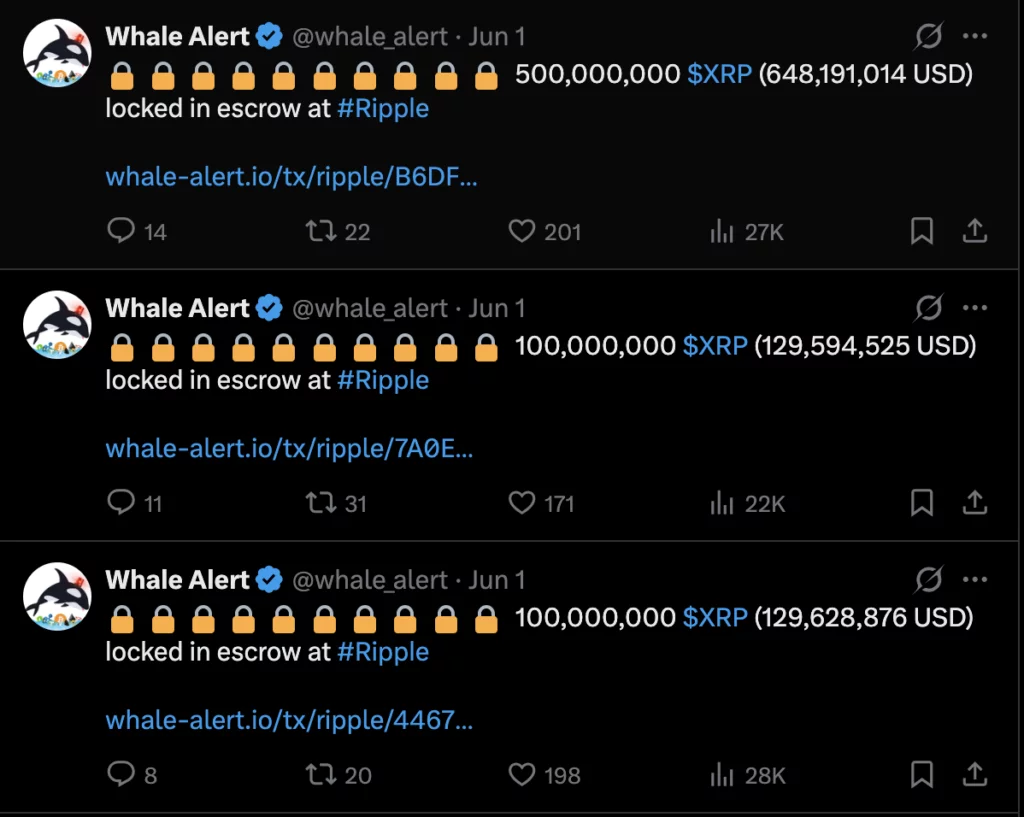 Source: Whale
Faster XRP release splits market views
Morgan framed a full circulating supply as part of XRP’s case as hard money. In his view, the sooner all escrowed XRP enters the active supply, the sooner the market can judge XRP without the overhang of future unlocks. He wrote that “the circulating supply is 100%” sooner, “the quicker XRP will become the best hard money.”
The view may not convince all token holders. Some traders fear larger releases could add selling pressure if demand does not rise at the same pace. Others argue the headline unlock amount already matters less than the net amount Ripple keeps out of escrow.
XRP price stays in a tight range
The debate comes as XRP trades in a narrow band. Recent market data showed XRP near $1.13, with buyers defending the $1.10 support area and sellers blocking a clean move above $1.20. The token has struggled to build strong momentum despite Ripple’s wider business activity.
Ripple adoption has grown through RLUSD, MXNB, Mastercard settlement links and AI payment tools. Fund flows have also helped the rebound case, but whale selling and weak volume have kept traders cautious.
Ripple business growth remains separate
Ripple has also tried to separate its company story from XRP holdings. As reported earlier, CEO Brad Garlinghouse expects Ripple to end 2026 with a $1 billion revenue run rate, excluding XRP on the company’s balance sheet.
That distinction matters for the escrow debate. Ripple’s operating business can grow through stablecoins, custody, treasury tools and payments, while XRP still trades on supply, demand and market sentiment. Morgan’s proposal would not change Ripple’s business model by itself. It would change how quickly the market reaches a final XRP supply structure.
Disclaimer: The content of this article solely reflects the author's opinion and does not represent the platform in any capacity. This article is not intended to serve as a reference for making investment decisions.
You may also like
Tesla Cybertruck: From Cracked Windows to Production Halt, a Three-and-a-Half Year Journey Ends
Since its launch in 2019, Cybertruck has been mired in controversy—ranging from a failed window demonstration on release day, a four-year delay in mass production, and its price rising from $39,900 to more than $100,000, along with a total of 11 recalls. The day before the halt of production was announced, Tesla raised the price once again, bringing a dramatic and intriguing end to the saga of this vehicle.
AI capital expenditure “peaks”; is the US economy also “peaking”?


Democrats to destroy the data center boom? Goldman Sachs bucks the trend with an upgrade forecast!
Goldman Sachs has raised its forecast for US data center construction spending against the trend, increasing the 2026 projection from $67 billion to $80 billion and, for the first time, projecting $125 billion for 2028. Despite the market panic caused by Texas's moratorium, Goldman Sachs believes this is essentially a delay rather than a termination, and the overall construction cycle remains resilient. However, highly leveraged developers face substantial risks from rising financing costs and contract cancellations.

Crypto prices
More


