
USD: Observations on the 100 Level

Morning FX
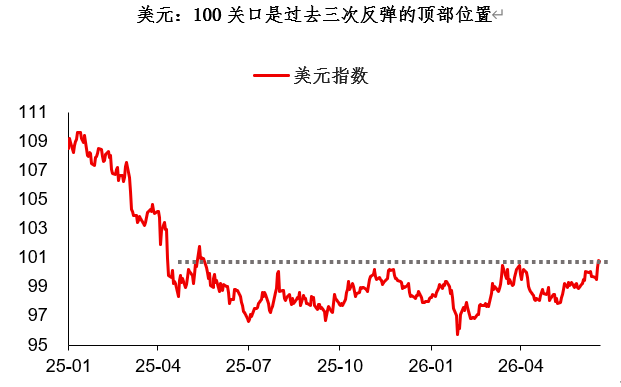
Quietly, the US Dollar Index has moved above the 100 level. The 100 threshold has been the peak of the dollar's three rebounds over the past year and is also a very important technical level. Therefore, let's discuss the market observations around this critical 100 mark.
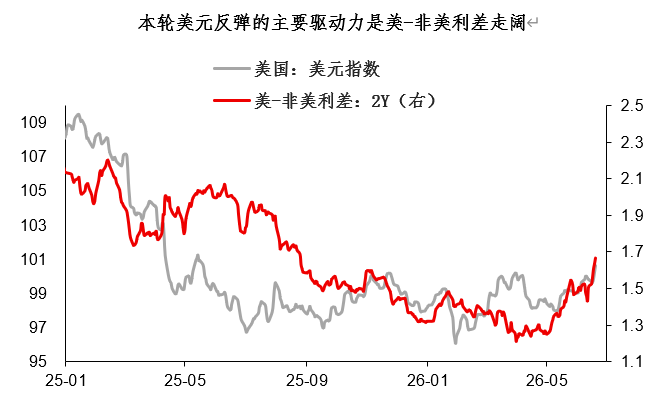
First of all, what is the main driving force behind this round of dollar rebound? Spreads, spreads, and more spreads. Since May, the US vs. non-US interest rate spread has clearly widened, which highly corresponds to the US dollar's rebound. Currently, the 2Y US vs. non-US spread maps to a dollar index center around 101. From the perspective of spreads, the fundamentals for this round of dollar rebound are more solid than previous ones.
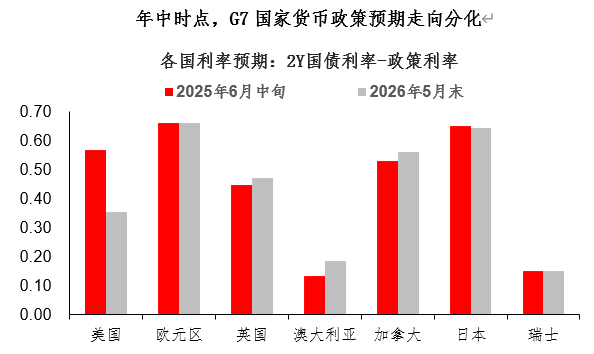
Why has the US vs. non-US interest rate spread widened? At its core, it's due to diverging monetary policy expectations among the G7 countries. As mentioned in the previous article “Mid-Year FX Market Outlook: Shadows Under the Scorching Sun”, the tightening cycles of different countries have diverged—some countries can continue to hike rates, while others can't. Data shows that in the past month, the rate hike expectations for the UK, Australia, and Canada have declined, while those for the Eurozone and Japan remain stable, and the US is one of the few economies where hike expectations continue to climb.
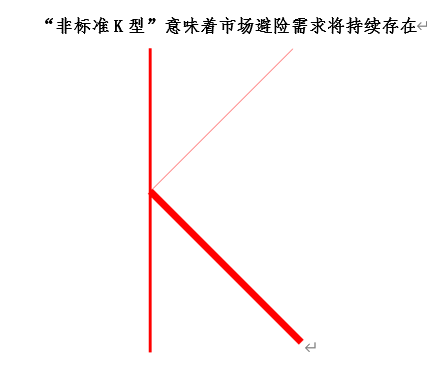
Besides the US vs. non-US interest rate spread, another important logic behind this round of dollar rebound is risk aversion. As we're at mid-year, many investors mention this: K-shaped divergence. Moreover, this year's K-shape is not quite typical—the upper arm is getting thinner and the lower arm is getting thicker. This “non-standard K-shape” suggests sustained market demand for safe-haven assets, regardless of whether the AI sector is crowded.
Within safe-haven assets, gold has been limited this year due to structural issues in the flow of funds, and its safe-haven properties are not strong (see “Gold: Market Observations at 4,300”). Looking back at the first half of the year, the US dollar has been the best safe-haven asset.
For safe-haven currencies like the US dollar, “whether positions are crowded” is also an important issue. From my observation, current dollar positions are not yet considered crowded. The 25D risk reversal implied volatility of the dollar against a basket of currencies is around its historical 60%-70% percentile, suggesting there is room for further development and momentum.
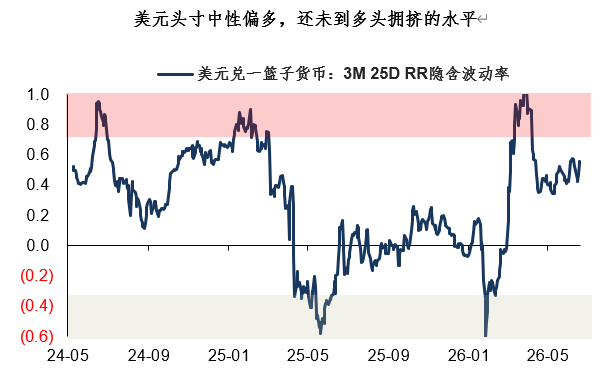
So, is the dollar index at the 100 level a starting point or an endpoint? In my view, 100 is not the endpoint—the real action in the second half of the year is just about to begin.
To summarize today's sharing:
1. The US Dollar Index has reached above the key 100 level, which is also an important technical threshold. What is the main driving force of this round of US dollar rebound? Spreads, spreads, and more spreads. The widening of the US vs. non-US spread essentially stems from diverging monetary policy expectations in G7 countries;
2. Besides the US vs. non-US interest rate spread, another key driver of this dollar rebound is risk aversion. Globally, the K-shaped divergence is becoming more pronounced, with a thinner upper arm and a thicker lower one. This “non-standard K-shape” means there will remain continuous demand for safe-haven assets in the market, and the US dollar is the best safe-haven this year;
3. In terms of position structure, the current dollar positioning is slightly net long, but not yet at crowded long levels—there's still room for further development and amplification. I tend to believe that 100 is not the end for the US Dollar Index, and the main show for the second half of the year is just about to begin.
Disclaimer: The content of this article solely reflects the author's opinion and does not represent the platform in any capacity. This article is not intended to serve as a reference for making investment decisions.
You may also like
The AI boom may follow the path of the 19th-century railway bubble, and builders may not be the ultimate winners
Goldman Sachs analyst Bobby Molavi compared the current situation to the 19th-century British railway mania: 500 companies spent more than the nation's annual income building 8,000 miles of railway, with most early investors losing out, while the real beneficiaries were the later "passengers." He pointed out that the current AI craze is driven by both debt and momentum, and that the S&P 500’s forward P/E ratio of 18x is only "a bit cheaper." Whether the builders can retain value is uncertain, and history does not offer an optimistic answer.

If Anthropic's IPO goes smoothly and the stock price rises next week, then everything remains the same for AI. Otherwise, some companies will go bankrupt.
The shrinking valuations of two major giants have triggered a chain reaction—investors are adopting more conservative revenue multiples for AI startups and are directly halting high-valuation financing for companies with zero revenue. Multiple venture capital firms have advised their portfolio companies to lower valuation expectations and to quickly build up cash reserves. Market participants warn that the outcome of Anthropic’s IPO will be a barometer for the industry: if successful, the boom will continue; if it fails, some companies may face elimination.
After the Brazilian election, political discount deepens; Morgan Stanley remains bullish on Petrobras (PBR.US), focusing on fuel pricing and dividends
Morgan Stanley still maintains its most optimistic "Overweight" rating, but has lowered its year-end 2027 target price from $31 to $25.

Corning (GLW.US) receives initial "Buy" rating from Jefferies! AI factories driving a fiber optic rush, with a potential global supply gap of up to 30%
For Corning, the recent profit growth mainly comes from the expansion of AI clusters. As the number of optical links crossing cabinets and campuses increases, customers need to deploy more optical fibers within limited conduit and cabinet space, thus driving demand for high-density optical cables and connection systems.
Crypto prices
More


