
Bitcoin Bearish Breakdown Setup Warns Sellers Still Control

TL;DR
- SHAY_ANALYTICS says BTCUSD confirmed a bearish breakdown from a multi-month symmetrical triangle.
- The analyst points to price trading below the breakout zone and Ichimoku cloud as bearish confirmation.
- The setup contrasts with short-term bounce calls, showing why BTC remains technically contested.
Bearish Continuation Case Remains Alive
Not every Bitcoin chart shared on June 20 treated the recent support reaction as a bullish reversal. A TradingView idea from SHAY_ANALYTICS argued that BTCUSD has confirmed a bearish breakdown from a multi-month symmetrical triangle, a structure that can mark a shift in market sentiment when support fails and price cannot quickly reclaim the lost range.
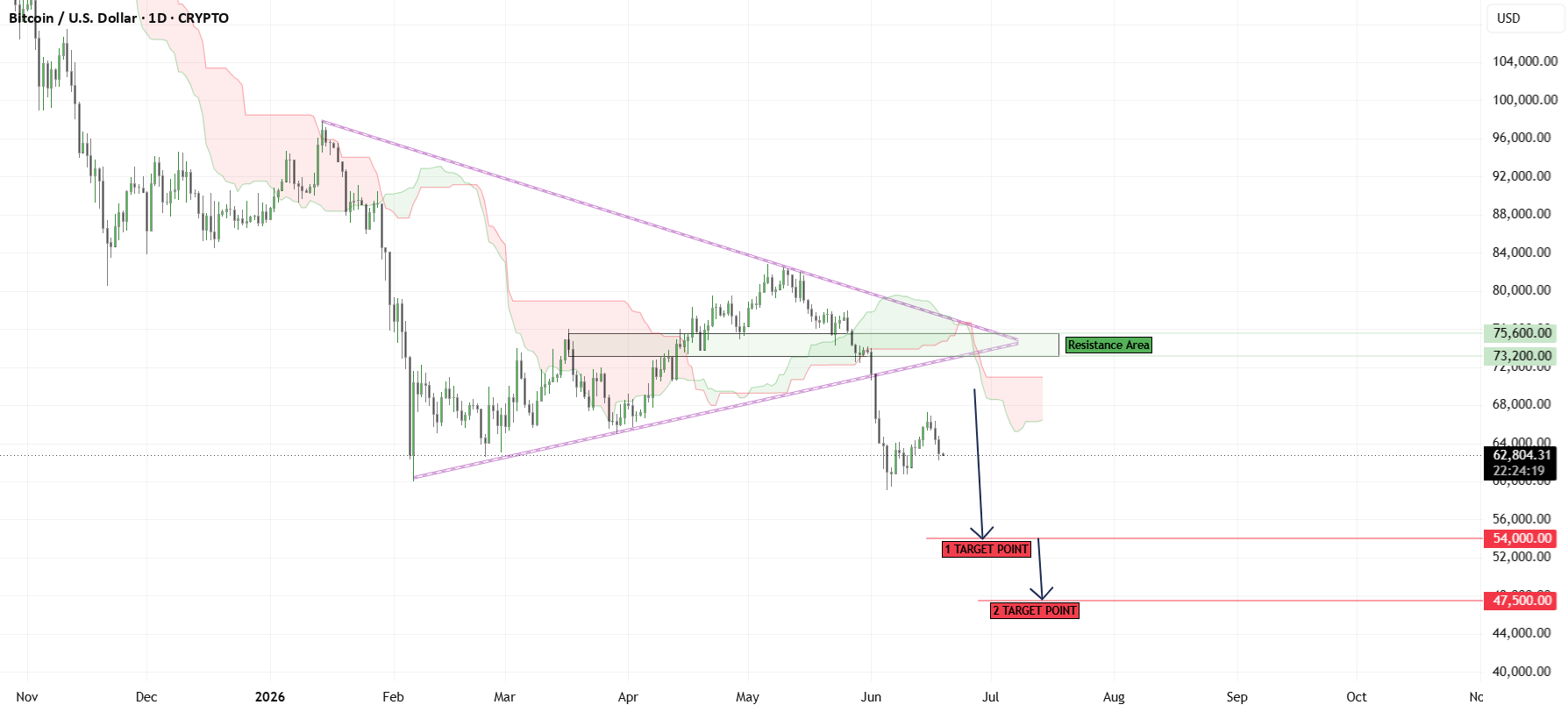
The analyst’s thesis is built around failed structure rather than a single price level. According to the chart summary, Bitcoin failed to hold above key support, then rejected from resistance after the breakdown. Price was also described as trading below the triangle breakout zone and below the Ichimoku cloud, reinforcing a downside bias.
Why The Larger Structure Matters
This bearish read is important because short-term bounces can happen inside broader downtrends. A reaction from support does not automatically reverse market structure if price remains below the levels that previously acted as support. For bulls, reclaiming those zones is usually more important than printing one or two strong candles.
The setup also explains why traders are watching nearby resistance so closely. If Bitcoin cannot recover the breakdown area, sellers can argue that rallies are simply retests. If price pushes back above the old structure, the bearish continuation thesis becomes less compelling.
A Useful Counterweight To Bullish Calls
The market currently has credible arguments on both sides. Some analysts are watching demand zones near $60,000 to $63,700 for a recovery. SHAY_ANALYTICS is focused on the larger breakdown and the risk that the market has already shifted lower.
That makes this a useful counterweight to more bullish weekend charts. Bitcoin does not need to collapse immediately for the bearish case to remain relevant. It simply needs to keep failing beneath broken support.
Disclaimer: The content of this article solely reflects the author's opinion and does not represent the platform in any capacity. This article is not intended to serve as a reference for making investment decisions.
You may also like
The AI boom may follow the path of the 19th-century railway bubble, and builders may not be the ultimate winners
Goldman Sachs analyst Bobby Molavi compared the current situation to the 19th-century British railway mania: 500 companies spent more than the nation's annual income building 8,000 miles of railway, with most early investors losing out, while the real beneficiaries were the later "passengers." He pointed out that the current AI craze is driven by both debt and momentum, and that the S&P 500’s forward P/E ratio of 18x is only "a bit cheaper." Whether the builders can retain value is uncertain, and history does not offer an optimistic answer.

If Anthropic's IPO goes smoothly and the stock price rises next week, then everything remains the same for AI. Otherwise, some companies will go bankrupt.
The shrinking valuations of two major giants have triggered a chain reaction—investors are adopting more conservative revenue multiples for AI startups and are directly halting high-valuation financing for companies with zero revenue. Multiple venture capital firms have advised their portfolio companies to lower valuation expectations and to quickly build up cash reserves. Market participants warn that the outcome of Anthropic’s IPO will be a barometer for the industry: if successful, the boom will continue; if it fails, some companies may face elimination.
After the Brazilian election, political discount deepens; Morgan Stanley remains bullish on Petrobras (PBR.US), focusing on fuel pricing and dividends
Morgan Stanley still maintains its most optimistic "Overweight" rating, but has lowered its year-end 2027 target price from $31 to $25.

Corning (GLW.US) receives initial "Buy" rating from Jefferies! AI factories driving a fiber optic rush, with a potential global supply gap of up to 30%
For Corning, the recent profit growth mainly comes from the expansion of AI clusters. As the number of optical links crossing cabinets and campuses increases, customers need to deploy more optical fibers within limited conduit and cabinet space, thus driving demand for high-density optical cables and connection systems.
Crypto prices
More


