
S token drops 5% as 3 former execs resign from Sonic Labs board

The S token, the native utility asset behind the Sonic blockchain, fell 5% on Friday after Sonic Labs, formerly known as the Fantom Foundation, announced the resignation of three former executives from its board.
The S token fell to 0.031 on Friday, down 5% over 24 hours. The resignations include Michael Kong, a former CEO of the Fantom Foundation and director at Sonic Labs; David Richardson, who served as executive chairman of Sonic Labs; and Andre Cronje, who previously served as its chief technology officer.
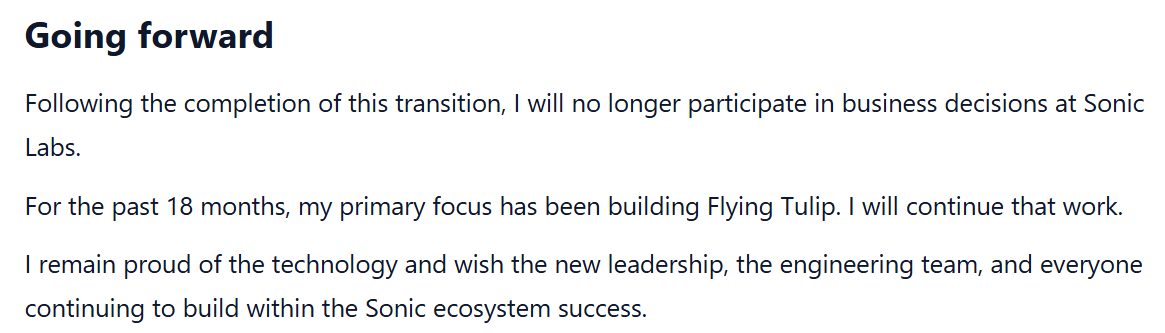
Statement from Andre Cronje about his resignation from the board. Source:
“These are the people who built what Sonic is today. They remain invested in Sonic’s success and are handing off their responsibilities the right way, in full. From here, they will no longer make business decisions for the organization,” Sonic Labs said as it announced Matt Visser as its new CEO and Kosta Kourkoumelis as chief operating officer.
Sonic Labs is overhauling its leadership and governance structure as it attempts to address growing community dissatisfaction and a prolonged decline in its S token, which has fallen 97% since launching in January 2025 as part of a network upgrade.
“We are not going to open with a victory lap. The token is down. Community sentiment is down. We see both clearly, we are not spinning it, and we are not asking anyone to pretend otherwise,” said Sonic Labs.
Sonic Labs, the research and development organization behind the Sonic EVM-compatible layer-1 blockchain, is the successor to the Fantom Foundation, which was founded in 2018.
The blockchain is focused on speed, claiming to provide 10,000 transactions per second and subsecond finality. Its rebrand from Fantom to Sonic introduced a major structural and technical upgrade to the network as it replaced its legacy Fantom Opera network.
Sonic Labs said the leadership change will also come with a commitment to more transparent governance, clear communication about project updates, and the creation of a dedicated risk and compliance committee.
The leadership shuffle comes just days after Ethereum Foundation co-executive director Hsiao-Wei Wang announced that she had stepped down on Thursday, adding to a list of 19 layoffs and departures from the foundation this year.
Disclaimer: The content of this article solely reflects the author's opinion and does not represent the platform in any capacity. This article is not intended to serve as a reference for making investment decisions.
You may also like
The AI boom may follow the path of the 19th-century railway bubble, and builders may not be the ultimate winners
Goldman Sachs analyst Bobby Molavi compared the current situation to the 19th-century British railway mania: 500 companies spent more than the nation's annual income building 8,000 miles of railway, with most early investors losing out, while the real beneficiaries were the later "passengers." He pointed out that the current AI craze is driven by both debt and momentum, and that the S&P 500’s forward P/E ratio of 18x is only "a bit cheaper." Whether the builders can retain value is uncertain, and history does not offer an optimistic answer.

If Anthropic's IPO goes smoothly and the stock price rises next week, then everything remains the same for AI. Otherwise, some companies will go bankrupt.
The shrinking valuations of two major giants have triggered a chain reaction—investors are adopting more conservative revenue multiples for AI startups and are directly halting high-valuation financing for companies with zero revenue. Multiple venture capital firms have advised their portfolio companies to lower valuation expectations and to quickly build up cash reserves. Market participants warn that the outcome of Anthropic’s IPO will be a barometer for the industry: if successful, the boom will continue; if it fails, some companies may face elimination.
After the Brazilian election, political discount deepens; Morgan Stanley remains bullish on Petrobras (PBR.US), focusing on fuel pricing and dividends
Morgan Stanley still maintains its most optimistic "Overweight" rating, but has lowered its year-end 2027 target price from $31 to $25.

Corning (GLW.US) receives initial "Buy" rating from Jefferies! AI factories driving a fiber optic rush, with a potential global supply gap of up to 30%
For Corning, the recent profit growth mainly comes from the expansion of AI clusters. As the number of optical links crossing cabinets and campuses increases, customers need to deploy more optical fibers within limited conduit and cabinet space, thus driving demand for high-density optical cables and connection systems.

Crypto prices
More


