
Republican lawmaker proposes prediction markets insider trading ban, not including White House officials

Wisconsin Representative Bryan Steil, who chairs the House subcommittee on digital assets, introduced a law to prevent certain public officials from “wagering on public policy issues and political outcomes,” notably without mentioning lawmakers in the White House.
In a Thursday notice, Steil said he had introduced the Stop Lawmakers from Predicting Act, which could bar "members of Congress, their spouses, and dependent children” from using policy-aligned event contracts on prediction markets platforms like Kalshi and Polymarket. The bill proposed that elected officials in violation pay a $2,000 fee or 10% of the value of the prohibited bets on the platforms.
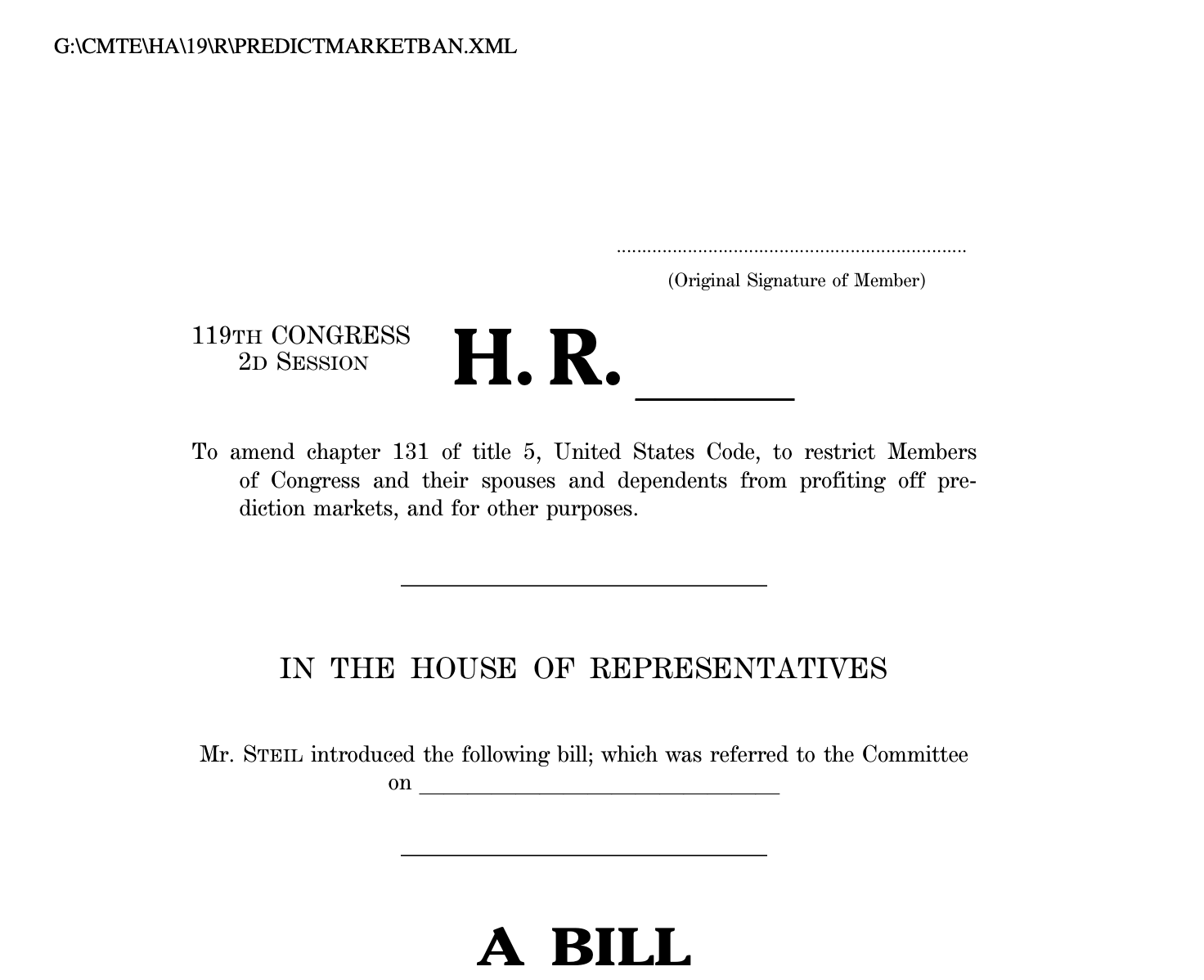
Source: Committee on House Administration
The proposed law did not specifically bar US lawmakers from using prediction markets platforms or making bets on sporting events, but prohibited wagers on specific government policies, government actions and “political outcomes,” presumably including election results. If passed by Congress and signed into law by the president, the law could take effect in 180 days after enactment.
Steil’s bill was the latest attempt by members of Congress to address lawmakers potentially using insider information to profit on event contracts. The issue drew attention from many in the public after an incident involving a soldier who allegedly made more than $400,000 betting on the removal of Venezuela President Nicolás Maduro, who was ousted by US forces in January.
Related: Polymarket weighs KYC requirements amid global crackdown on prediction markets
Although the proposed law follows attempts from other lawmakers to crack down on insider trading on prediction markets, Steil’s legislation did not extend to White House officials, including President Donald Trump and Vice President JD Vance. Trump’s son, Donald Trump Jr., is a strategic adviser to Kalshi and an adviser to Polymarket, which was also a sponsor of the UFC Freedom 250 event at the White House on Sunday.
Cointelegraph reached out to Steil’s office for comment but did not receive an immediate response.
Federal regulator still fighting for control of prediction markets
Under Trump, the Commodity Futures Trading Commission (CFTC) and its chair Michael Selig have claimed that the federal agency has “exclusive jurisdiction” in the regulation and enforcement around prediction markets. The CFTC has already filed multiple lawsuits against state-level authorities restricting or banning the platforms, claiming that under the Commodity Exchange Act, event contracts can be regulated as “swaps” and not bets.
Some experts believe that the legal fight could be headed to the Supreme Court next.
Magazine: The end of anon? AI could unmask crypto’s hidden identities
Disclaimer: The content of this article solely reflects the author's opinion and does not represent the platform in any capacity. This article is not intended to serve as a reference for making investment decisions.
You may also like
The AI boom may follow the path of the 19th-century railway bubble, and builders may not be the ultimate winners
Goldman Sachs analyst Bobby Molavi compared the current situation to the 19th-century British railway mania: 500 companies spent more than the nation's annual income building 8,000 miles of railway, with most early investors losing out, while the real beneficiaries were the later "passengers." He pointed out that the current AI craze is driven by both debt and momentum, and that the S&P 500’s forward P/E ratio of 18x is only "a bit cheaper." Whether the builders can retain value is uncertain, and history does not offer an optimistic answer.

If Anthropic's IPO goes smoothly and the stock price rises next week, then everything remains the same for AI. Otherwise, some companies will go bankrupt.
The shrinking valuations of two major giants have triggered a chain reaction—investors are adopting more conservative revenue multiples for AI startups and are directly halting high-valuation financing for companies with zero revenue. Multiple venture capital firms have advised their portfolio companies to lower valuation expectations and to quickly build up cash reserves. Market participants warn that the outcome of Anthropic’s IPO will be a barometer for the industry: if successful, the boom will continue; if it fails, some companies may face elimination.
After the Brazilian election, political discount deepens; Morgan Stanley remains bullish on Petrobras (PBR.US), focusing on fuel pricing and dividends
Morgan Stanley still maintains its most optimistic "Overweight" rating, but has lowered its year-end 2027 target price from $31 to $25.

Corning (GLW.US) receives initial "Buy" rating from Jefferies! AI factories driving a fiber optic rush, with a potential global supply gap of up to 30%
For Corning, the recent profit growth mainly comes from the expansion of AI clusters. As the number of optical links crossing cabinets and campuses increases, customers need to deploy more optical fibers within limited conduit and cabinet space, thus driving demand for high-density optical cables and connection systems.

Crypto prices
More


