
Is there a divergence between the bond market and Federal Reserve expectations? The market is no longer afraid of inflation!

As a core indicator measuring the market's short-term inflation expectations, the US 2-year breakeven inflation rate has recently dropped sharply, declining by a cumulative 100 basis points since reaching a year-to-date high in mid-March. This trend is not limited to the front-end but has spread along the entire curve: during the peak of the energy shock in May, the 5-year, 10-year, and 30-year breakeven inflation rates surged to 274, 252, and 236 basis points respectively, but have since given back all gains and now are all below their three-year averages.
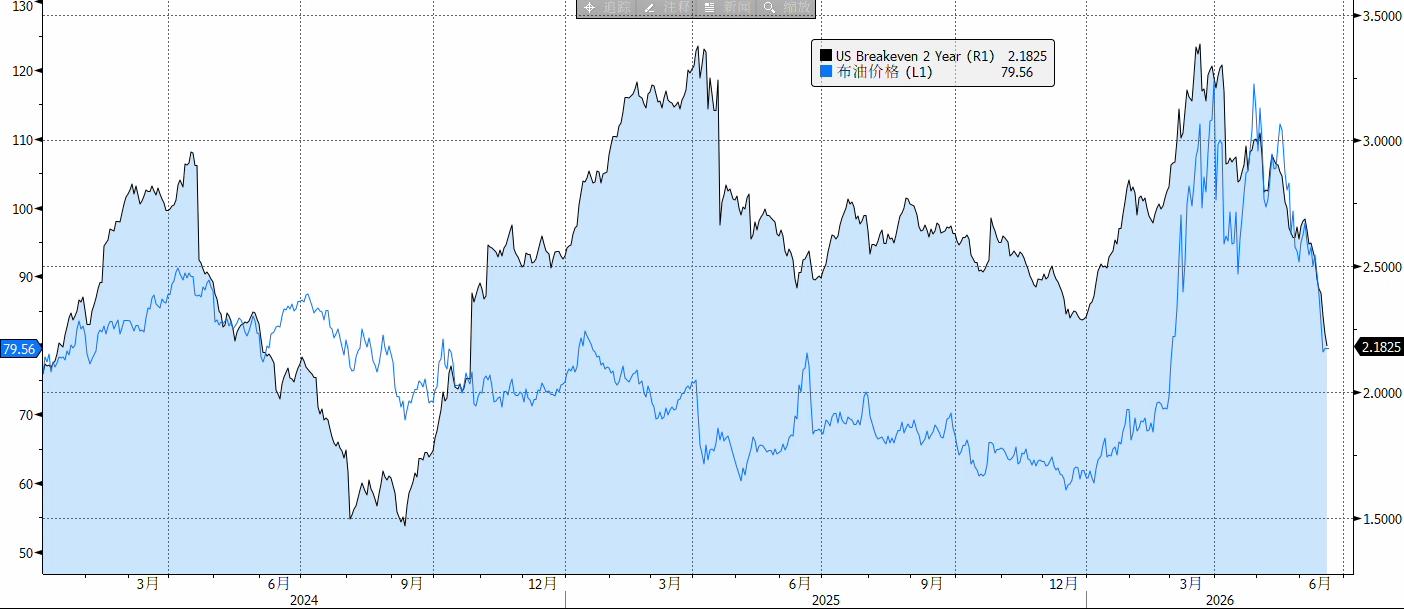
The most direct implication of the decline in breakeven inflation rates is that the market's risk premium for inflation over the next two years has decreased. Previously, there were concerns that the escalation of tensions in the Middle East, rising oil prices, and renewed supply chain disruptions would cause inflation to resurge. Although US CPI year-on-year growth reached as high as 4.2% in May, and there is a lag in the transmission of energy prices to end prices, current market trends suggest that investors no longer interpret this as a signal of structural inflation, but rather view the energy shock triggered by the US-Iran conflict as a one-off, temporary factor.
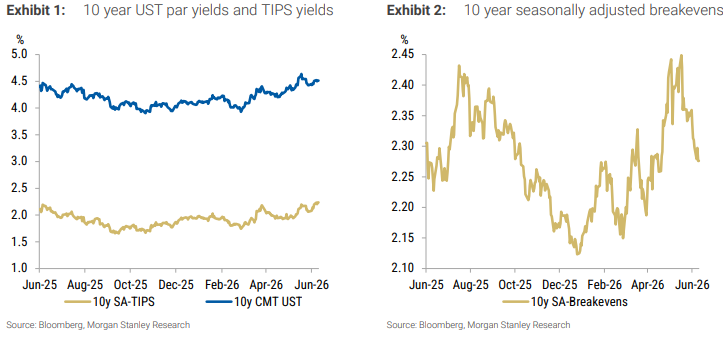
During the conflict, oil prices surged, but the breakeven inflation rate did not hit new highs and actually started to fall ahead of oil prices. Since oil prices retreated from their March highs, the decline in the 1-year CPI swap rate has only been about one-third to one-half that of the oil price drop, indicating that the market recognizes the indirect effects of weaker energy prices but has largely discounted the possibility of a subsequent revision up of core inflation. This shows that the market is gradually filtering out geopolitical noise and is instead focusing on trend-driven inflation signals.
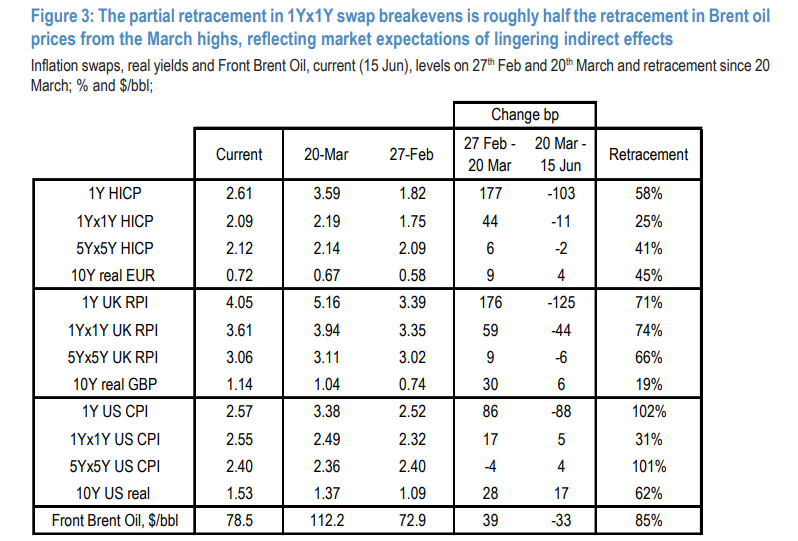
Is the Market Preemptively Pricing in Lower Inflation?
The sustained decline in the 2-year breakeven inflation rate has been mainly driven by two factors: first, a sharp pullback in oil prices after the easing of geopolitical tensions; second, strong US employment data and the Federal Reserve’s shift to a more hawkish stance.
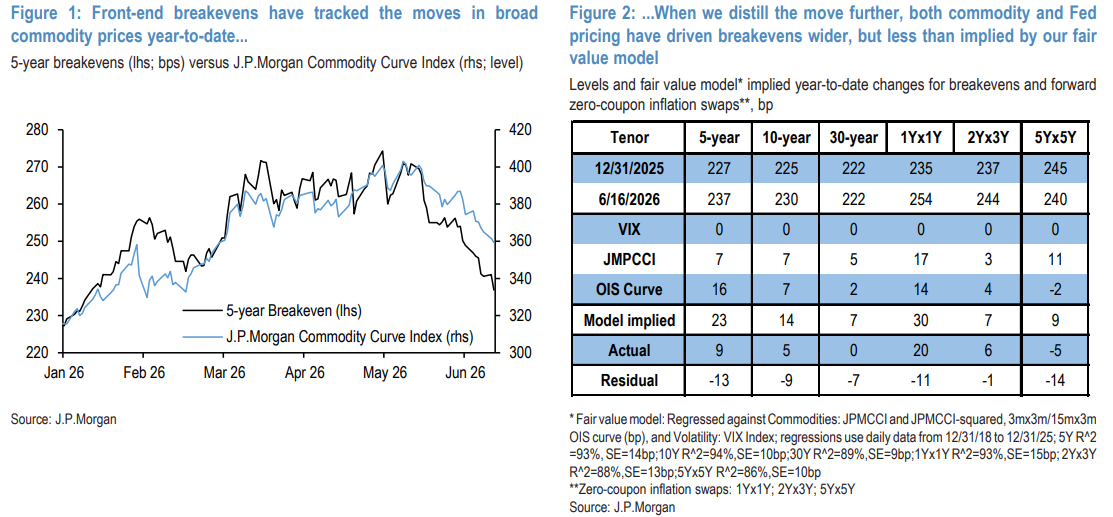
Since the outbreak of the US-Iran conflict at the end of February, oil supply shocks pushed the US 2-year breakeven inflation rate upward; after both sides reached a ceasefire agreement for the first time in early April, this indicator entered a downtrend, despite repeated negotiations and substantial oil price fluctuations in between. Following the signing of a memorandum of understanding for a truce on June 18 by the US and Iran, this months-long geopolitical military conflict has entered a substantive concluding phase.
Disclaimer: The content of this article solely reflects the author's opinion and does not represent the platform in any capacity. This article is not intended to serve as a reference for making investment decisions.
You may also like
The AI boom may follow the path of the 19th-century railway bubble, and builders may not be the ultimate winners
Goldman Sachs analyst Bobby Molavi compared the current situation to the 19th-century British railway mania: 500 companies spent more than the nation's annual income building 8,000 miles of railway, with most early investors losing out, while the real beneficiaries were the later "passengers." He pointed out that the current AI craze is driven by both debt and momentum, and that the S&P 500’s forward P/E ratio of 18x is only "a bit cheaper." Whether the builders can retain value is uncertain, and history does not offer an optimistic answer.

If Anthropic's IPO goes smoothly and the stock price rises next week, then everything remains the same for AI. Otherwise, some companies will go bankrupt.
The shrinking valuations of two major giants have triggered a chain reaction—investors are adopting more conservative revenue multiples for AI startups and are directly halting high-valuation financing for companies with zero revenue. Multiple venture capital firms have advised their portfolio companies to lower valuation expectations and to quickly build up cash reserves. Market participants warn that the outcome of Anthropic’s IPO will be a barometer for the industry: if successful, the boom will continue; if it fails, some companies may face elimination.
After the Brazilian election, political discount deepens; Morgan Stanley remains bullish on Petrobras (PBR.US), focusing on fuel pricing and dividends
Morgan Stanley still maintains its most optimistic "Overweight" rating, but has lowered its year-end 2027 target price from $31 to $25.

Corning (GLW.US) receives initial "Buy" rating from Jefferies! AI factories driving a fiber optic rush, with a potential global supply gap of up to 30%
For Corning, the recent profit growth mainly comes from the expansion of AI clusters. As the number of optical links crossing cabinets and campuses increases, customers need to deploy more optical fibers within limited conduit and cabinet space, thus driving demand for high-density optical cables and connection systems.

Crypto prices
More


