Bitget App
Trade smarter
Buy cryptoMarketsTradeFuturesStocksEarnInstitutionAI & More
Why Avalanche (AVAX) Price Has Fallen Behind Solana, TRON, and BNB

Why Avalanche (AVAX) Price Has Fallen Behind Solana, TRON, and BNB

CoinpediaCoinpedia2026/06/19 13:03
By:Coinpedia

Following a rejection from the consolidated zone between $8.50 and $10, the Avalanche (AVAX) price has been facing massive selling pressure. The bulls attempted hard to prevent a continued bearish action, while the latest pullback has intensified the possibility of a deeper correction. Moreover, the token has remained under heavy pressure this cycle, continuing to lag behind major cryptos like Solana (SOL), TRON (TRX), and BNB despite maintaining strong ecosystem development.

While rival Layer-1 tokens have benefited from stronger narratives, liquidity inflows, and user-driven momentum, the AVAX price has drained heavily from the yearly highs and is currently trading near the local lows around $6. This raises a question about the current demand for the token, which appears to be fading. 

Avalanche Breakdown Puts $6 Support Under Immediate Pressure

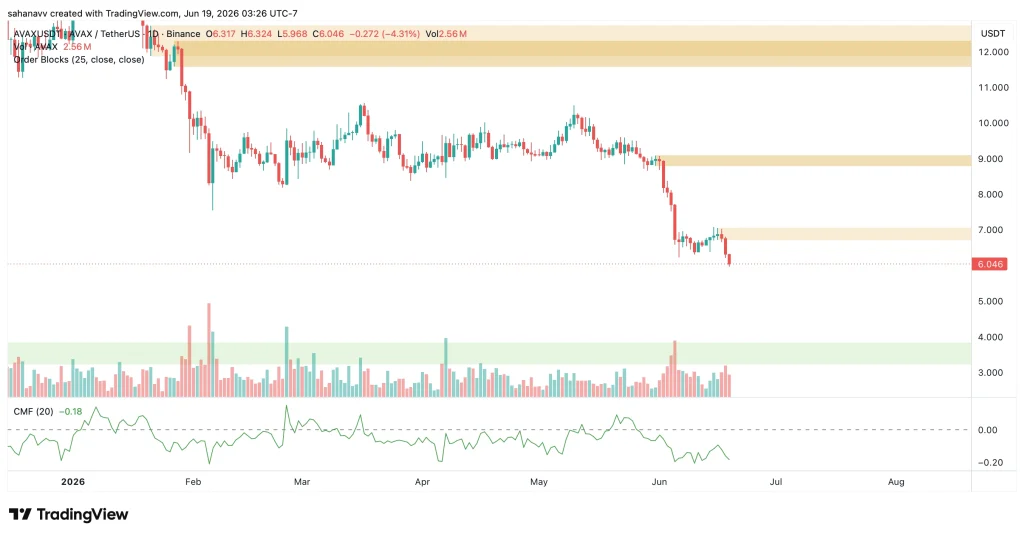
Avalanche continues to struggle as selling pressure keeps outweighing buyer interest, leaving the token stuck in a broader downtrend. After facing strong rejection from the $12–$12.5 order block earlier this year, AVAX has consistently printed lower highs and lower lows—a sign that momentum has remained weak compared to other major altcoins. The latest breakdown below the $9 order block was particularly important, as that zone had acted as a key support base for weeks. Once that level gave way, price quickly slid toward the $6 region, showing how fragile market confidence has become.
Why Avalanche (AVAX) Price Has Fallen Behind Solana, TRON, and BNB  image 0

Right now, AVAX is trying to stabilize, but the bounce back into the $6.8–$7.0 order block doesn’t yet look convincing. Instead, it feels more like a short-term relief move rather than the start of a stronger recovery, especially with money flow indicators still pointing to capital leaving the asset. For bulls, reclaiming this nearby order block is the first real test. If they fail, the pressure could build for another drop below $6, which may drag AVAX toward the $3.5–$4 demand zone. Until buyers can start reclaiming these lost levels, Avalanche remains one of the weaker names in the market.

Avalanche’s Weak Structure Keeps It Behind Market Leaders

In the bigger picture, Avalanche’s inability to hold key order blocks and generate strong buying interest highlights why it has lagged behind stronger altcoins like SOL, BNB, and TRX. While those assets have managed to reclaim important resistance levels and attract fresh liquidity, AVAX continues to trade defensively, with sellers controlling most rallies. Unless the token can reclaim its nearby supply zones and rebuild momentum, the risk of deeper downside remains elevated—keeping Avalanche in a weaker position within the broader market cycle.

0
0

Disclaimer: The content of this article solely reflects the author's opinion and does not represent the platform in any capacity. This article is not intended to serve as a reference for making investment decisions.

Understand the market, then trade.
Bitget offers one-stop trading for cryptocurrencies, stocks, and gold.
Trade now!

You may also like

The AI boom may follow the path of the 19th-century railway bubble, and builders may not be the ultimate winners

Goldman Sachs analyst Bobby Molavi compared the current situation to the 19th-century British railway mania: 500 companies spent more than the nation's annual income building 8,000 miles of railway, with most early investors losing out, while the real beneficiaries were the later "passengers." He pointed out that the current AI craze is driven by both debt and momentum, and that the S&P 500’s forward P/E ratio of 18x is only "a bit cheaper." Whether the builders can retain value is uncertain, and history does not offer an optimistic answer.

华尔街见闻•2026/11/12 03:56
The AI boom may follow the path of the 19th-century railway bubble, and builders may not be the ultimate winners

If Anthropic's IPO goes smoothly and the stock price rises next week, then everything remains the same for AI. Otherwise, some companies will go bankrupt.

The shrinking valuations of two major giants have triggered a chain reaction—investors are adopting more conservative revenue multiples for AI startups and are directly halting high-valuation financing for companies with zero revenue. Multiple venture capital firms have advised their portfolio companies to lower valuation expectations and to quickly build up cash reserves. Market participants warn that the outcome of Anthropic’s IPO will be a barometer for the industry: if successful, the boom will continue; if it fails, some companies may face elimination.

华尔街见闻•2026/11/12 03:46

After the Brazilian election, political discount deepens; Morgan Stanley remains bullish on Petrobras (PBR.US), focusing on fuel pricing and dividends

Morgan Stanley still maintains its most optimistic "Overweight" rating, but has lowered its year-end 2027 target price from $31 to $25.

智通财经•2026/11/12 03:42
After the Brazilian election, political discount deepens; Morgan Stanley remains bullish on Petrobras (PBR.US), focusing on fuel pricing and dividends

Corning (GLW.US) receives initial "Buy" rating from Jefferies! AI factories driving a fiber optic rush, with a potential global supply gap of up to 30%

For Corning, the recent profit growth mainly comes from the expansion of AI clusters. As the number of optical links crossing cabinets and campuses increases, customers need to deploy more optical fibers within limited conduit and cabinet space, thus driving demand for high-density optical cables and connection systems.

智通财经•2026/11/12 02:47
Corning (GLW.US) receives initial "Buy" rating from Jefferies! AI factories driving a fiber optic rush, with a potential global supply gap of up to 30%