
Former SK hynix CEO appointed to lead packaging business, Intel stock surges 10% to hit record high

Intel is accelerating the restructuring of its foundry division to focus on the AI chip manufacturing market.
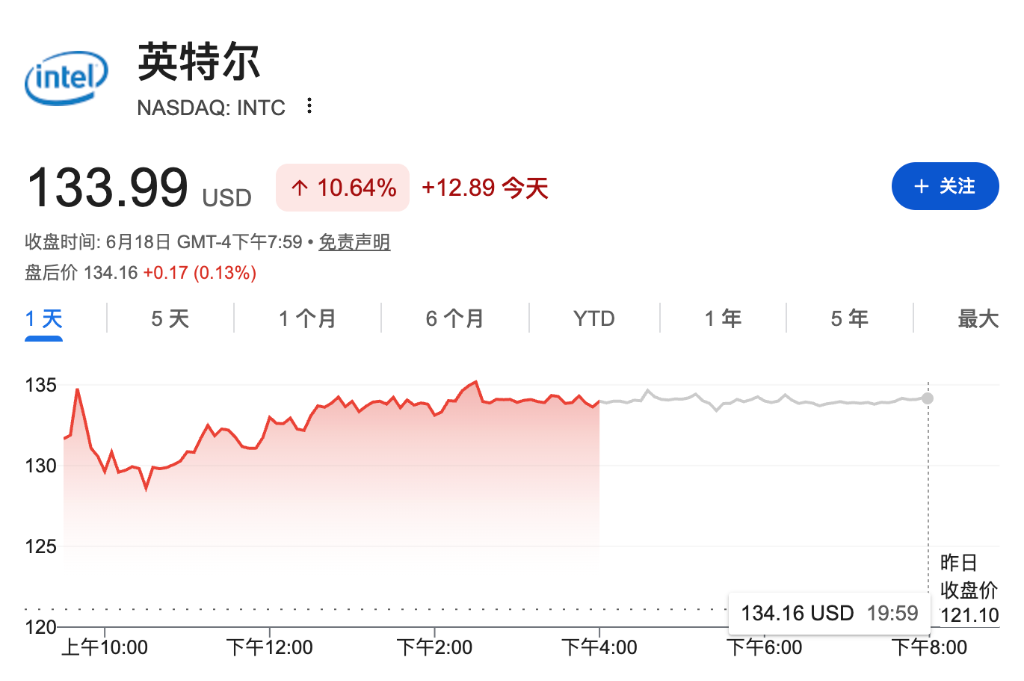
According to Reuters, on Thursday the company appointed former SK Hynix CEO Seok-Hee Lee as the Executive Vice President of the foundry division. He will report directly to CEO Pat Gelsinger and be responsible for advanced packaging, system integration, and back-end manufacturing operations. On the same day, Trump announced that Apple has agreed to collaborate with Intel to jointly design and manufacture chips in the United States. Driven by this dual positive news, Intel's stock price surged 10%, hitting a record high.
This appointment establishes advanced packaging as an independent operating segment, giving it dedicated leadership and strategic focus. It is a key step in advancing Intel's IDM 2.0 strategy and revitalizing its manufacturing business. Analysts believe advanced packaging is a technological pillar for Intel’s differentiated competition, while Apple’s involvement provides a long-term demand basis for the foundry business.
Personnel Appointment: Bringing in an Industry Veteran to Lead Packaging Strategy
Seok-Hee Lee’s arrival provides crucial talent support for Intel’s foundry business. He previously served as President and CEO of SK Hynix and as President and CEO of SK On, with extensive experience managing large-scale technology and manufacturing organizations. Lee worked at Intel in engineering leadership roles earlier in his career, and refers to his return as “coming home.”
CEO Pat Gelsinger stated that advanced packaging and system integration are becoming core competencies for next-generation computing systems. Lee’s expertise in operational execution and managing technical organizations will help Intel strengthen its system integration capabilities, tightly coupling components such as logic, memory, and networking to build high-performance computing systems for foundry clients.
With this restructuring, former Executive Vice President of the Foundry Business Naga Chandrasekaran will continue to report to Pat Gelsinger, focusing on front-end technology development and manufacturing, especially ramping up mass production for Intel 18A, Intel 14A, and future processes. The clear division of labor between front-end and back-end operations aims to deliver greater execution certainty to clients. In addition, Executive Vice President Navid Shahriari announced his retirement after a 37-year career.
Advanced Packaging: A Key Battleground in the AI Era
Intel’s move to establish advanced packaging as a standalone business segment reflects structural trends in the semiconductor industry. As chipmakers enhance performance through multi-chip integrated packaging, the strategic importance of advanced packaging continues to rise, especially in the fields of AI systems and high-performance computing.
In its statement, Intel highlighted two advanced packaging technologies, EMIB-T and HBI, noting that both are moving toward high-volume production. CEO Pat Gelsinger said Lee is “the right leader to build and scale this critical pillar of Intel’s foundry business.”
This appointment is the latest move in Intel’s intensive expansion of its foundry business. According to Reuters, in April this year, Intel hired Shawn Han from Samsung to assist in advancing its contract manufacturing business. In the same month, Tesla became the first major customer for its next-generation 14A manufacturing process, which is expected to reach mass production in 2029.
Disclaimer: The content of this article solely reflects the author's opinion and does not represent the platform in any capacity. This article is not intended to serve as a reference for making investment decisions.
You may also like
The AI boom may follow the path of the 19th-century railway bubble, and builders may not be the ultimate winners
Goldman Sachs analyst Bobby Molavi compared the current situation to the 19th-century British railway mania: 500 companies spent more than the nation's annual income building 8,000 miles of railway, with most early investors losing out, while the real beneficiaries were the later "passengers." He pointed out that the current AI craze is driven by both debt and momentum, and that the S&P 500’s forward P/E ratio of 18x is only "a bit cheaper." Whether the builders can retain value is uncertain, and history does not offer an optimistic answer.

If Anthropic's IPO goes smoothly and the stock price rises next week, then everything remains the same for AI. Otherwise, some companies will go bankrupt.
The shrinking valuations of two major giants have triggered a chain reaction—investors are adopting more conservative revenue multiples for AI startups and are directly halting high-valuation financing for companies with zero revenue. Multiple venture capital firms have advised their portfolio companies to lower valuation expectations and to quickly build up cash reserves. Market participants warn that the outcome of Anthropic’s IPO will be a barometer for the industry: if successful, the boom will continue; if it fails, some companies may face elimination.
After the Brazilian election, political discount deepens; Morgan Stanley remains bullish on Petrobras (PBR.US), focusing on fuel pricing and dividends
Morgan Stanley still maintains its most optimistic "Overweight" rating, but has lowered its year-end 2027 target price from $31 to $25.
Corning (GLW.US) receives initial "Buy" rating from Jefferies! AI factories driving a fiber optic rush, with a potential global supply gap of up to 30%
For Corning, the recent profit growth mainly comes from the expansion of AI clusters. As the number of optical links crossing cabinets and campuses increases, customers need to deploy more optical fibers within limited conduit and cabinet space, thus driving demand for high-density optical cables and connection systems.
Crypto prices
More


