Bitget App
Trade smarter
Buy cryptoMarketsTradeFuturesStocksEarnInstitutionAI & More
U.S. Margin Debt Reaches Record High as Borrowing Surges

U.S. Margin Debt Reaches Record High as Borrowing Surges

CoinEditionCoinEdition2026/06/19 12:06
By:CoinEdition

Investor margin debt in U.S. financial markets surged to a new record in May, reflecting increased use of leverage as stock prices continued to approach historic highs. According to the data, margin debt rose by $112 billion during the month to reach $1.42 trillion, marking the second consecutive monthly increase.

Combined with April’s gains, margin debt expanded by $195 billion over two months and has increased by $495 billion, or 54%, over the last year.

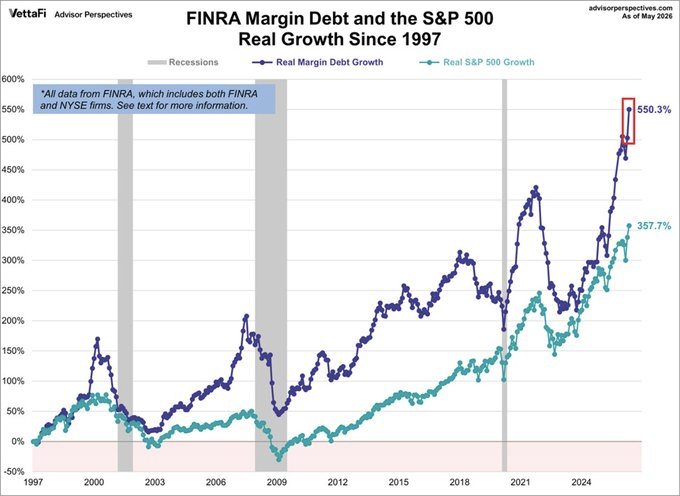
Data compiled by VettaFi indicate that margin debt growth has outpaced the long-term performance of the S&P 500. Since 1997, real margin debt has increased by approximately 550.3%, while the inflation-adjusted S&P 500 has risen about 357.7% over the same period.
U.S. Margin Debt Reaches Record High as Borrowing Surges  image 0 Source:

Adjusted for inflation, margin debt advanced 7.9% in May from the previous month and was up by 47.4% from a year earlier.

The latest increase also pushed margin debt above previous highs recorded during earlier market cycles, including the peak reached in 2021. At the same time, the S&P 500 continued climbing, moving above the 7,000 level and reaching new records of its own.

(adsbygoogle = window.adsbygoogle || []).push({});

Long-term data show that major increases in margin debt have often occurred near key market peaks. During the technology-driven market expansion of the late 1990s, margin debt surged before reaching a peak in March 2000, around the same period the S&P 500 approached its cycle high.

A similar pattern emerged ahead of the global financial crisis. Margin debt rallied throughout 2006 and peaked in July 2007, several months before the stock market reached its high. Following the crisis, borrowing activity fell and bottomed in February 2009, coinciding with the market’s low point.

More recently, margin debt reached a high in October 2021 before declining through 2022. The borrowing cycle later found a low in December 2022, shortly after the broader market downturn.

While rising margin debt often reflects investor confidence and strong market momentum, historical trends show that rapid increases in leverage have frequently preceded periods of heightened volatility. With margin debt now at a record high and stock indexes continuing to set new highs, investors will be watching closely to see whether borrowing continues to support the rally or becomes a source of risk if market conditions change.

Related: Peter Schiff Warns U.S. Debt Could Hit $50T During Trump’s Presidency

div#ce-iframe-ads div#frame { margin: auto; text-align: center; }
0
0

Disclaimer: The content of this article solely reflects the author's opinion and does not represent the platform in any capacity. This article is not intended to serve as a reference for making investment decisions.

Understand the market, then trade.
Bitget offers one-stop trading for cryptocurrencies, stocks, and gold.
Trade now!

You may also like

The AI boom may follow the path of the 19th-century railway bubble, and builders may not be the ultimate winners

Goldman Sachs analyst Bobby Molavi compared the current situation to the 19th-century British railway mania: 500 companies spent more than the nation's annual income building 8,000 miles of railway, with most early investors losing out, while the real beneficiaries were the later "passengers." He pointed out that the current AI craze is driven by both debt and momentum, and that the S&P 500’s forward P/E ratio of 18x is only "a bit cheaper." Whether the builders can retain value is uncertain, and history does not offer an optimistic answer.

华尔街见闻•2026/11/12 03:56
The AI boom may follow the path of the 19th-century railway bubble, and builders may not be the ultimate winners

If Anthropic's IPO goes smoothly and the stock price rises next week, then everything remains the same for AI. Otherwise, some companies will go bankrupt.

The shrinking valuations of two major giants have triggered a chain reaction—investors are adopting more conservative revenue multiples for AI startups and are directly halting high-valuation financing for companies with zero revenue. Multiple venture capital firms have advised their portfolio companies to lower valuation expectations and to quickly build up cash reserves. Market participants warn that the outcome of Anthropic’s IPO will be a barometer for the industry: if successful, the boom will continue; if it fails, some companies may face elimination.

华尔街见闻•2026/11/12 03:46

After the Brazilian election, political discount deepens; Morgan Stanley remains bullish on Petrobras (PBR.US), focusing on fuel pricing and dividends

Morgan Stanley still maintains its most optimistic "Overweight" rating, but has lowered its year-end 2027 target price from $31 to $25.

智通财经•2026/11/12 03:42
After the Brazilian election, political discount deepens; Morgan Stanley remains bullish on Petrobras (PBR.US), focusing on fuel pricing and dividends

Corning (GLW.US) receives initial "Buy" rating from Jefferies! AI factories driving a fiber optic rush, with a potential global supply gap of up to 30%

For Corning, the recent profit growth mainly comes from the expansion of AI clusters. As the number of optical links crossing cabinets and campuses increases, customers need to deploy more optical fibers within limited conduit and cabinet space, thus driving demand for high-density optical cables and connection systems.

智通财经•2026/11/12 02:47
Corning (GLW.US) receives initial "Buy" rating from Jefferies! AI factories driving a fiber optic rush, with a potential global supply gap of up to 30%