
Bitget App
Trade smarter
Buy cryptoMarketsTradeFuturesStocksEarnInstitutionAI & More
Yen Nears 40-Year Low: What Does It Mean for XRP?

Yen Nears 40-Year Low: What Does It Mean for XRP?

CryptoNewsNetCryptoNewsNet2026/06/19 10:45
By:CryptoNewsNet
Back to the list

Yen Nears 40-Year Low: What Does It Mean for XRP?

Yen Nears 40-Year Low: What Does It Mean for XRP? image 0  coinedition.com 19 m
Yen Nears 40-Year Low: What Does It Mean for XRP? image 1

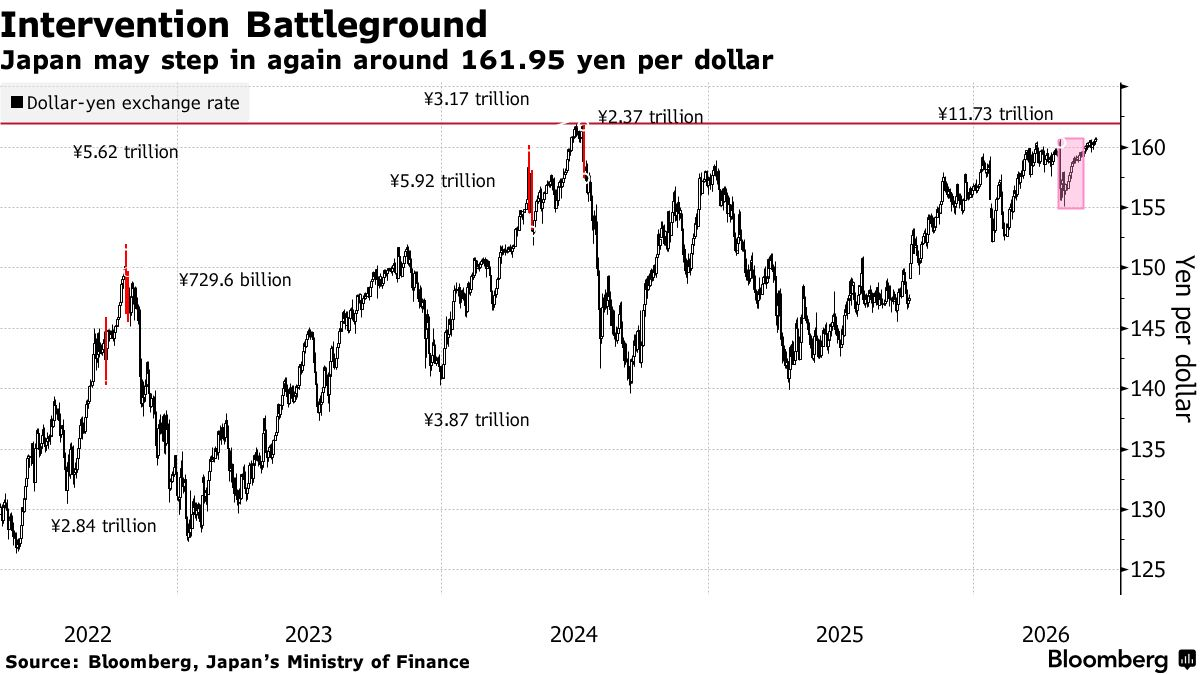
The Japanese yen is approaching its weakest level against the US dollar in nearly four decades, and traders are watching the 161.95 level closely.

According to reports, USD/JPY recently touched 160.80, with many analysts expecting a move toward 162. This would mark the weakest level for the yen since late 1986 and could trigger another round of intervention from Japanese authorities.
Yen Nears 40-Year Low: What Does It Mean for XRP? image 2 Source: Bloomberg

For crypto markets, the yen is important because Japan has long been a source of carry-trade liquidity. Cheap borrowing costs allow investors to borrow yen and deploy capital into higher-yield assets, including stocks and cryptocurrencies.

As long as the yen remains weak, those flows tend to support risk assets. A sharp intervention by Japan, however, could force investors to unwind positions and create volatility across markets.

$XRP Has Strong Links to Japan

Unlike many cryptocurrencies, $XRP has deep ties to Japan through SBI Holdings and SBI Ripple Asia. Japanese financial institutions have spent years exploring $XRP for cross-border payments, and recent developments have expanded that relationship.

Ripple-related infrastructure has gained support through blockchain bond initiatives, $XRP Tokyo 2026, and discussions around XRPL adoption and RLUSD integration.

Weak Yen Could Support $XRP, But Intervention Brings Risks

A weak yen supports carry trades and liquidity flows, which can indirectly benefit cryptocurrencies. $XRP could see greater influence from Asia, particularly Japan, compared with Bitcoin and Ethereum because of Ripple’s strong presence in the region.

The risk comes if Japan intervenes near the 161.95-162 area. Japan spent a record ¥11.73 trillion ($72 billion) between April and May to support the currency, but those gains have already disappeared. Analysts at IG Australia, SBI FX Trade, and JPMorgan expect another intervention if dollar-yen reaches 162.

Previous interventions caused rapid yen rallies and triggered selling across risk assets. As per Grok, similar moves could pressure crypto markets and create short-term volatility for $XRP.

Ripple’s On-Demand Liquidity service may also benefit from periods of currency stress. The system uses $XRP to provide instant liquidity without requiring banks to hold funds overseas. Rising volatility and higher Japanese interest rates could increase demand for faster payment systems.

Analysts Continue to See Long-Term Upside

$XRP trades at $1.16 at press time. On-chain data from Ali Martinez shows network activity has dropped nearly 50% over the last two weeks, with active addresses falling from 50,000 to around 25,000.

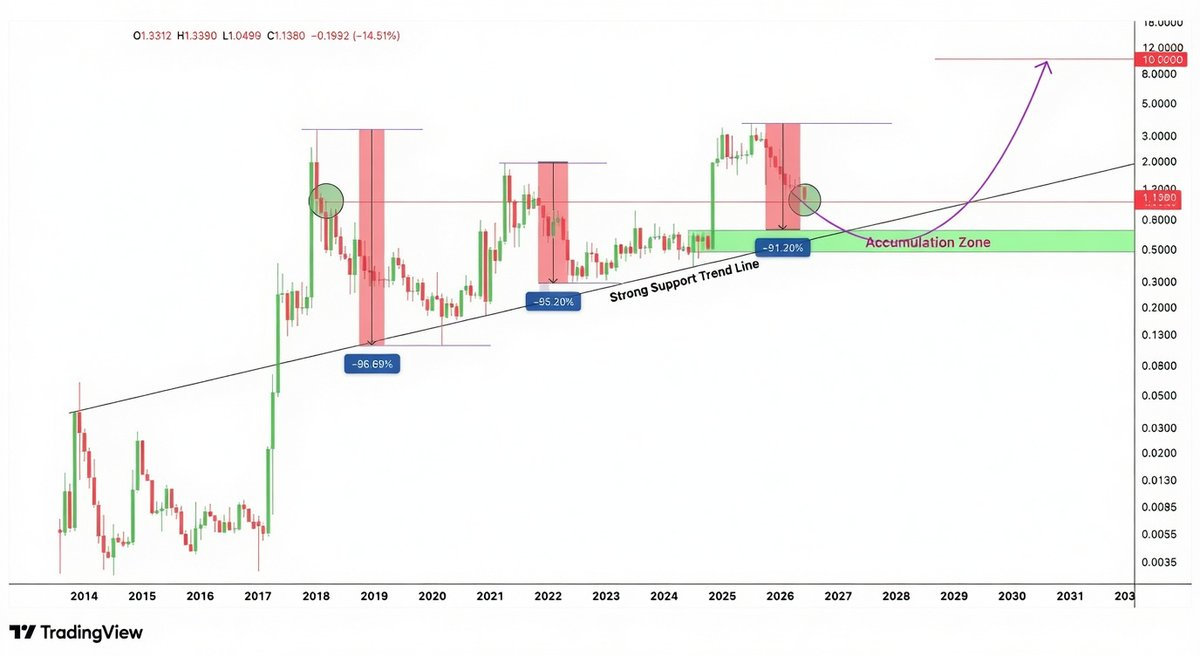
Despite weaker activity, Black Swan Capitalist founder Versan Aljarrah believes $XRP remains inside a multi-year accumulation range.
Yen Nears 40-Year Low: What Does It Mean for XRP? image 3 Source: X

His chart shows three major corrections since 2018, with pullbacks reaching roughly 96.7%, 95.2%, and 91.2%. Higher lows have formed throughout the cycle, while a long-term support trend line continues to hold.

According to the chart, $XRP is currently trading inside an accumulation zone near support. Aljarrah argues that prolonged consolidation often leads to stronger breakouts, with his long-term projection pointing toward the $10 area.

As the yen nears the 162 level, $XRP could benefit from continued liquidity flows. However, any intervention by Japanese authorities may increase market volatility and alter the liquidity conditions supporting risk assets.

Related: $XRP Falls Below $1.20 Despite Ripple’s Africa Stablecoin Expansion

0
0

Disclaimer: The content of this article solely reflects the author's opinion and does not represent the platform in any capacity. This article is not intended to serve as a reference for making investment decisions.

Understand the market, then trade.
Bitget offers one-stop trading for cryptocurrencies, stocks, and gold.
Trade now!

You may also like

The AI boom may follow the path of the 19th-century railway bubble, and builders may not be the ultimate winners

Goldman Sachs analyst Bobby Molavi compared the current situation to the 19th-century British railway mania: 500 companies spent more than the nation's annual income building 8,000 miles of railway, with most early investors losing out, while the real beneficiaries were the later "passengers." He pointed out that the current AI craze is driven by both debt and momentum, and that the S&P 500’s forward P/E ratio of 18x is only "a bit cheaper." Whether the builders can retain value is uncertain, and history does not offer an optimistic answer.

华尔街见闻•2026/11/12 03:56
The AI boom may follow the path of the 19th-century railway bubble, and builders may not be the ultimate winners

If Anthropic's IPO goes smoothly and the stock price rises next week, then everything remains the same for AI. Otherwise, some companies will go bankrupt.

The shrinking valuations of two major giants have triggered a chain reaction—investors are adopting more conservative revenue multiples for AI startups and are directly halting high-valuation financing for companies with zero revenue. Multiple venture capital firms have advised their portfolio companies to lower valuation expectations and to quickly build up cash reserves. Market participants warn that the outcome of Anthropic’s IPO will be a barometer for the industry: if successful, the boom will continue; if it fails, some companies may face elimination.

华尔街见闻•2026/11/12 03:46

After the Brazilian election, political discount deepens; Morgan Stanley remains bullish on Petrobras (PBR.US), focusing on fuel pricing and dividends

Morgan Stanley still maintains its most optimistic "Overweight" rating, but has lowered its year-end 2027 target price from $31 to $25.

智通财经•2026/11/12 03:42
After the Brazilian election, political discount deepens; Morgan Stanley remains bullish on Petrobras (PBR.US), focusing on fuel pricing and dividends

Corning (GLW.US) receives initial "Buy" rating from Jefferies! AI factories driving a fiber optic rush, with a potential global supply gap of up to 30%

For Corning, the recent profit growth mainly comes from the expansion of AI clusters. As the number of optical links crossing cabinets and campuses increases, customers need to deploy more optical fibers within limited conduit and cabinet space, thus driving demand for high-density optical cables and connection systems.

智通财经•2026/11/12 02:47
Corning (GLW.US) receives initial "Buy" rating from Jefferies! AI factories driving a fiber optic rush, with a potential global supply gap of up to 30%