
Bitget App
Trade smarter
Buy cryptoMarketsTradeFuturesStocksEarnInstitutionAI & More
30 Million XRP Whale Exodus: Why Millionaire Wallets Are Selling Ripple's 'North Star'

30 Million XRP Whale Exodus: Why Millionaire Wallets Are Selling Ripple's 'North Star'

CryptoNewsNetCryptoNewsNet2026/06/19 10:45
By:CryptoNewsNet
Back to the list

30 Million XRP Whale Exodus: Why Millionaire Wallets Are Selling Ripple's 'North Star'

30 Million XRP Whale Exodus: Why Millionaire Wallets Are Selling Ripple's 'North Star' image 0  u.today 36 m
30 Million XRP Whale Exodus: Why Millionaire Wallets Are Selling Ripple's 'North Star' image 1

The cryptocurrency $XRP, considered the "North Star" of the Ripple ecosystem, has faced heavy selling pressure over the past five days. It turns out the main driver of the price reversal is a large-scale exodus of "whales" — wallets holding at least 1 million $XRP — which redistributed and brought more than 30 million tokens to the market in this short period of time.

According to on-chain data from the analytics platform Santiment, published by analyst Ali Martinez, the combined holdings of these large addresses fell from 3.82 billion to 3.77 billion $XRP. This move by long-term holders injected excess liquidity into spot exchanges, fully offsetting the market's recent optimism.

Analyzing the ripple effect on the $XRP price

The price rally began on June 14 from a relatively stable level of $1.14 per $XRP, where unexpected news about a sharp decline in macroeconomic risks and the stabilization of global logistics chains served as a powerful buying catalyst. Renewed investor confidence triggered a wave of buying, pushing $XRP rapidly higher and sending it to a local peak near $1.29 by June 16.

However, the token failed to hold those highs, and as soon as the price approached key resistance, millionaire wallets began locking in profits en masse. Over the following three days, the chart formed a decline, breaking through support levels one after another and falling to $1.1273 per $XRP by June 19.
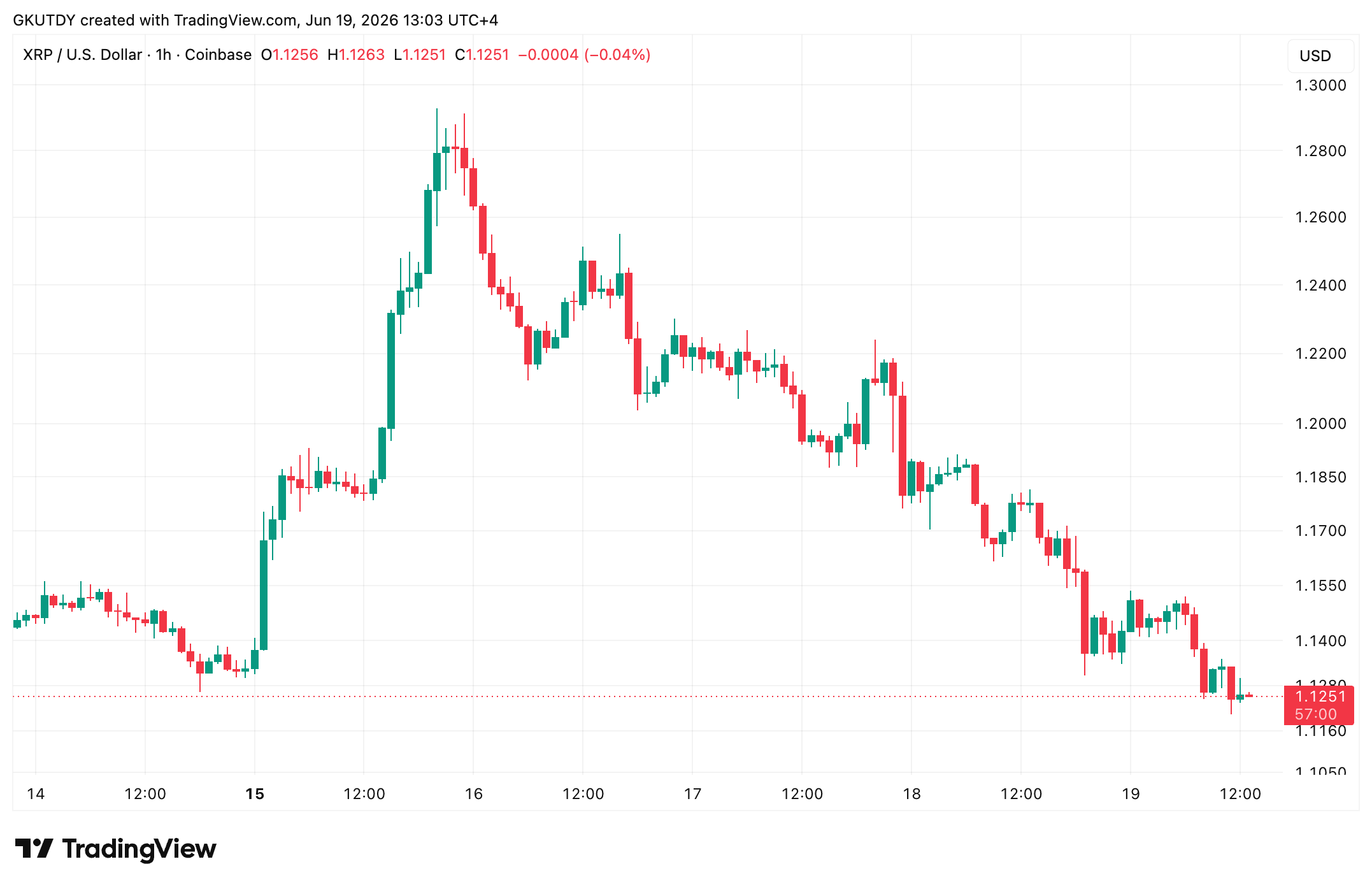
30 Million XRP Whale Exodus: Why Millionaire Wallets Are Selling Ripple's 'North Star' image 2 $XRP price action from June 14 to June 19 2026, Source: TradingView

The situation was aggravated by a severe sell-off in the derivatives market, where a cascade of forced liquidations of leveraged long positions acted as an accelerator for the downtrend. The catalyst for this panic was the FOMC meeting, during which extremely hawkish rhetoric from new chair of the Federal Reserve, Kevin Warsh, froze expectations for an imminent interest rate cut.

Surprisingly, institutional investors are not giving in to panic and continue defending Ripple's "North Star," as data on U.S. spot $XRP ETFs shows steady capital inflows, with $5.30 million at the price peak on June 16 and $2.55 million more during the market decline on June 18.

The clear gap between the long-term strategy of funds and the aggressive spot selling by whales may indicate that the current exodus of large holders is temporary and speculative in nature. The next critical battleground for buyers may be the support zone near $1.05.


0
0

Disclaimer: The content of this article solely reflects the author's opinion and does not represent the platform in any capacity. This article is not intended to serve as a reference for making investment decisions.

Understand the market, then trade.
Bitget offers one-stop trading for cryptocurrencies, stocks, and gold.
Trade now!

You may also like

The AI boom may follow the path of the 19th-century railway bubble, and builders may not be the ultimate winners

Goldman Sachs analyst Bobby Molavi compared the current situation to the 19th-century British railway mania: 500 companies spent more than the nation's annual income building 8,000 miles of railway, with most early investors losing out, while the real beneficiaries were the later "passengers." He pointed out that the current AI craze is driven by both debt and momentum, and that the S&P 500’s forward P/E ratio of 18x is only "a bit cheaper." Whether the builders can retain value is uncertain, and history does not offer an optimistic answer.

华尔街见闻•2026/11/12 03:56
The AI boom may follow the path of the 19th-century railway bubble, and builders may not be the ultimate winners

If Anthropic's IPO goes smoothly and the stock price rises next week, then everything remains the same for AI. Otherwise, some companies will go bankrupt.

The shrinking valuations of two major giants have triggered a chain reaction—investors are adopting more conservative revenue multiples for AI startups and are directly halting high-valuation financing for companies with zero revenue. Multiple venture capital firms have advised their portfolio companies to lower valuation expectations and to quickly build up cash reserves. Market participants warn that the outcome of Anthropic’s IPO will be a barometer for the industry: if successful, the boom will continue; if it fails, some companies may face elimination.

华尔街见闻•2026/11/12 03:46

After the Brazilian election, political discount deepens; Morgan Stanley remains bullish on Petrobras (PBR.US), focusing on fuel pricing and dividends

Morgan Stanley still maintains its most optimistic "Overweight" rating, but has lowered its year-end 2027 target price from $31 to $25.

智通财经•2026/11/12 03:42
After the Brazilian election, political discount deepens; Morgan Stanley remains bullish on Petrobras (PBR.US), focusing on fuel pricing and dividends

Corning (GLW.US) receives initial "Buy" rating from Jefferies! AI factories driving a fiber optic rush, with a potential global supply gap of up to 30%

For Corning, the recent profit growth mainly comes from the expansion of AI clusters. As the number of optical links crossing cabinets and campuses increases, customers need to deploy more optical fibers within limited conduit and cabinet space, thus driving demand for high-density optical cables and connection systems.

智通财经•2026/11/12 02:47
Corning (GLW.US) receives initial "Buy" rating from Jefferies! AI factories driving a fiber optic rush, with a potential global supply gap of up to 30%