
US crypto ETFs are pulling Bitcoiners into TradFi: BlackRock's Jay Jacobs

BlackRock’s spot Bitcoin exchange-traded fund has been a gateway for new investors to enter the wider ETF market, according to Jay Jacobs, US head of equity ETFs at BlackRock.
Around three-quarters of investors in BlackRock’s iShares Bitcoin Trust ETF have never owned an ETF before, Jacobs told Cointelegraph on the Chain Reaction podcast Thursday.
“IBIT was a way for traditional investors to now get into digital assets. But we have seen a lot of people really kind of enter into IBIT, starting with digital asset ETPs,” he said.
Bitcoin ETFs were heralded as a way to bring traditional investors into the world of digital assets. BlackRock's Jacob suggests the shift has been two-way.
The iShares Bitcoin Trust, launched in January 2024, is BlackRock’s flagship crypto product with $48 billion in assets under management. It holds 765,936 BTC and has been an on-ramp for many digital asset investors to engage with ETPs.
However, Jacobs said that once investors get exposure to the Bitcoin product, many start buying other BlackRock funds, such as S&P 500 (IVV), artificial intelligence (BAI) and gold (IAU).
“We absolutely see it as this is a way to engage with a different group of people than maybe we’ve engaged with in the past,” he said.
The company launched a new product called the iShares Bitcoin Premium Income ETF (BITA) on Wednesday, which generates income by selling covered call options on Bitcoin holdings.
The “Great Convergence” of TradFi and crypto
Bitcoiners' engagement with TradFi comes amid a growing overlap between crypto, decentralized finance and traditional finance, which BlackRock is calling the “Great Convergence,” according to Jacobs.
“Historically, you’ve seen a lot of different assets held separately,” he said. “DeFi versus TradFi, actively managed funds versus index funds, private assets versus publicly listed assets… and what’s happening is people are looking for more solutions to manage their portfolios,” he said.
“I think you’re gonna hear a lot less about versus, you know, TradFi versus DeFi, and I think you’re gonna see a lot more ampersands, it’s TradFi and DeFi.”
Related:
A recent example could be seen during the high-profile SpaceX IPO earlier this month, with crypto traders given an opportunity to get a piece of the action through pre-IPO perpetual futures or tokenized stocks.
Pre-IPO perps enable investors to get exposure to private companies before they start trading on TradFi exchanges.
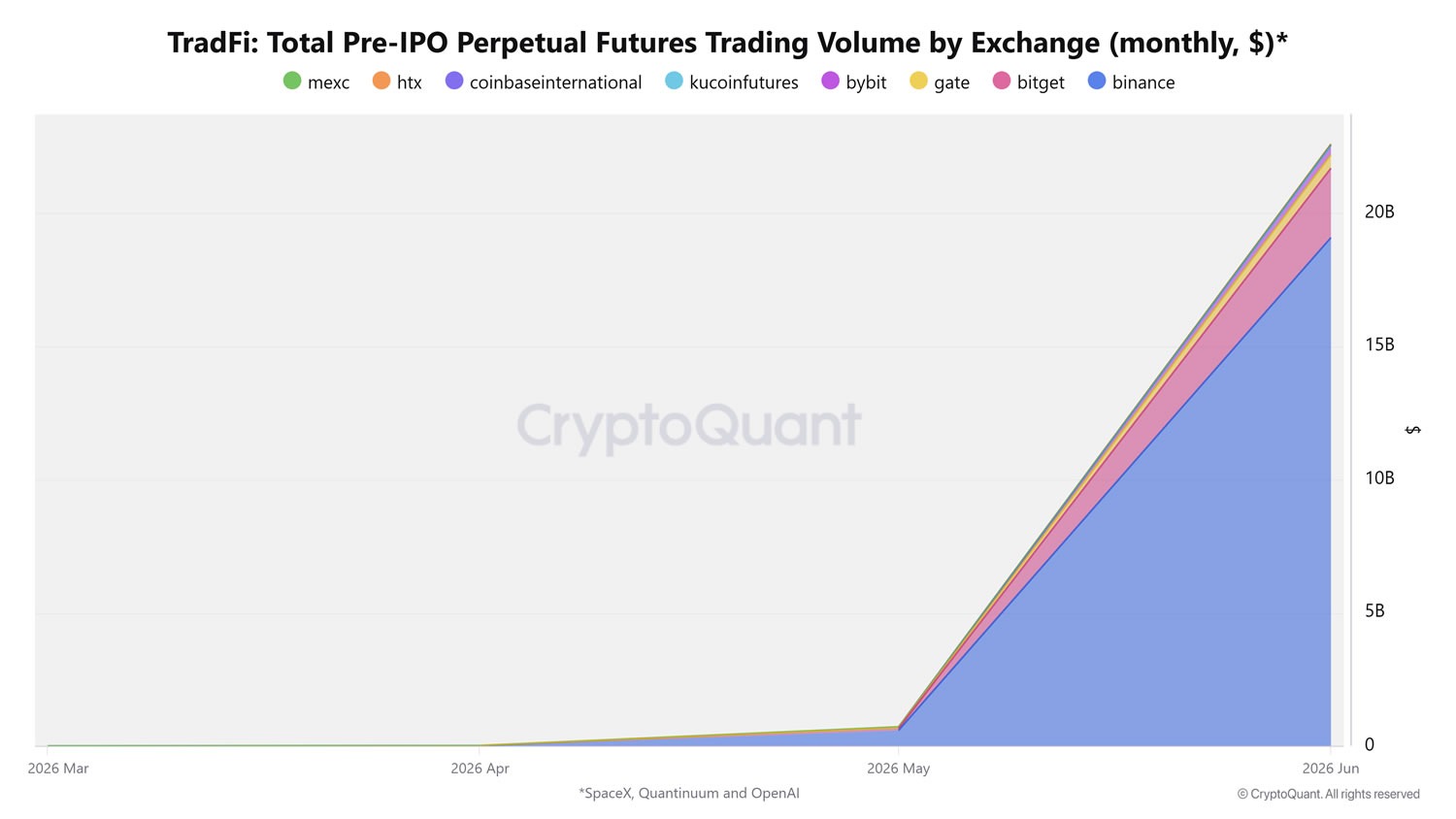
All major crypto exchanges are now offering pre-IPO perps, and trading volume has skyrocketed from around $1 billion in early May to about $22 billion, with Binance establishing itself as the largest venue, according to CryptoQuant.
Magazine:
Disclaimer: The content of this article solely reflects the author's opinion and does not represent the platform in any capacity. This article is not intended to serve as a reference for making investment decisions.
You may also like
The AI boom may follow the path of the 19th-century railway bubble, and builders may not be the ultimate winners
Goldman Sachs analyst Bobby Molavi compared the current situation to the 19th-century British railway mania: 500 companies spent more than the nation's annual income building 8,000 miles of railway, with most early investors losing out, while the real beneficiaries were the later "passengers." He pointed out that the current AI craze is driven by both debt and momentum, and that the S&P 500’s forward P/E ratio of 18x is only "a bit cheaper." Whether the builders can retain value is uncertain, and history does not offer an optimistic answer.

If Anthropic's IPO goes smoothly and the stock price rises next week, then everything remains the same for AI. Otherwise, some companies will go bankrupt.
The shrinking valuations of two major giants have triggered a chain reaction—investors are adopting more conservative revenue multiples for AI startups and are directly halting high-valuation financing for companies with zero revenue. Multiple venture capital firms have advised their portfolio companies to lower valuation expectations and to quickly build up cash reserves. Market participants warn that the outcome of Anthropic’s IPO will be a barometer for the industry: if successful, the boom will continue; if it fails, some companies may face elimination.
After the Brazilian election, political discount deepens; Morgan Stanley remains bullish on Petrobras (PBR.US), focusing on fuel pricing and dividends
Morgan Stanley still maintains its most optimistic "Overweight" rating, but has lowered its year-end 2027 target price from $31 to $25.
Corning (GLW.US) receives initial "Buy" rating from Jefferies! AI factories driving a fiber optic rush, with a potential global supply gap of up to 30%
For Corning, the recent profit growth mainly comes from the expansion of AI clusters. As the number of optical links crossing cabinets and campuses increases, customers need to deploy more optical fibers within limited conduit and cabinet space, thus driving demand for high-density optical cables and connection systems.
Crypto prices
More


