
Custodia, Vantage propose token that toggles between bank deposits and stablecoins

Custodia and Vantage Bank have proposed a token that automatically switches between a bank deposit and a stablecoin as it moves between participating banks and external users.
According to a white paper shared with Cointelegraph on Thursday, the token would operate as a deposit issued by a participating bank when held within a banking consortium and as a stablecoin backed by cash and short-term Treasurys when transferred outside the so-called Hazel network.
The companies said the system has been running on Ethereum (ETH) since March and is being tested by participating banks ahead of a broader rollout planned for later this year. The platform is designed to support tokenized deposits, stablecoins and other blockchain-based financial assets through a shared banking infrastructure.
According to the white paper, participating institutions would not need to replace existing core banking systems, with the platform operating alongside current ledgers and payment infrastructure.
The companies said it was designed for banks and credit unions of all sizes, including community banks, and aims to let institutions participate in tokenized payments without moving customer deposits outside the banking system.
Wyoming-based Custodia and Texas-based Vantage said they expect the Hazel network to become broadly available to banks and their customers in the fourth quarter of 2026.
Related:
Banks seek alternatives to stablecoins
The proposal comes as banks increasingly look for ways to offer blockchain-based payment services without losing customer deposits to stablecoin issuers.
Earlier this month, The Wall Street Journal reported that The Clearing House, whose owners include JPMorgan Chase, Bank of America and Citigroup, plans to launch a tokenized deposit network in the first half of 2027, allowing banks to settle payments using blockchain-based representations of customer deposits.
Banking groups have also pushed back against legislation that could allow stablecoin issuers to offer yield-bearing products.
JPMorgan CEO Jamie Dimon recently said banks would continue fighting provisions in the CLARITY Act, a US crypto market structure bill, arguing they could let crypto companies compete for deposits without obtaining bank charters. The bill advanced out of the Senate Banking Committee in May and still requires approval from both chambers of Congress.
According to DefiLlama data, the total stablecoin market capitalization stands at roughly $315 billion, up from about $251 billion a year ago.
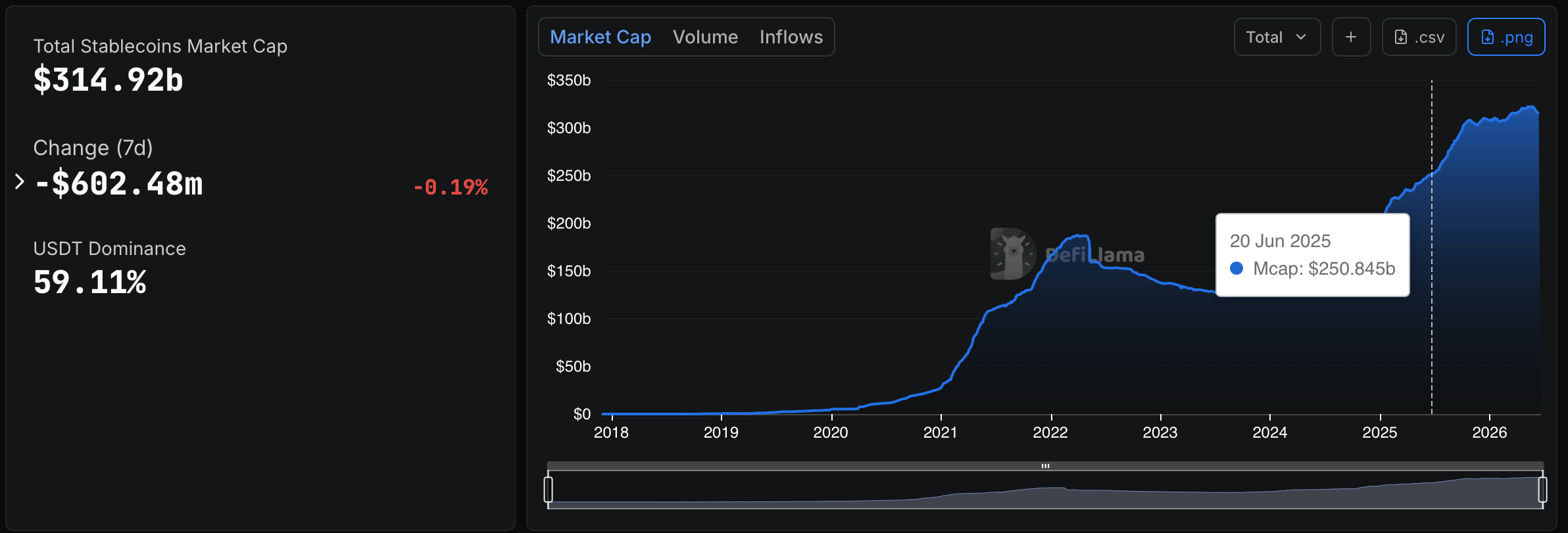
Source: DefiLlama
Magazine:
Disclaimer: The content of this article solely reflects the author's opinion and does not represent the platform in any capacity. This article is not intended to serve as a reference for making investment decisions.
You may also like
The AI boom may follow the path of the 19th-century railway bubble, and builders may not be the ultimate winners
Goldman Sachs analyst Bobby Molavi compared the current situation to the 19th-century British railway mania: 500 companies spent more than the nation's annual income building 8,000 miles of railway, with most early investors losing out, while the real beneficiaries were the later "passengers." He pointed out that the current AI craze is driven by both debt and momentum, and that the S&P 500’s forward P/E ratio of 18x is only "a bit cheaper." Whether the builders can retain value is uncertain, and history does not offer an optimistic answer.

If Anthropic's IPO goes smoothly and the stock price rises next week, then everything remains the same for AI. Otherwise, some companies will go bankrupt.
The shrinking valuations of two major giants have triggered a chain reaction—investors are adopting more conservative revenue multiples for AI startups and are directly halting high-valuation financing for companies with zero revenue. Multiple venture capital firms have advised their portfolio companies to lower valuation expectations and to quickly build up cash reserves. Market participants warn that the outcome of Anthropic’s IPO will be a barometer for the industry: if successful, the boom will continue; if it fails, some companies may face elimination.
After the Brazilian election, political discount deepens; Morgan Stanley remains bullish on Petrobras (PBR.US), focusing on fuel pricing and dividends
Morgan Stanley still maintains its most optimistic "Overweight" rating, but has lowered its year-end 2027 target price from $31 to $25.
Corning (GLW.US) receives initial "Buy" rating from Jefferies! AI factories driving a fiber optic rush, with a potential global supply gap of up to 30%
For Corning, the recent profit growth mainly comes from the expansion of AI clusters. As the number of optical links crossing cabinets and campuses increases, customers need to deploy more optical fibers within limited conduit and cabinet space, thus driving demand for high-density optical cables and connection systems.

Crypto prices
More


