
Ethereum Foundation leadership exodus continues with director’s departure

The Ethereum Foundation has lost another high-ranking contributor, amid increasing scrutiny of the research organization as the network faces ongoing questions about talent retention and governance philosophy.
In a post on X, co-executive director Hsiao-Wei Wang announced that she had stepped down from her role, effective immediately, following a recent sabbatical. Wang wrote that "Ethereum has always been bigger than any role" and indicated that she has not yet decided what she will do next.
Ethereum co-founder Vitalik Buterin commented on Wang’s an X post, acknowledging that she had taken on “the most challenging position in the Ethereum Foundation” alongside Tomasz Stanczak, who also stepped down from his leadership role earlier this year.
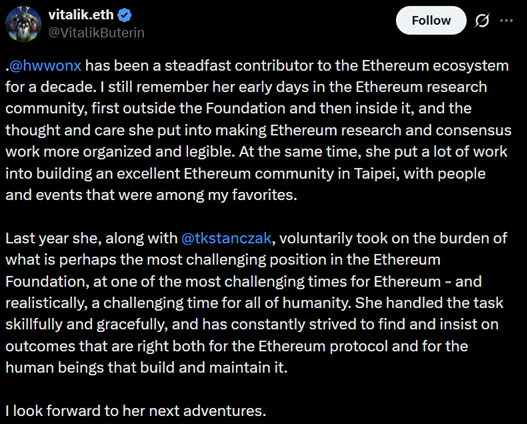
Source: Vitalik Buterin
The Ethereum Foundation has logged an estimated 19 layoffs and departures this year, although the loss of senior executives and core contributors has drawn the most attention. The wave of departures comes as the foundation grapples with intensifying competition, ongoing debate over Ethereum’s governance and long-term development strategy, and continued pressure on Ether’s market performance.
Buterin has also pushed back against criticism, particularly claims that the foundation should play a more active role in promoting the network. In May, he said that the foundation “is not the ‘center of Ethereum,’ rather [...] ‘one node, with a defined purpose, alongside other nodes.’”
Related: Blockchain researcher defends Ethereum Foundation, says it’s doing ‘exactly’ its job
Decentralization remains Ethereum Foundation’s core mandate
In March, the Ethereum Foundation reaffirmed its role as a steward of the Ethereum ecosystem, unveiling a revised mandate that places even greater emphasis on decentralization.
“Our ultimate goal is for Ethereum to pass the walkaway test: its protocol and core application layers become robust and trustless enough that they would continue to reliably function and evolve even if the Foundation and today’s core developers disappeared tomorrow,” the foundation said.

Source: Ethereum Foundation
That philosophy has also shaped Buterin’s evolving stance on Ethereum layer-2 networks — the independent blockchains built on top of Ethereum to improve scalability and reduce transaction costs.
Buterin recently stated that the original vision for layer-2s “no longer makes sense,” contending that many have failed to achieve meaningful decentralization and that improvements to the Ethereum mainnet make it a more suitable long-term scaling solution.
Magazine: Ethereum’s roadmap to 10,000 TPS using ZK tech: Dummies’ guide
Disclaimer: The content of this article solely reflects the author's opinion and does not represent the platform in any capacity. This article is not intended to serve as a reference for making investment decisions.
You may also like
The AI boom may follow the path of the 19th-century railway bubble, and builders may not be the ultimate winners
Goldman Sachs analyst Bobby Molavi compared the current situation to the 19th-century British railway mania: 500 companies spent more than the nation's annual income building 8,000 miles of railway, with most early investors losing out, while the real beneficiaries were the later "passengers." He pointed out that the current AI craze is driven by both debt and momentum, and that the S&P 500’s forward P/E ratio of 18x is only "a bit cheaper." Whether the builders can retain value is uncertain, and history does not offer an optimistic answer.

If Anthropic's IPO goes smoothly and the stock price rises next week, then everything remains the same for AI. Otherwise, some companies will go bankrupt.
The shrinking valuations of two major giants have triggered a chain reaction—investors are adopting more conservative revenue multiples for AI startups and are directly halting high-valuation financing for companies with zero revenue. Multiple venture capital firms have advised their portfolio companies to lower valuation expectations and to quickly build up cash reserves. Market participants warn that the outcome of Anthropic’s IPO will be a barometer for the industry: if successful, the boom will continue; if it fails, some companies may face elimination.
After the Brazilian election, political discount deepens; Morgan Stanley remains bullish on Petrobras (PBR.US), focusing on fuel pricing and dividends
Morgan Stanley still maintains its most optimistic "Overweight" rating, but has lowered its year-end 2027 target price from $31 to $25.

Corning (GLW.US) receives initial "Buy" rating from Jefferies! AI factories driving a fiber optic rush, with a potential global supply gap of up to 30%
For Corning, the recent profit growth mainly comes from the expansion of AI clusters. As the number of optical links crossing cabinets and campuses increases, customers need to deploy more optical fibers within limited conduit and cabinet space, thus driving demand for high-density optical cables and connection systems.

Crypto prices
More


