
As the West Hesitates, Asian Investors are Quietly Accumulating Gold

An intriguing rift is emerging in the gold market: while Western investors continue to exit, Asian buyers are rushing in against the trend.
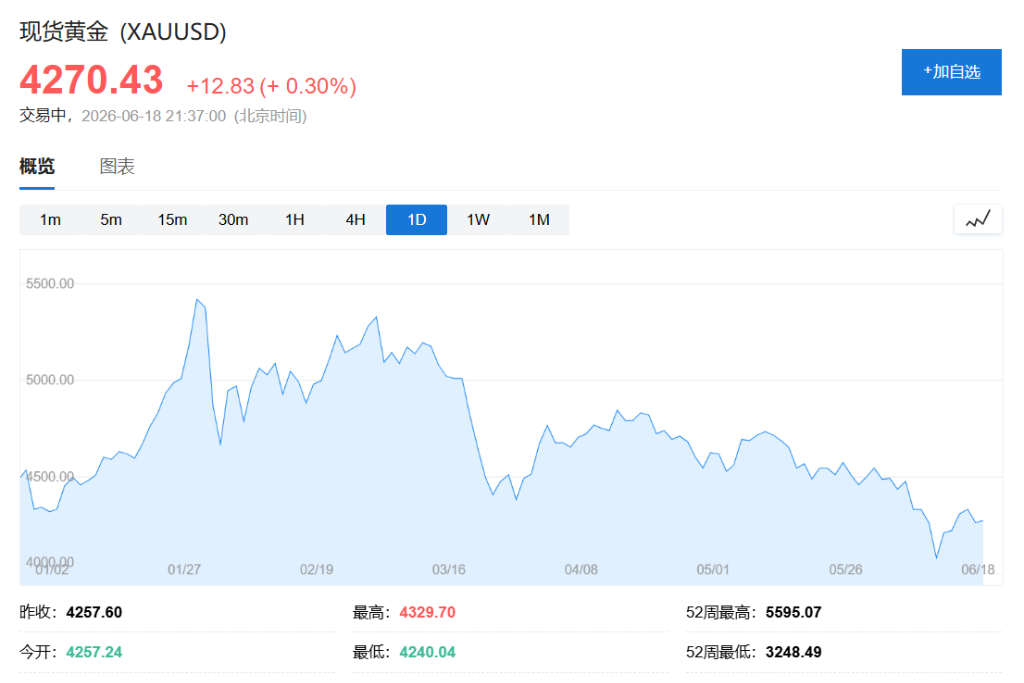
According to an article by Bloomberg macro strategist Simon White, despite a growing sense of caution among US and European investors toward gold, demand in the Asian market remains strong. Gold prices saw a strong rebound near the $4,000 mark last week—although news of an Iran peace agreement had temporarily suppressed prices, Asian buyers did not retreat. This divergence is becoming an important signal for observing the direction of the gold market.
For the market, this divergence in demand between East and West indicates that the structural support for gold is shifting. While funds continue to exit Western ETFs, Asian ETF sizes are expanding rapidly. The sustained divergence in these trends could have profound implications for the medium-term outlook of gold prices.
Continued Outflows from Western ETFs, Temporary Resurgence in Bitcoin's Appeal
Gold is currently trying to find support above the $4,000 level.
Last week, after news of the Iran peace agreement broke, gold prices rebounded strongly from that level, but the pace of Western investor withdrawals did not slow down as a result.
According to Bloomberg, large gold ETFs primarily registered in the US have seen sustained and expanding outflows. Meanwhile, outflows from bitcoin ETFs have begun to stabilize, a comparison that may suggest some investors are redirecting preferences back to cryptocurrencies rather than physical gold.
However, Simon White believes that drawing the conclusion that gold is losing ground based solely on this signal may be too hasty.
Hong Kong and India Lead, Asia Heavily Importing Gold from Switzerland
Asian market demand for gold is being clearly validated through trade data. As the world's largest gold exporter, Switzerland's export flows show that Hong Kong and India are currently the two largest economies importing gold from Switzerland, surpassing all other countries.
This trade data closely matches global ETF position changes. Holdings in US gold ETFs continue to decline, European ETFs remain relatively stable, while Asian gold ETFs are rapidly climbing—with almost no signs of pullback.
Simon White points out that Asian gold ETFs are still smaller than their Western counterparts, but this is likely just the tip of the iceberg of real gold demand in Asia—as evidenced by Swiss export data.
Recent Weakness in Gold Prices Has Not Shaken Asian Buying; The Signal is Significant
In Simon White’s view, Asian investors’ enthusiasm for gold has not waned despite the recent price corrections—this phenomenon itself is a market signal that should not be easily ignored.
While Western investors are hesitating between gold and bitcoin, Asian funds continue to accumulate gold positions in a steady and persistent manner. This resilience of demand shows that Asian buyers’ allocation logic for gold is not reliant on short-term price momentum, but is more likely rooted in deeper asset allocation needs.
For investors focusing on the trajectory of gold, instead of fixating on fund flows in Western ETFs, it may be more valuable to look to Asia—which could be the real driving force behind the next wave of gold prices.
Disclaimer: The content of this article solely reflects the author's opinion and does not represent the platform in any capacity. This article is not intended to serve as a reference for making investment decisions.
You may also like
The AI boom may follow the path of the 19th-century railway bubble, and builders may not be the ultimate winners
Goldman Sachs analyst Bobby Molavi compared the current situation to the 19th-century British railway mania: 500 companies spent more than the nation's annual income building 8,000 miles of railway, with most early investors losing out, while the real beneficiaries were the later "passengers." He pointed out that the current AI craze is driven by both debt and momentum, and that the S&P 500’s forward P/E ratio of 18x is only "a bit cheaper." Whether the builders can retain value is uncertain, and history does not offer an optimistic answer.

If Anthropic's IPO goes smoothly and the stock price rises next week, then everything remains the same for AI. Otherwise, some companies will go bankrupt.
The shrinking valuations of two major giants have triggered a chain reaction—investors are adopting more conservative revenue multiples for AI startups and are directly halting high-valuation financing for companies with zero revenue. Multiple venture capital firms have advised their portfolio companies to lower valuation expectations and to quickly build up cash reserves. Market participants warn that the outcome of Anthropic’s IPO will be a barometer for the industry: if successful, the boom will continue; if it fails, some companies may face elimination.
After the Brazilian election, political discount deepens; Morgan Stanley remains bullish on Petrobras (PBR.US), focusing on fuel pricing and dividends
Morgan Stanley still maintains its most optimistic "Overweight" rating, but has lowered its year-end 2027 target price from $31 to $25.

Corning (GLW.US) receives initial "Buy" rating from Jefferies! AI factories driving a fiber optic rush, with a potential global supply gap of up to 30%
For Corning, the recent profit growth mainly comes from the expansion of AI clusters. As the number of optical links crossing cabinets and campuses increases, customers need to deploy more optical fibers within limited conduit and cabinet space, thus driving demand for high-density optical cables and connection systems.

Crypto prices
More


