
Satori Finance joins growing list of crypto projects shutting down

Satori Finance has announced plans to shut down its decentralized exchange operations after determining that revenue no longer supports the business, despite processing more than $134 billion in cumulative perpetual futures volume since launch.
- Satori Finance will shut down operations on July 16 after citing insufficient revenue and prolonged unfavorable market conditions.
- Users have until July 16, 23:59 UTC, to close positions and withdraw assets before the platform goes offline.
- The closure comes despite Satori processing $134 billion in cumulative perpetual trading volume and raising $10 million from major crypto investors.
Satori said in a June 16 statement that it would begin winding down the platform and keep withdrawals available until July 16, 2026, at 23:59 UTC. The team attributed the decision to prolonged unfavorable market conditions and said continued operation was no longer financially viable.
The company urged users to close open positions and withdraw assets during the transition period. Satori warned that the platform will cease operating after the deadline and that users may no longer be able to access assets left on the platform beyond that date.
“We have made the difficult decision to wind down Satori Finance operations,” the team wrote, adding that user assets remain under users’ control throughout the shutdown process.
“We want to reassure you that your assets remain fully safe and under your control throughout this transition period. There is no need for concern — this notice is simply to help you plan ahead and ensure a smooth, orderly withdrawal process.”
Users given one month to withdraw funds
The closure affects a protocol that once claimed to serve more than 600,000 traders across multiple blockchain networks. Satori offered leveraged perpetual futures trading with up to 25x leverage and expanded to networks including Polygon zkEVM, Zircuit, BNB Chain, Arbitrum, Scroll and Optimism.
Some users on X reported difficulties withdrawing assets from networks other than Ethereum after the announcement. Satori has not publicly addressed those individual claims.
Data from DeFiLlama shows Satori currently holds about $1.2 million in total value locked. The protocol held as much as $6.7 million during 2024. DeFiLlama data also shows Satori generated roughly $3 million in annualized fees before announcing the shutdown.
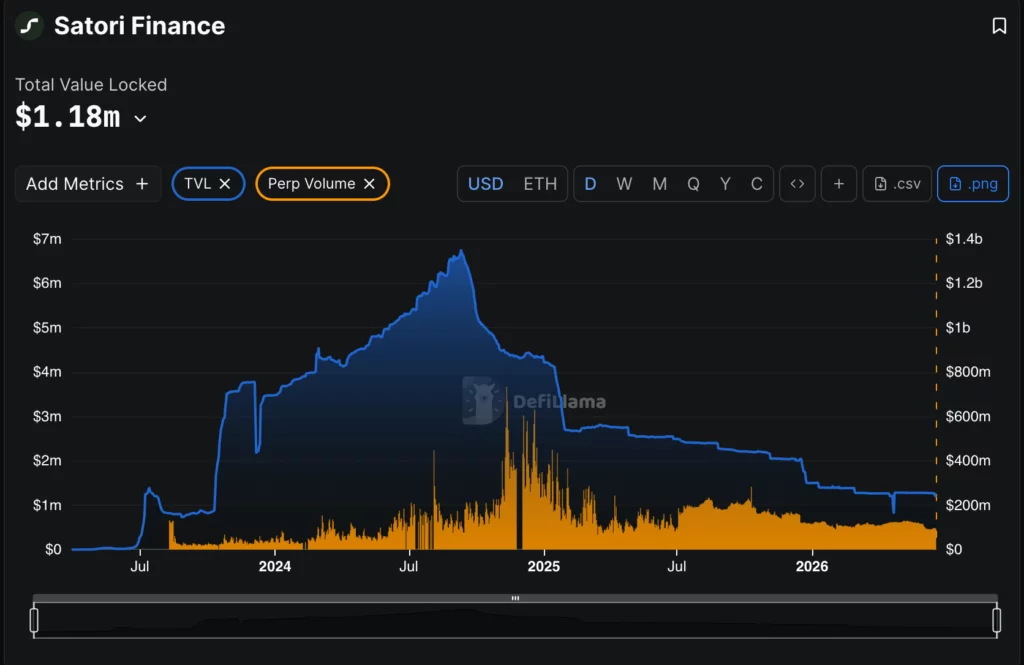 Source:
The protocol gained traction during the points farming period that many crypto projects used to attract users ahead of potential token airdrops.
Satori later reported more than $134 billion in cumulative perpetual trading volume, although activity had slowed considerably in recent months. The platform recorded about $3.2 billion in trading volume over the last 30 days and held roughly $559,000 in open interest.
Satori ended its announcement by thanking users for supporting the project throughout its lifespan.
“Whether you joined us early on or discovered us along the way, your trust meant everything to our team. While we wish circumstances allowed us to continue this journey together, we are grateful for every moment of it.”
Industry closures continue despite institutional interest
Satori secured $10 million in seed funding in May 2022 from investors led by Polychain Capital. Coinbase Ventures, Jump Crypto, and several other firms also participated in the round.
The shutdown adds to a growing list of crypto companies and protocols that have ceased operations this year.
Earlier this month, Bitcoin scaling project Botanix announced plans to discontinue its network after concluding that demand had not reached levels needed to support long-term operations. Crypto payments platform Pyra also revealed plans to close after months of attempting to recover from losses linked to the Drift exploit.
Disclaimer: The content of this article solely reflects the author's opinion and does not represent the platform in any capacity. This article is not intended to serve as a reference for making investment decisions.
You may also like
The AI boom may follow the path of the 19th-century railway bubble, and builders may not be the ultimate winners
Goldman Sachs analyst Bobby Molavi compared the current situation to the 19th-century British railway mania: 500 companies spent more than the nation's annual income building 8,000 miles of railway, with most early investors losing out, while the real beneficiaries were the later "passengers." He pointed out that the current AI craze is driven by both debt and momentum, and that the S&P 500’s forward P/E ratio of 18x is only "a bit cheaper." Whether the builders can retain value is uncertain, and history does not offer an optimistic answer.

If Anthropic's IPO goes smoothly and the stock price rises next week, then everything remains the same for AI. Otherwise, some companies will go bankrupt.
The shrinking valuations of two major giants have triggered a chain reaction—investors are adopting more conservative revenue multiples for AI startups and are directly halting high-valuation financing for companies with zero revenue. Multiple venture capital firms have advised their portfolio companies to lower valuation expectations and to quickly build up cash reserves. Market participants warn that the outcome of Anthropic’s IPO will be a barometer for the industry: if successful, the boom will continue; if it fails, some companies may face elimination.
After the Brazilian election, political discount deepens; Morgan Stanley remains bullish on Petrobras (PBR.US), focusing on fuel pricing and dividends
Morgan Stanley still maintains its most optimistic "Overweight" rating, but has lowered its year-end 2027 target price from $31 to $25.
Corning (GLW.US) receives initial "Buy" rating from Jefferies! AI factories driving a fiber optic rush, with a potential global supply gap of up to 30%
For Corning, the recent profit growth mainly comes from the expansion of AI clusters. As the number of optical links crossing cabinets and campuses increases, customers need to deploy more optical fibers within limited conduit and cabinet space, thus driving demand for high-density optical cables and connection systems.

Crypto prices
More


