
Bitget App
Trade smarter
Buy cryptoMarketsTradeFuturesStocksEarnInstitutionAI & More
Humanity Protocol’s 1100% relief rally vanishes in 48 hours: What’s going on?

Humanity Protocol’s 1100% relief rally vanishes in 48 hours: What’s going on?

CryptoNewsNetCryptoNewsNet2026/06/17 09:45
By:CryptoNewsNet
Back to the list

Humanity Protocol’s 1100% relief rally vanishes in 48 hours: What’s going on?

Humanity Protocol’s 1100% relief rally vanishes in 48 hours: What’s going on? image 0  ambcrypto.com 8 h
Humanity Protocol’s 1100% relief rally vanishes in 48 hours: What’s going on? image 1

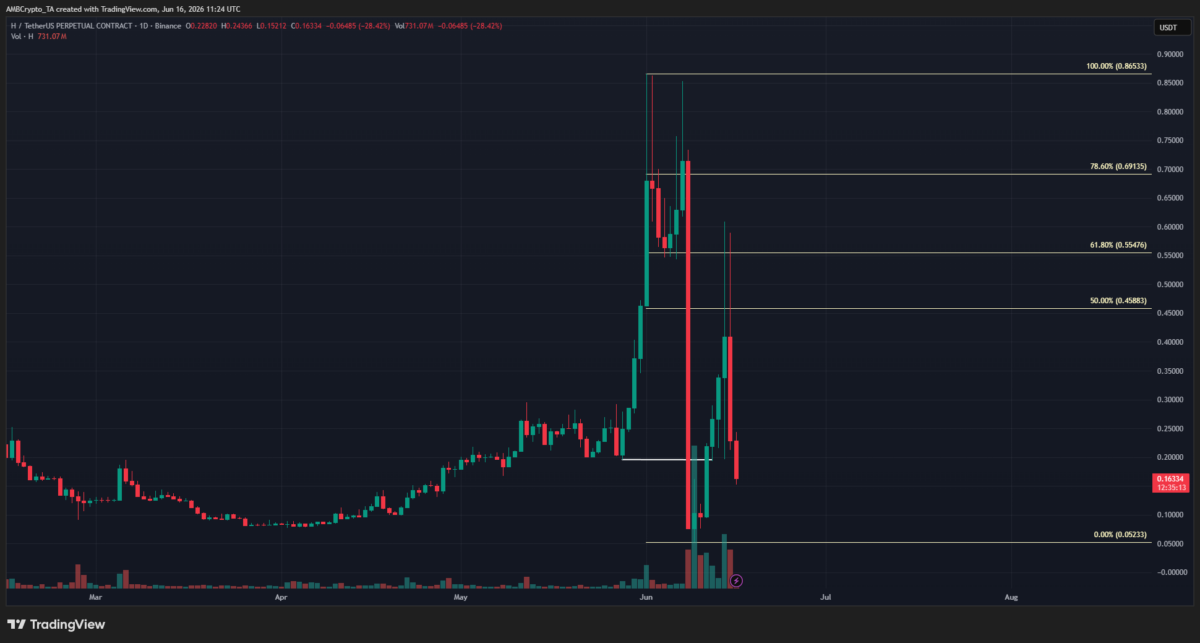
Humanity Protocol [H] corrected by 40% in the past 24 hours. Since making a high of $0.609 on Sunday, the 14th of June, the H token is down by 73.8% in just over 48 hours.
Humanity Protocol’s 1100% relief rally vanishes in 48 hours: What’s going on? image 2 Source: H on TradingView

The structural break on the 1-day timeframe came on Monday, the 8th of June. Since then, the token reached a low of $0.052 and climbed to the $0.554 level over the following 5 days.

The 40% drop over the previous day’s trading followed a rejection from the 61.8% retracement level. Structurally, H was firmly bearish. The market sentiment around the altcoin was not encouraging, either.

What has happened since the exploit?

This represented a whopping 1,064% move that was just part of the relief rally. It showcased extremely high volatility for a token that faced a major exploit. The protocol has also faced criticism following the exploit, damaging trust.

AMBCrypto reported that attackers gained access to the private keys linked to a foundation member. Crypto sleuth ZachXBT pointed toward a supply concentration to make the point that it was unclear if the exploit was theft or market maker-related.

Allegations of this kind helped explain the divided community.

An incident update, published on the 12th of June, helped clarify that the attacker used stolen administrative credentials to upgrade contracts.

They then moved H tokens across the Ethereum network, printed more H on the Binance Smart Chain, and used DEXes such as Uniswap and PancakeSwap to sell the tokens.

This caused the massive price plunge as the selling also affected market liquidity and led to the price collapse.

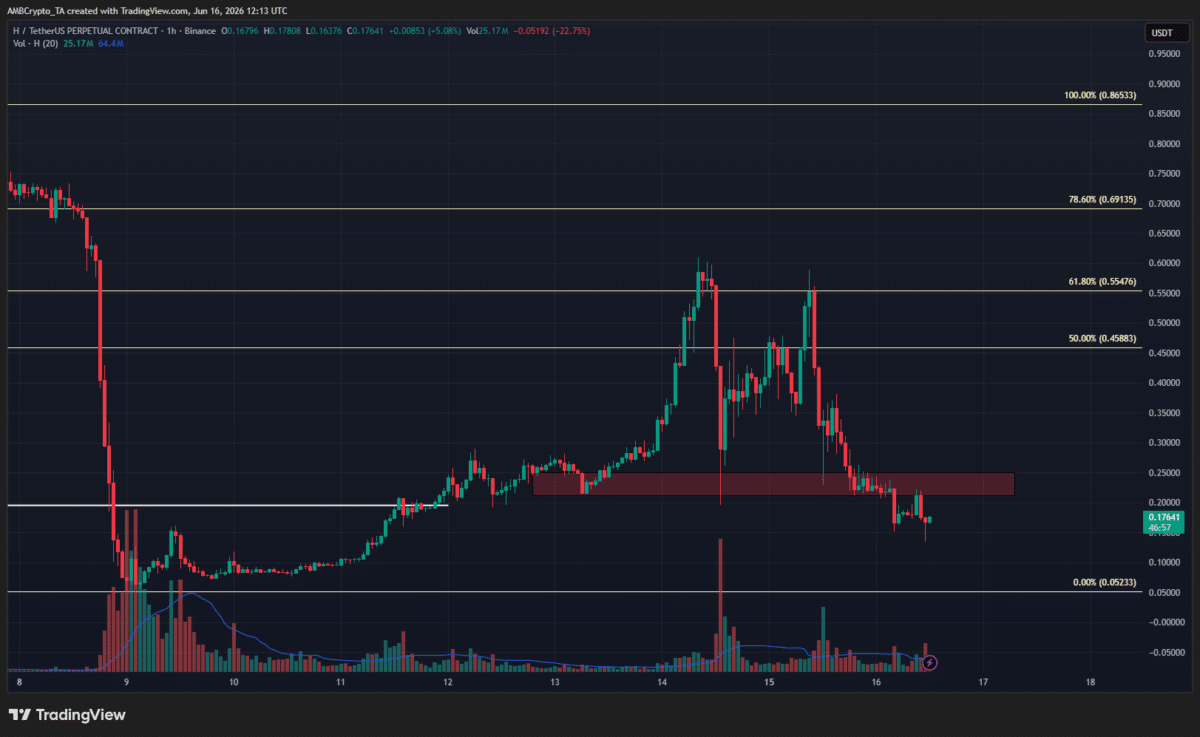
The reclaim of the $0.50 key area did not last long, and the short-term bias has since flipped bearishly. It liquidated short sellers on the way higher but was never en route to recovery following the exploit.

Traders’ call to action – Sell

Sentiment was deeply pessimistic, price action was extremely volatile, and the relief rally has run its course.
Humanity Protocol’s 1100% relief rally vanishes in 48 hours: What’s going on? image 3 Source: H on TradingView

The $0.20-$0.25 local supply zone has already been tested as resistance. The downward momentum was strong, and another drop to or even below the $0.052 low from last week appeared likely.

Final Summary

  • The Humanity Protocol token has seen massive volatility in recent days. Just its relief rally measured close to 1,100%.
  • The shattered user trust following the exploit meant that recovery was long and difficult.

0
0

Disclaimer: The content of this article solely reflects the author's opinion and does not represent the platform in any capacity. This article is not intended to serve as a reference for making investment decisions.

Understand the market, then trade.
Bitget offers one-stop trading for cryptocurrencies, stocks, and gold.
Trade now!

You may also like

The AI boom may follow the path of the 19th-century railway bubble, and builders may not be the ultimate winners

Goldman Sachs analyst Bobby Molavi compared the current situation to the 19th-century British railway mania: 500 companies spent more than the nation's annual income building 8,000 miles of railway, with most early investors losing out, while the real beneficiaries were the later "passengers." He pointed out that the current AI craze is driven by both debt and momentum, and that the S&P 500’s forward P/E ratio of 18x is only "a bit cheaper." Whether the builders can retain value is uncertain, and history does not offer an optimistic answer.

华尔街见闻•2026/11/12 03:56
The AI boom may follow the path of the 19th-century railway bubble, and builders may not be the ultimate winners

If Anthropic's IPO goes smoothly and the stock price rises next week, then everything remains the same for AI. Otherwise, some companies will go bankrupt.

The shrinking valuations of two major giants have triggered a chain reaction—investors are adopting more conservative revenue multiples for AI startups and are directly halting high-valuation financing for companies with zero revenue. Multiple venture capital firms have advised their portfolio companies to lower valuation expectations and to quickly build up cash reserves. Market participants warn that the outcome of Anthropic’s IPO will be a barometer for the industry: if successful, the boom will continue; if it fails, some companies may face elimination.

华尔街见闻•2026/11/12 03:46

After the Brazilian election, political discount deepens; Morgan Stanley remains bullish on Petrobras (PBR.US), focusing on fuel pricing and dividends

Morgan Stanley still maintains its most optimistic "Overweight" rating, but has lowered its year-end 2027 target price from $31 to $25.

智通财经•2026/11/12 03:42
After the Brazilian election, political discount deepens; Morgan Stanley remains bullish on Petrobras (PBR.US), focusing on fuel pricing and dividends

Corning (GLW.US) receives initial "Buy" rating from Jefferies! AI factories driving a fiber optic rush, with a potential global supply gap of up to 30%

For Corning, the recent profit growth mainly comes from the expansion of AI clusters. As the number of optical links crossing cabinets and campuses increases, customers need to deploy more optical fibers within limited conduit and cabinet space, thus driving demand for high-density optical cables and connection systems.

智通财经•2026/11/12 02:47
Corning (GLW.US) receives initial "Buy" rating from Jefferies! AI factories driving a fiber optic rush, with a potential global supply gap of up to 30%

